The Mahavakyas are called “great statements” because they express, in a few words, a recognition that changes our understanding of who we are and what is real. In Advaita Vedanta, they gather the heart of the Upanishadic teaching into direct declarations of the identity of Atman and Brahman. Their greatness lies in the depth of what they reveal and its significance for freedom: the essential Self is already whole, inseparable from Source, by whatever name.
Their value becomes clear when we examine the belief that we are fundamentally separate and incomplete, and must find something outside ourselves to make us whole. The Mahavakyas bring that assumption into question. Understood through listening, reflection and inquiry, they can loosen the mistaken identification through which a changing body, a passing thought or a personal role is taken to be the whole of who we are. They give spiritual awakening a clear focus: recognizing your true nature and allowing that understanding to find expression in ordinary life.
The four Mahavakyas are short statements from the Upanishads that point to the identity of Atman, your true nature, and Brahman, limitless reality. In plain English, their message is that the awareness you know intimately as your own being is not separate from Source, by whatever name. Spiritual awakening is the recognition of this, and the assimilation of that understanding in living.
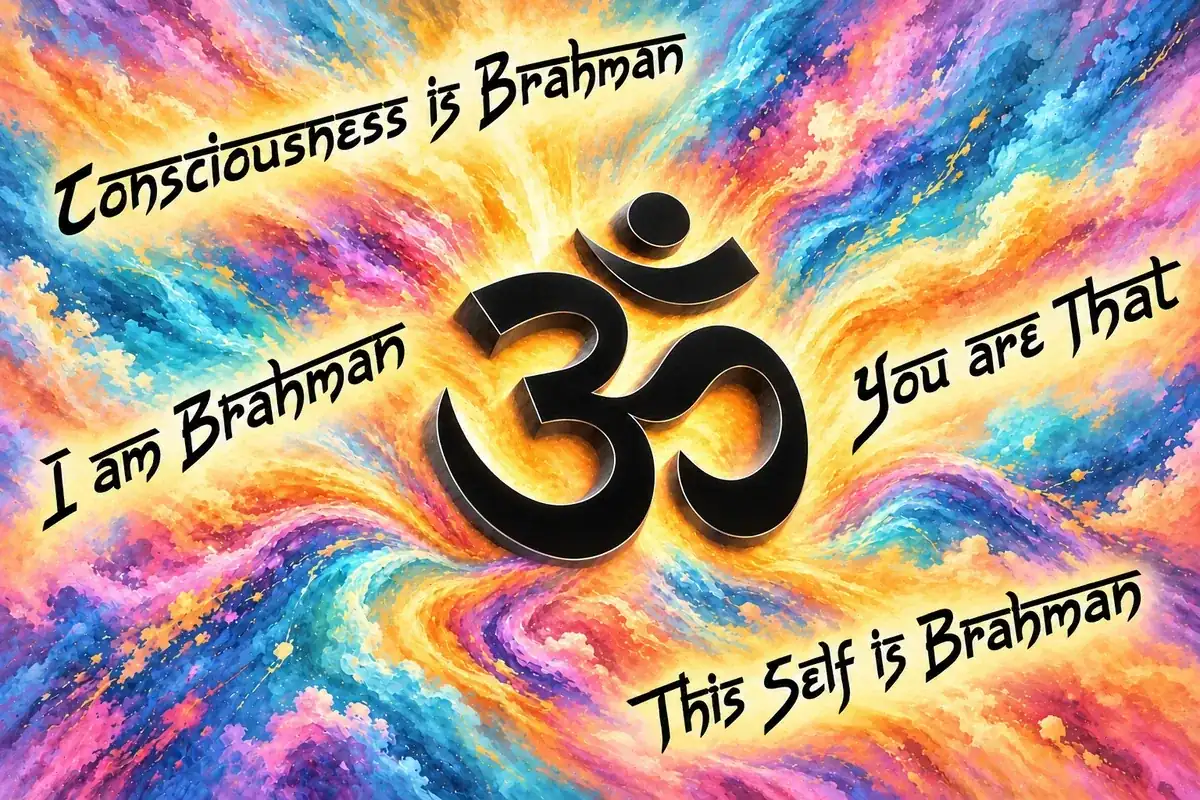
The field is a visual metaphor for Brahman, which is prior to space and time.
A few words can open a large question. What do you mean when you say “I”? Is your essential nature the story you tell about yourself? Is Source somewhere else? And what becomes of the world when you recognize that Source and its appearances are not two?
This guide explores the four sayings through the nondual perspective of Being Yoga and connects them with James Traverse’s writings on spiritual awakening, self-inquiry, dreams, mithya and everyday life. The Sanskrit statements belong to the Upanishadic tradition. The explanations and practical reflections here bring them into the language of this teaching.
Watch: The Four Mahavakyas and Spiritual Awakening
This video explores the four great sayings, self-inquiry and mithya. It was generated with NotebookLM using James Traverse’s writings as source material.
Watch on YouTube · 7 minutes 50 seconds.
What does Mahavakya mean?
Mahavakya means “great statement” or “great saying.” The four most widely recognized Mahavakyas in Advaita Vedanta are drawn from Upanishads associated with the four Vedas. They are not the only important declarations in the Upanishads. They offer four concise ways to approach one recognition.
- Prajnanam Brahma: “Consciousness is Brahman.” The knowing presence through which experience is known is limitless reality.
- Aham Brahmasmi: “I am Brahman.” My essential nature is that reality, rather than a separate, incomplete self.
- Tat Tvam Asi: “You are That.” The Source you seek is your own true nature.
- Ayam Atma Brahma: “This Self is Brahman.” The Self immediately present as your being is the same limitless reality.
The quoted English phrases are common translations. The sentences that follow them are explanatory paraphrases within an Advaita reading. Other Vedanta traditions interpret the relationship between self and ultimate reality differently; this page presents the nondual understanding explored at Being Yoga.
Atman, Brahman and the meaning of “not two”
Atman names your essential Self. It is not simply your personality, memories, opinions or the image of yourself that appears in thought. Brahman names limitless reality: Source, by whatever name. Brahman is distinct from Brahma, the name of the creator deity.
Atman and Brahman allow us to speak from two perspectives. Atman begins with the intimacy of your own being; Brahman speaks of reality without limitation. An inward perspective may initially seem confined to a person, while an outward perspective seems to concern the whole. The Mahavakyas invite us to examine that apparent division. The naming gives us a way to speak; it does not establish two separate realities.
Consider water and a wave. A wave has a shape, movement and duration. You can describe it and feel it. Yet where is the wave apart from water? Recognizing water does not require the wave to disappear. The wave is water appearing in a particular form.
In the same way, the teaching does not place Brahman behind appearances as a hidden second thing. Brahman and how it appears are not two things. This is developed in The True Nature of Being and in What Is Spiritual Awakening?
1. Prajnanam Brahma — Consciousness is Brahman
Sanskrit: प्रज्ञानं ब्रह्म — Prajñānam Brahma
Source: Aitareya Upanishad 3.1.3, also cited as 3.3 in shorter numbering; associated with the Rig Veda.
Common translation: “Consciousness is Brahman.”
In plain English: The awareness through which experience is known is not separate from limitless reality.
Begin with an ordinary sound. Before you name it, it is heard. A sensation is felt. A thought is known. The experiences differ, but each is available through knowing.
Here, consciousness does not mean being well informed or holding a particular opinion. Nor does it mean that whatever you think must be true. It points to the knowing presence because of which a thought, including a mistaken thought, can be known.
If a worried thought appears, both its content and the feeling accompanying it can be noticed. You may need to respond to the situation it concerns. Yet the appearance of the thought also raises a question: can your essential nature be reduced to this particular thought?
This is an opening for inquiry. Noticing that a thought is known begins to loosen identification with its content. The further teaching questions the assumption that awareness belongs to a separate observer standing apart from everything observed.
Connection with spiritual awakening
In Being Yoga’s spiritual awakening guide, a changing experience is distinguished from recognition of your true nature. A peaceful sitting can be welcome. It can also end. Prajnanam Brahma directs attention toward what is meant by awareness rather than toward the effort to preserve a particular mood.
Mindfulness and Self-Inquiry offers a useful distinction here. Noticing a thought is one movement; examining the identity you attach to the thought is another. Both can be part of attentive living.
A reflection
Listen to one nearby sound. Notice a sensation in your hands. Allow a thought to appear. Ask gently: What allows each of these to be known? Stay with the question without demanding an unusual experience or a quick philosophical answer.
2. Aham Brahmasmi — I am Brahman
Sanskrit: अहं ब्रह्मास्मि — Aham Brahmāsmi
Source: Brihadaranyaka Upanishad 1.4.10; associated with the Yajur Veda.
Common translation: “I am Brahman.”
In plain English: My essential being is not separate from Source.
The small word “I” carries many meanings. “I am tired” describes a present condition. “I am a teacher” describes a role. “I am a failure” may turn one event into a judgment about your entire existence.
These descriptions can be examined. Tiredness changes. Roles begin and end. Judgments may be repeated so often that they feel like facts. What is the “I” to which you attach them?
Aham Brahmasmi concerns the essential Self, not the claim that a particular personality controls the universe. It does not enlarge the personal identity into something grander. It questions the limitation through which that identity has been understood.
Imagine a gold ring saying, “I am gold.” The recognition does not make the ring a more important ornament. It clarifies its substance. The form can remain useful without defining a separate substance called “ring” in addition to gold.
Connection with self-inquiry
Self-Inquiry Meditation: Who Am I? brings this question into direct exploration. An answer may first arrive as a name, image, memory or bodily feeling. Each is something you can notice. Let the noticing open the question rather than using another description to close it.
In the BREATHE chapter Being Misidentified, a useful role becomes confused with the whole of who a person is. Aham Brahmasmi speaks to that confusion. A role may be needed today; your essential being is not exhausted by its success or failure.
A reflection
Complete the sentence “I am…” with something you habitually say about yourself. Ask: Is this a condition, a role, a judgment or my essential nature? There is no need to reject the description. Explore the weight you have asked it to carry.
3. Tat Tvam Asi — You are That
Sanskrit: तत् त्वम् असि — Tat Tvam Asi
Source: Chandogya Upanishad 6.8.7, repeated through the teaching in chapter 6; associated with the Sama Veda.
Common translation: “You are That,” traditionally also “That thou art.”
In plain English: The reality you seek as Source is your own true nature.
In the Chandogya Upanishad, Uddalaka teaches his son Shvetaketu through familiar examples. The dialogue turns attention from knowledge of many things toward the reality on which their names and forms depend.
“That” points to Brahman. “You” points to your essential Self. “Are” expresses identity. The statement does not say that you will become That after accumulating enough experiences. It invites recognition of what has been misunderstood.
At first, “That” sounds distant. We imagine Source elsewhere: above the world, beyond the body, waiting at the end of a spiritual journey. Meanwhile, “you” seems to name a small person here. The saying draws those assumptions into inquiry.
Return to the wave. If water were presented as the wave’s distant destination, the wave could spend its life trying to reach what it already is. Understanding changes the search. It does not remove the movement of the water.
Connection with knowing through being
Assimilating Knowledge retells the Shvetaketu story within James Traverse’s BREATHE framework. It explores the difference between collecting the language of a teaching and understanding what that language points to.
Reading “You are That” may provide a new idea. Looking at the assumptions behind “you” and “That” gives the idea a different function. It becomes an invitation to recognition. Being Okay with Not Knowing Is a Living Meditation supports the openness needed to look without rushing to repeat a familiar answer.
A reflection
Notice what you hope awakening will finally give you. Peace? Completeness? Permission to be? Ask: Am I treating my essential being as something that must arrive from elsewhere? Let a genuine doubt remain available for further reflection.
4. Ayam Atma Brahma — This Self is Brahman
Sanskrit: अयम् आत्मा ब्रह्म — Ayam Ātmā Brahma
Source: Mandukya Upanishad, mantra 2; associated with the Atharva Veda.
Common translation: “This Self is Brahman.”
In plain English: Your immediately present essential being is the same limitless reality called Brahman.
“This” gives the statement an intimacy. You do not have to travel elsewhere to begin. Your existence is already evident in the fact that these words are being read.
The difficulty is how that existence is interpreted. We identify it with a body, a history or the thought “I am this particular person.” The saying asks us to investigate the Self indicated through these changing descriptions.
Waking, dreaming, deep sleep and Turiya
The Mandukya explores the Self through waking, dreaming and deep sleep, and through what it calls the fourth, Turiya. In the classical Advaita reading, Turiya indicates the nondual Self rather than another passing experience added to the other three.
This connects with Are Dreams Real? Spiritual Awakening and Mithya. A dream is experienced. On waking, we understand its status differently. The article uses this change of understanding to invite inquiry into waking appearances as well.
The point is not to make waking life disappear or to prefer the absence of differentiated experience in sleep. It is to examine whether your essential nature is confined to the person and world as they appear in a particular state.
In James Traverse’s correspondence of OM, koshas and Source, Turiya can also be spoken of as the most subtle appearance of Atman, akin to a point without dimensions. That is a particular teaching lens, rather than a literal translation of this Mahavakya. Naming makes the appearance discussable without making it independent of Brahman. The names and correspondences remain pointers; Source and its appearances are not two.
A reflection
Recall a dream. Notice that you can describe what appeared and how your understanding changed on waking. Now turn to the present moment. Ask: What am I assuming about the independent reality of this appearance and the “me” who experiences it?
The four sayings express one recognition
You can approach the Mahavakyas as four entrances into the same inquiry. Prajnanam Brahma names reality as consciousness. Aham Brahmasmi brings the question to “I.” Tat Tvam Asi addresses the seeker directly. Ayam Atma Brahma points to the immediacy of the Self.
They are not four levels of accomplishment. You need not earn one before reading the next. Nor are they four independent realities that must eventually be joined. The apparent separation is the matter being examined.
For a connected exploration of identity, misunderstanding and recognition, follow Breath IS Bridge: the seven-part BREATHE framework. Its chapters provide room to revisit the questions through story, reflection and ordinary experience.
Mithya: appearances are neither real nor unreal
If Atman is Brahman, what becomes of the body, the person and the world? They are experienced. They have practical significance. What is questioned is their existence as independent realities.
Mithya names this status. Appearances are neither absolutely real in themselves nor unreal in the sense of being wholly nonexistent. A wave is experienced; it is not a second substance apart from water. Similarly, appearance does not establish separation from Source.
“Neither real nor unreal” is therefore not an invitation to confusion or indifference. It distinguishes experienced appearance from independent existence. You can respond to a changing situation without requiring it to provide a final definition of who you are.
Mithya in Advaita Vedanta: Beyond Real and Fake explores this distinction more fully. Read it alongside the dreams article when the words “illusion” or “unreal” seem to imply that experience does not matter.
From understanding the words to living the teaching
A sentence can be memorized while the assumptions it questions remain active. You may say “I am Brahman” and still feel that one person’s disapproval has diminished your essential being. This is a useful place to look.
The three movements discussed in Assimilating Knowledge give study depth: listening to the teaching, examining doubts, and allowing understanding to become natural in living. Traditionally these are called shravana, manana and nididhyasana.
Read one Mahavakya slowly. Put its meaning into your own words. Identify a real question. Then notice where the question arises in an ordinary situation. If you feel dismissed in a conversation, for example, distinguish the actual exchange from the conclusion that you are fundamentally deficient.
Body and breath can support this attention. Feel your feet, allow a natural breath, and listen. You do not need to force the body into stillness or the mind into silence. The Yoga of Listening offers a practical way to bring inquiry into relationship.
Spiritual Awakening in Daily Life continues the exploration after an insight. Care, honest speech, practical responsibilities and clear boundaries give understanding expression. Recognition does not make every habitual reaction disappear at once.
The Bhagavad Gita brings Upanishadic wisdom into story form. Through Krishna and Arjuna’s dialogue, the inquiry into who you are meets the practical question of how to act. Explore all 18 chapters through Dharma, Yajna and Yoga: duty, sacrifice and skill in action.
Common questions about the Mahavakyas
Where do the Mahavakyas come from?
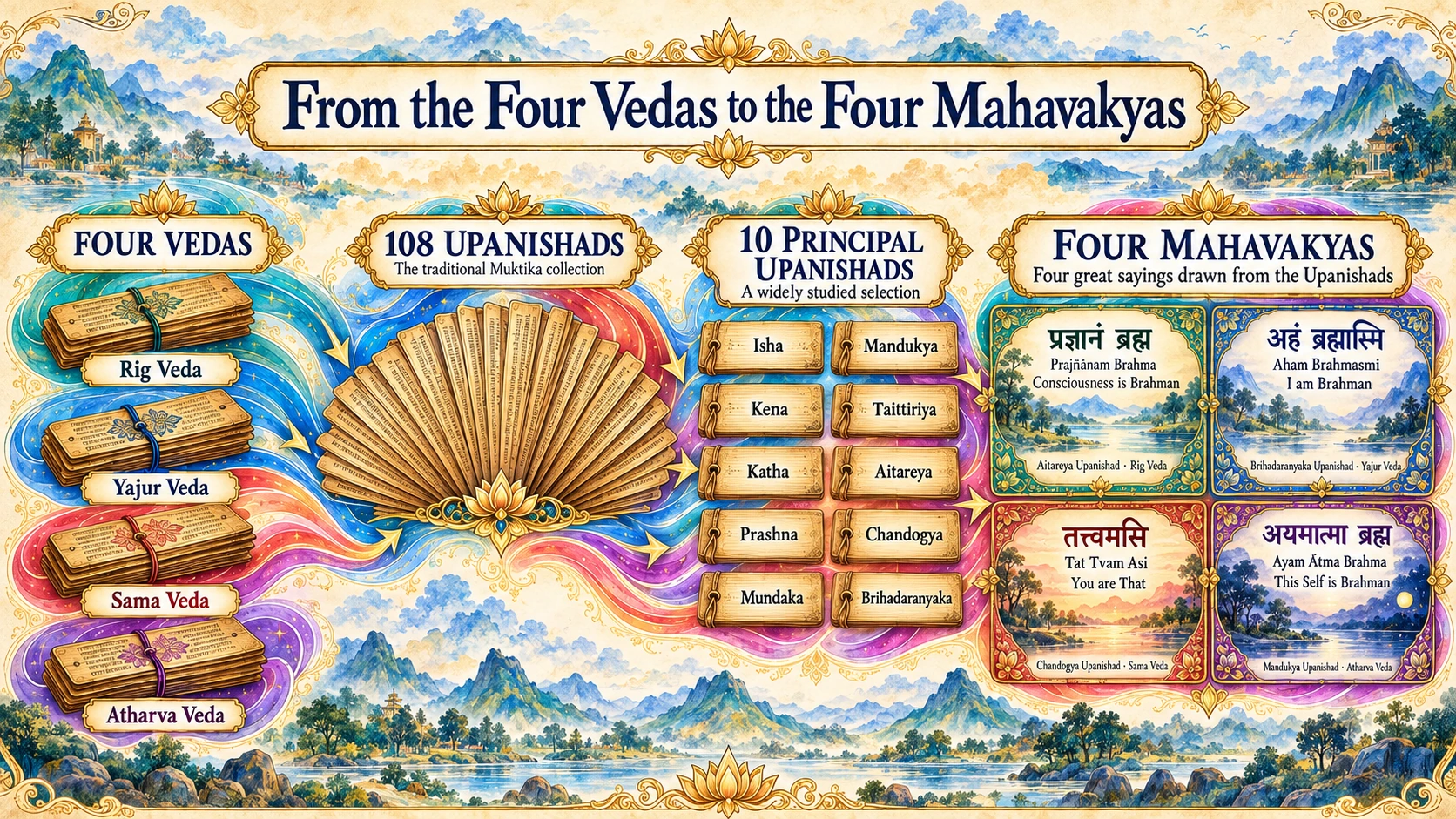
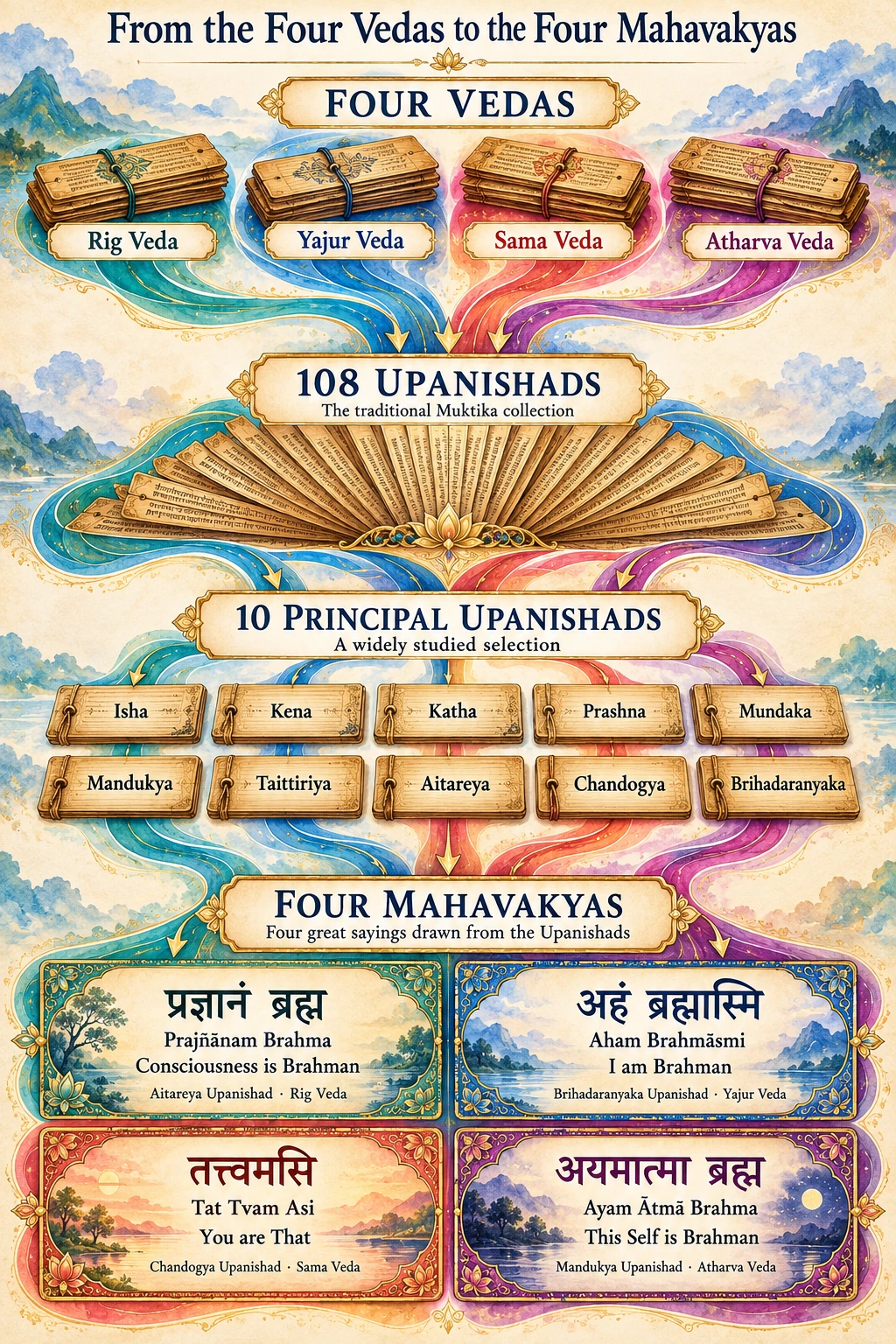
The four Mahavakyas are drawn from four Upanishads associated with the four Vedas: Aitareya, Brihadaranyaka, Chandogya and Mandukya. Each expresses, in a few words, the identity of Atman and Brahman.
The illustration traces their scriptural context: the four Vedas, the traditional collection of 108 Upanishads, ten widely studied principal Upanishads, and the four great sayings found within these teachings.
Does “I am Brahman” mean my personality is all-powerful?
No. “I” here points to the essential Self. The statement questions identification with a limited personality; it does not promise extraordinary personal control.
Does “You are That” mean I have nothing to learn?
Your true nature need not be manufactured. Understanding can still require careful listening, reflection and the resolution of doubts. Being already whole and recognizing wholeness are not the same claim about what you presently understand.
Can I use the sayings as meditation phrases?
You can return to a phrase gently, but attend to its meaning. Mechanical repetition can become another activity of the mind. Let the saying reveal a question worth examining rather than using it to suppress what you feel.
Do these statements deny the world?
They invite inquiry into its reality and into your identity. Within the understanding presented here, appearances are mithya: experienced, yet not independently existent. Relationships, consequences and appropriate action remain part of living.
Which Mahavakya should I begin with?
Begin with the one that opens an honest question. “Consciousness is Brahman” may invite you to investigate knowing. “I am Brahman” may expose an identification. “You are That” may question the distance you imagine from Source. “This Self is Brahman” may bring you back to the immediacy of being.
Continue exploring with Being Yoga
Begin with the Start Here learning route if you want a practical introduction. Return to the main spiritual awakening guide for the broader perspective, or explore Who Am I? for a short inquiry.
The Mahavakyas bring the search close. Source is not somewhere else waiting for the person to reach it. Atman is Brahman. Brahman and how it appears are not two things. Let the words invite you to look, and let understanding find expression in the life you are already living.
Explore the teaching visually
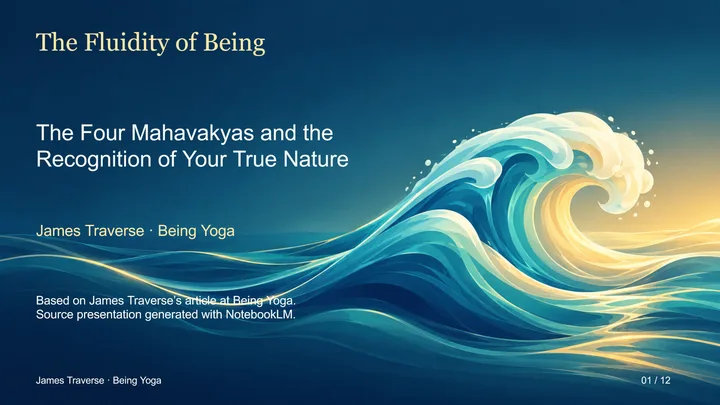
Download The Four Mahavakyas and Spiritual Awakening—a colourful illustrated companion to this article, with reflections on Atman, Brahman and mithya. Save it for quiet reflection or share it with someone exploring these teachings.
View or download the PDF · 12 pages · 4 MB.
Sources and teaching context
Primary textual references: Aitareya Upanishad 3.1.3 (also numbered 3.3); Brihadaranyaka Upanishad 1.4.10; Chandogya Upanishad 6.8.7 and its subsequent repetitions; Mandukya Upanishad 2, with the discussion of Turiya in mantra 7.
For traditional Advaita explanations, see Swami Krishnananda’s discussion of the four Mahavakyas, Swami Sivananda’s Mahavakya glossary entry, and Chinmaya Mission’s introduction to the Chandogya teaching.
The connections to spiritual awakening, BREATHE and lived inquiry are contemporary reflections in James Traverse’s teaching context. His writings are original works informed by his study of Vedanta and the Upanishads.
About James Traverse
James Traverse is a yoga educator and writer in Halifax, Nova Scotia, with over 50 years of yoga experience. His teaching explores nondual awareness, meditation and self-inquiry, drawing on his study with Jean Klein. Enquire about learning with James.