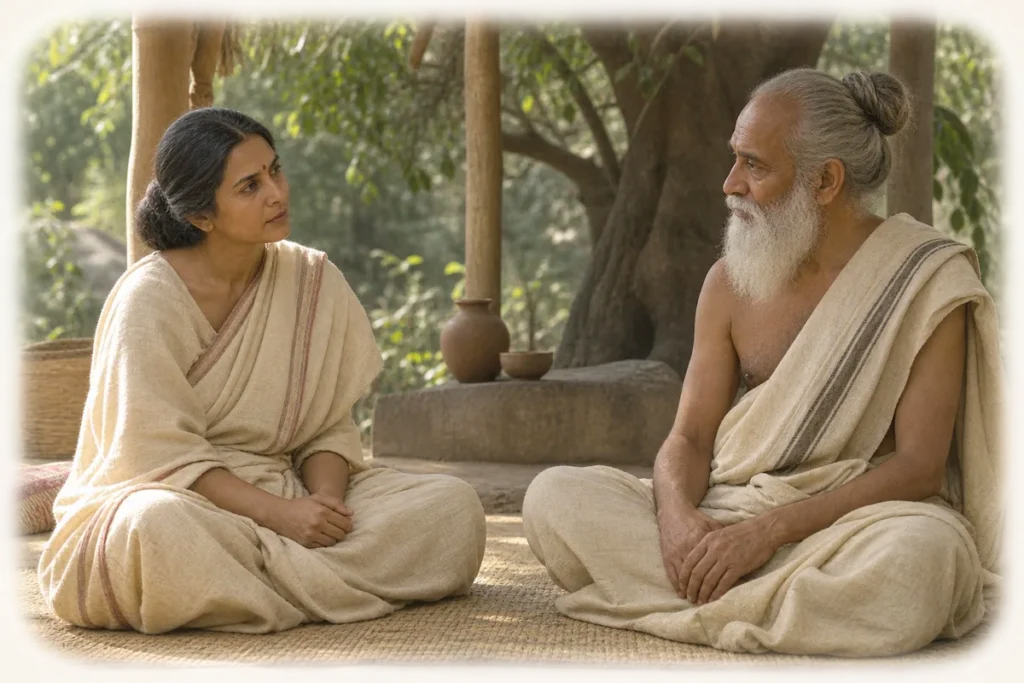
When Maitreyī asks whether owning all the wealth in the world could make her immortal, Yājñavalkya tells her what wealth can give her: the life of a wealthy person. She asks him to teach her what he knows about immortality. Her question makes the direction of the inquiry clear. Some things can be acquired. What she wants to understand is the nature of the one who would acquire them.
In the Bṛhadāraṇyaka Upanishad, their conversation leads to an instruction about the Self. It is to be seen, heard about, reflected upon and deeply contemplated. Advaita Vedānta draws on this passage in teaching śravaṇa (hearing), manana (reflection) and nididhyāsana (contemplation). Each has a different job in the inquiry. Read the dialogue, Bṛhadāraṇyaka Upanishad 2.4.1–5.
Śravaṇa — hear what the teaching is saying
A teacher says, “You are already whole.” The words can sound like encouragement to feel better about yourself. In Advaita they raise a more fundamental question about who that “you” is. Śravaṇa is listening closely enough to hear the teaching’s actual claim. In the traditional setting, this means attending to the Upanishadic teaching as it is unfolded by a teacher. The distinction matters because we often hear a new sentence through an old assumption.
Manana — take the doubt seriously
You may hear what is meant and still ask, “If I am already whole, why do I feel incomplete?” Manana gives that doubt room. Look at the word incomplete. It might describe a project, a conversation, or a felt sense of lack. How does a description of what is happening become a conclusion about what you are? Reflection tests that step. It lets you see exactly where you are convinced and where a question remains.
Nididhyāsana — stay with what has become clear
You may see the distinction clearly while reading and find yourself defending a familiar self-image hours later. Contemplation gives the understanding sustained attention. Traditions differ in how they describe its precise role. In Being Yoga, a practical way to approach it is to revisit the understanding when an old conclusion feels persuasive. If someone corrects you, feel the bodily response and hear the correction through. Is there something useful to acknowledge? Notice how that question differs from asking what the correction says about your worth. See Anantanand Rambachan’s study of the threefold process, chapter 5.
Why this matters for spiritual awakening
Listening gives the inquiry its direction. Reflection clears up a doubt you can name. Contemplation gives you a chance to see whether that clarity reaches your ordinary life. In Being Yoga, Insight is the turning point at which you recognize the wholeness you were looking for. Being Understanding is living in the light of that recognition. These practices give the inquiry somewhere to begin today, with a question you actually have. Explore the movement from intellectual understanding to Insight or follow the Spiritual Awakening Journey.
Leave a Reply