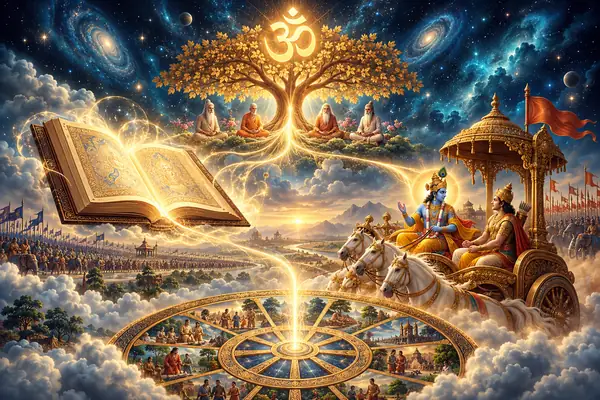
The Bhagavad Gita brings the wisdom of the Upanishads into a moment of human crisis. Its teaching unfolds through a conversation between Arjuna, a warrior who can no longer see what is right, and Krishna, his charioteer and guide. Questions about the Self, action, love and freedom arise where they matter most: in the midst of life.
The Upanishads inquire into our essential nature and the reality underlying all appearances. The Gita carries that inquiry onto a battlefield. What happens when understanding must become action? How can we participate fully without making our identity depend on what happens?
This is why the Gita speaks so directly to spiritual awakening. It invites recognition of what we are, together with a transformation in how we live.
What does Bhagavad Gita mean—and why Gitopanishad?
Bhagavad Gita is commonly translated as “The Song of the Lord.” The speaker, Krishna, is both Arjuna’s companion and the divine teacher. The text belongs to the Mahabharata, the great Indian epic, and its standard form contains 700 verses in 18 chapters.
It is also called Gitopanishad: the Gita understood as an Upanishad. Traditional chapter-ending formulas describe it in connection with the Upanishads, Brahma-vidya—the knowledge of ultimate reality—and yoga, the discipline through which understanding is lived. See the traditional closing formula.
This name expresses its spiritual authority and affinity with Upanishadic teaching. The Gita is part of the epic tradition, rather than one of the ancient Vedic Upanishads. It presents their central inquiry in a distinctive dialogue about life, duty and liberation.
The four Mahavakyas express Upanishadic understanding in concentrated declarations. The Gita approaches related questions through a person’s doubt, a teacher’s response and the gradual clarification of understanding.
The story: a family divided
The battlefield is Kurukshetra. Facing one another are two branches of the same royal family: the sons of King Dhritarashtra, commonly called the Kauravas, and the five sons of his brother Pandu, the Pandavas.
The Pandavas are Yudhishthira, Bhima, Arjuna, Nakula and Sahadeva. The leading Kaurava is Duryodhana. A struggle over the kingdom, a disastrous dice game, the humiliation of Draupadi, exile and unsuccessful attempts at peace have brought the families to war. These events belong to the larger Mahabharata; the Gita begins when the armies are already assembled.
Respected elders and teachers stand on both sides. Bhishma, the family patriarch, and Drona, the princes’ teacher, serve with the Kaurava army. For Arjuna, the opposing soldiers are people he knows and loves. The conflict cannot be reduced to an impersonal contest.
Dhritarashtra asks; Sanjaya sees
The Gita opens with the blind King Dhritarashtra asking Sanjaya what his sons and Pandu’s sons are doing at Kurukshetra. Sanjaya is his trusted counsellor and charioteer. Through the divine vision granted by Sage Vyasa, he can relate events on the distant battlefield, including the conversation between Krishna and Arjuna. Read the opening verse and its narrative background.
The reader therefore hears a conversation within a conversation. Sanjaya tells the king what Krishna tells Arjuna. The story begins with a question about an outward conflict and opens into an inquiry about identity, responsibility and reality.
Krishna places the chariot between the armies
Arjuna asks Krishna to position their chariot between the two armies so he can see those he must face. Looking at relatives, friends and teachers, he becomes overwhelmed. His body trembles, his mouth dries, and his bow slips from his hand.
He questions the value of victory bought at such a cost. He fears the destruction of families and the breakdown of their sustaining customs. Finally, he lays down his bow. The teaching begins at the point where his familiar answers no longer suffice.
You exist. Therefore you have to act. The question is: how?
Just as Arjuna has to act, it follows from the fact that you exist that now you have to act. The question is: “How to act?”
You are already participating in life. Breathing, speaking, working, resting and responding are all part of that participation. Even postponing a decision has an effect. You cannot step outside life and wait for an understanding that removes the need to respond.
Arjuna’s question is therefore our question. From what understanding do we act? Do we act through fear, grasping and the need to defend an image of ourselves? Or can action arise through clarity, care and recognition of our essential nature?
The Gita answers through Karma Yoga, Bhakti Yoga and Jnana Yoga: act with care, offer the action without possessiveness, and inquire into who you are. These meet in the living question: How to act, here and now?
Three central themes: Dharma, Yajna and Yoga
The Gita’s question “How to act?” becomes clearer through three themes: Dharma—duty, Yajna—sacrifice, and Yoga—skill in action. They are present throughout the teaching, shaping the relationship between understanding and participation in life.
Dharma—duty: what is yours to do?
Dharma concerns the order that sustains life, right conduct and responsibility. Svadharma concerns one’s own duty, understood in relation to one’s nature and situation. For Arjuna, this includes his role as a warrior confronting a struggle over justice and the kingdom.
His difficulty is that responsibilities appear to conflict. Loyalty to family, respect for teachers and the obligation to uphold justice cannot be resolved by repeating a rule. He needs discernment.
In everyday life, duty asks: what does this situation require, and what responsibility is actually mine? The Gita discusses duties within the social framework of its time. A present-day application must be considered thoughtfully. Duty involves honest attention to circumstances, capacities and the well-being of others.
Yajna—sacrifice: can action become an offering?
Yajna, commonly translated as sacrifice, begins with the traditional language of sacred offering and extends into a broader understanding of action. Life is sustained through giving and receiving. We participate in a whole that no individual creates or owns.
To act in the spirit of sacrifice is to offer the action beyond personal gain: to contribute, serve, learn and care without claiming that everything must return to “me.” In this sense, what is relinquished is the possessive demand on action and its fruits.
A meal prepared with care, work that serves a real need, or a conversation in which you truly listen can become an offering. This spirit also includes wise limits. Sacrifice is compatible with caring for your body and meeting your own legitimate needs.
Yoga—skill in action: the actor and the action
In Gita 2.50, Krishna says yogah karmasu kaushalam: “Yoga is skill in action.” In the reading offered here, this means right action arising from right understanding. Skill includes practical competence, yet reaches deeper into the understanding from which we act. Read Gita 2.50.
No action can be right unless the actor is right – when the actor is right, right action unfolds naturally, it leaves nothing lacking and no residue. The decisive question is therefore the actor’s understanding. “Right” here means clarity free from the distortion of greed, hatred, fear and possessive self-interest, responsive to the whole situation and its demands.
Arjuna’s skill with a bow is already established. What needs clarification is the understanding of the one who uses it. Krishna’s teaching addresses the actor, and through that clarification the quality of action changes. An outwardly impressive deed may serve self-importance, while a difficult deed may arise from clear responsibility.
Consider an operation: outwardly, a surgeon cuts into a body. The visible act alone does not tell us its meaning. Competence, care, the actual need and the purpose of the action belong to understanding it. Similarly, Arjuna’s action cannot be understood apart from the actor and the dharma of his situation.
The Gita carries this inquiry into freedom from the ego’s claim to be the independent doer. Verse 18.17 describes an actor without egoistic doership and with an unclouded understanding as unbound even in the terrible circumstances of battle. This concerns the absence of binding doership; the actor’s clarity must be understood alongside the Gita’s teachings on discernment, compassion and dharma. Read Gita 18.17.
Karma still means action, with its consequences. Yoga names the quality of understanding and participation through which action becomes right action. The issue is more than what is done: it is the understanding from which the doing arises.
Dharma clarifies what is yours to do. Yajna makes the action an offering. Yoga is the skill in action that follows from a rightly understood actor. Together they answer the living question: “How to act?”
The 18 chapters: three groups of six
A traditional way to read the Gita divides its 18 chapters into three groups of six. The first emphasizes Karma Yoga, the second Bhakti Yoga and the third Jnana Yoga. These are three interwoven aspects of the teaching, rather than sealed compartments. See the traditional threefold organization.
| Chapters | Main emphasis | In plain English |
|---|---|---|
| 1–6 | Karma Yoga | Act responsibly without clinging to the results. |
| 7–12 | Bhakti Yoga | Let devotion open the heart beyond self-centred concern. |
| 13–18 | Jnana Yoga | Discern what changes and recognize your essential nature. |
Karma means action; bhakti means devotion; jnana means knowledge or understanding. Here, yoga includes the discipline and orientation of a whole life. It is much more than physical posture.
The chapter illustrations below are symbolic visual summaries of the teachings.
Chapters 1–6: Karma Yoga—understanding and action
1. Arjuna’s sorrow: when certainty collapses
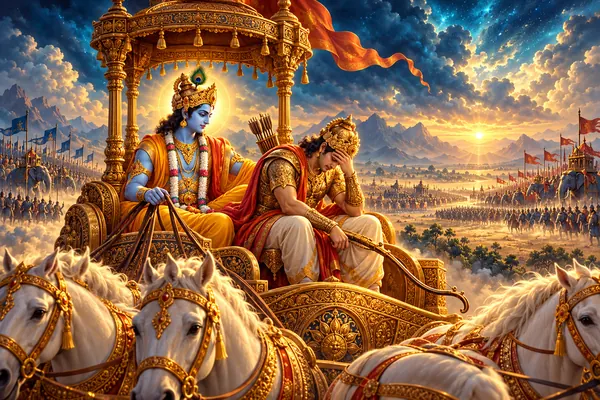
Chapter 1 sets the scene and lets us feel Arjuna’s conflict. His sorrow exposes a question that success alone cannot answer: what is worth doing, and on what understanding should action rest?
The chapter is traditionally called the yoga of Arjuna’s despondency. Sorrow itself does not guarantee wisdom, yet an honest encounter with confusion can make inquiry possible. Arjuna has reached the limit of his habitual way of seeing. Chapter 1.
2. The enduring Self and the beginning of clear action
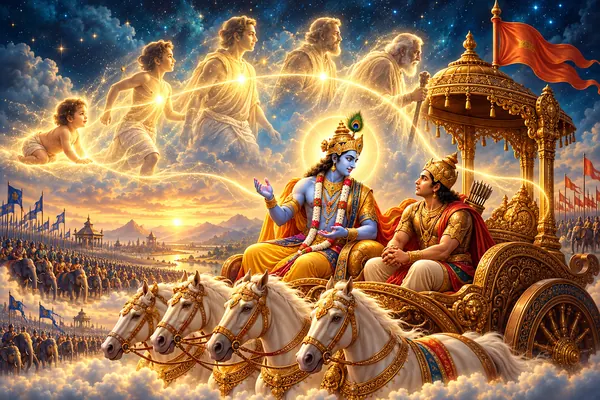
Arjuna asks Krishna to teach him. Krishna distinguishes the changing body from the enduring Self: that which is not born and does not die. The text also teaches rebirth, using the image of exchanging worn clothes for new ones.
Krishna then introduces action without attachment to its fruits. We can attend to what we do, but we cannot possess or completely control the outcome. This is an invitation to care without making success or failure the measure of our being.
The chapter closes with the person of steady wisdom: one less governed by craving, fear and anger. In an Advaita reading, the inquiry opens toward the Self that is not confined to a passing personal identity. Chapter 2; especially 2.20, 2.47–48 and 2.55–72.
3. Karma Yoga: participation without possessiveness

Arjuna wonders why he should act if knowledge is so important. Krishna explains that simply refusing action does not bring freedom. Life continues to act through us.
You exist, so you have to act. The question is how to act. Action can arise from grasping and self-importance, or from a clearer response to what is needed. Krishna emphasizes contribution, responsibility and the welfare of the world—loka-sangraha, sustaining the shared order.
Dharma, Yajna and Yoga meet here. Perform the action that is yours to do, offer it as a contribution to the whole, and recognize its consequences without clinging to its fruits. For an everyday example, help someone because help is needed. Do the work well, without turning their gratitude into a requirement for your peace. Chapter 3; especially 3.19–25.
4. Knowledge transforms the meaning of action
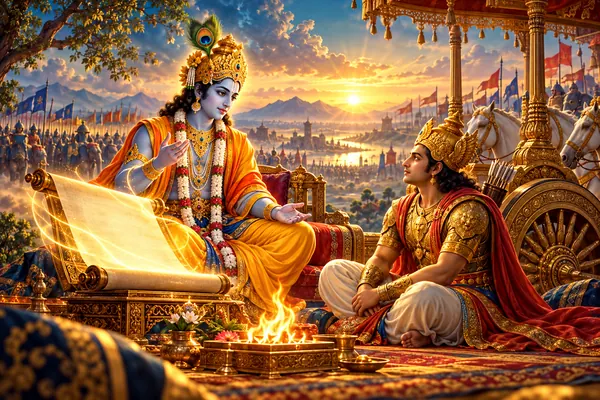
Krishna describes an ancient teaching transmitted through generations and renewed when it is obscured. He also explains his divine manifestation when dharma declines: the divine entering the world to uphold its order.
The chapter explores action, inaction and the many forms of sacrifice. Offering includes study, disciplined attention and understanding, as well as ritual. Knowledge changes our relationship to the assumption “I alone am the doer.”
Krishna encourages approaching a teacher with humility, sincere questions and service. Listening and inquiry belong together. Chapter 4; especially 4.7–8, 4.18 and 4.34.
5. Renunciation in the midst of life
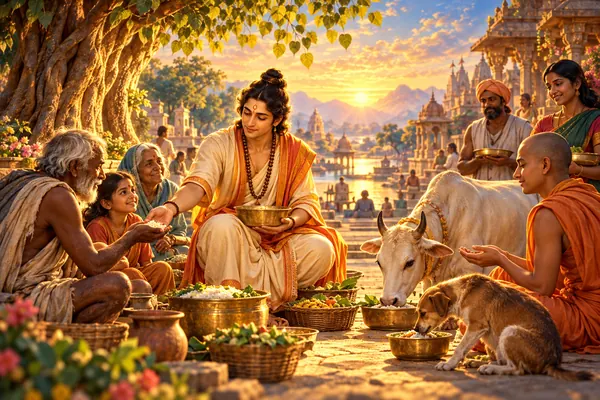
Must we leave ordinary activity to be free? Krishna brings renunciation and disciplined action into relation. Giving up possessiveness and attachment matters more than merely changing outward circumstances.
The wise recognize a fundamental equality across beings. This vision questions the habit of assigning a different essential worth to people according to status or appearance.
We can perform a task wholeheartedly while noticing the impulse to claim it as proof of personal superiority. That noticing allows a different quality of participation. Chapter 5; especially 5.2, 5.10 and 5.18.
6. Meditation and the restless mind

Krishna describes meditation, a steady posture, moderation in eating and sleeping, and returning the wandering mind. Arjuna says the mind seems as difficult to restrain as the wind. Krishna acknowledges the difficulty and points to practice and non-attachment.
The chapter also describes seeing oneself in all beings and all beings in oneself. Meditation opens into relationship, rather than remaining a private achievement.
Arjuna asks about someone whose practice remains incomplete. Krishna reassures him that sincere effort is not lost. You can begin with Being Yoga’s simple meditation practice and its guidance for a busy mind. Chapter 6; especially 6.16–17, 6.26, 6.29 and 6.35–40.
Chapters 7–12: Bhakti Yoga—devotion and the whole
7. Knowing the Source through its expressions

Krishna speaks of nature and the living principle, identifying himself as the source and support of existence. Water’s taste, sunlight and the sound OM become invitations to recognize the divine in ordinary experience.
The chapter distinguishes knowledge from its fuller realization. Knowing the words “all comes from Source” is different from allowing that understanding to inform our seeing.
In Being Yoga’s language, Source and its expressions are not-two. This is an Advaita-oriented reading of the teaching; other Vedanta traditions explain the relationship differently. Chapter 7; especially 7.4–8.
8. The imperishable, remembrance and death

Arjuna asks about Brahman, the Self and action. Krishna discusses the imperishable reality and remembrance of the divine at death. The text includes teachings about rebirth, cosmic cycles and paths after death.
Its practical invitation concerns the orientation of a whole life. What we repeatedly attend to shapes how we meet experience. Krishna therefore joins remembrance with action: remember the divine and fulfil the task before you.
OM appears here in the context of spiritual remembrance. It points beyond being merely a sound to be performed. Chapter 8; especially 8.3, 8.7 and 8.13.
9. The intimate teaching: offering an ordinary life
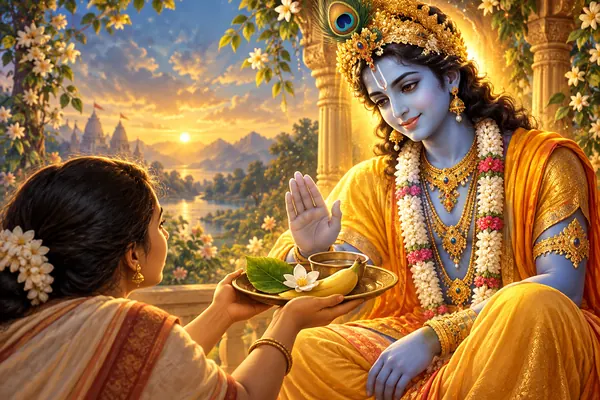
Krishna describes the divine as pervading and sustaining the world while exceeding what can be grasped through its forms. The relationship between the manifest world and its source is presented as profound and subtle.
A leaf, a flower, fruit or water offered with devotion is enough. The value lies in the sincerity of the offering. Krishna extends this orientation to what we do, eat and give.
Preparing food, caring for another person or completing a necessary task can become an offering. Devotion changes the quality of attention with which we meet ordinary life. Chapter 9; especially 9.4–5 and 9.26–27.
10. Recognizing the divine in the world

Arjuna asks how he can contemplate Krishna. Krishna responds through a series of divine manifestations: forms of excellence, power, beauty, wisdom and vitality.
The examples direct attention through particular things toward their sustaining source. The world can become a place of recognition.
A moment of beauty may interrupt our usual self-concern. The invitation is to notice what that openness reveals, without trying to possess the experience. Chapter 10; especially 10.20 and 10.41–42.
11. The universal form: beauty, terror and time
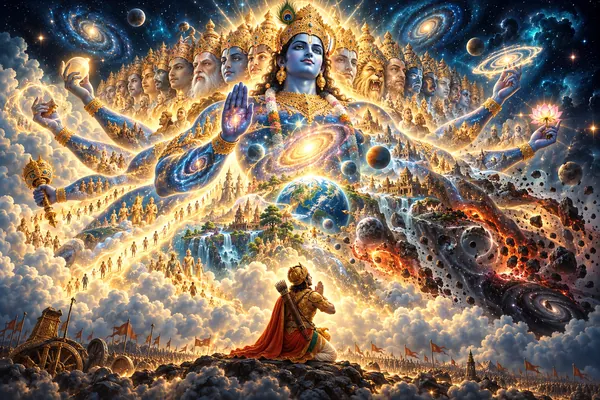
Arjuna asks to see Krishna’s universal form. Krishna grants him divine sight. Arjuna beholds an overwhelming vision in which countless beings and worlds appear together.
The vision includes destruction as well as splendour. Krishna reveals himself as Time, bringing worlds to their end. Arjuna sees the warriors moving toward death and hears that he is to act as an instrument.
Shaken, Arjuna asks to see Krishna’s familiar form again. This encounter expands his understanding beyond a comforting picture of divinity. It also shows that a spectacular experience must be assimilated. Its intensity alone is not a complete way of living. Chapter 11; especially 11.8, 11.32–34 and 11.45–50.
12. Devotion expressed as a way of being
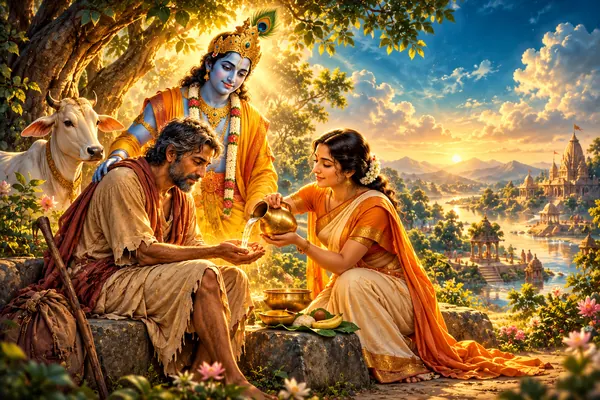
Arjuna asks about devotion to the personal divine and contemplation of the unmanifest. Krishna acknowledges both, while describing the difficulty of the unmanifest approach for embodied people.
He offers accessible ways to begin: direct attention toward the divine, practise returning, act as an offering, or relinquish attachment to the fruits of action.
The beloved devotee is described through qualities such as friendliness, compassion, freedom from possessiveness and steadiness. The chapter brings devotion into how we treat people. Chapter 12; especially 12.1–5, 12.8–12 and 12.13–20.
Chapters 13–18: Jnana Yoga—discernment and freedom
13. The field and the knower of the field

The body and the changing range of experience are described as the field—kshetra. The knower of the field—kshetrajna—is distinguished from what is known. Krishna also speaks of himself as the knower in all fields.
This brings the Upanishadic inquiry close: a sensation, thought or emotion is known. Can what you essentially are be reduced to one of these changing objects?
The chapter includes humility, non-harming and other qualities as part of knowledge. Discernment has an ethical expression. Explore this inquiry further in Who am I? Chapter 13.
14. The three gunas: clarity, agitation and inertia

The gunas are three qualities of nature: sattva, clarity and harmony; rajas, activity and restlessness; and tamas, inertia and obscuration.
These qualities help explain changing conditions in the mind and behaviour. Even attachment to clarity can bind us when we make it our identity.
Freedom involves recognizing their activity without taking every movement as the final truth of “me.” We can notice restlessness and respond intelligently, rather than naming ourselves a permanently restless person. Krishna also connects going beyond the gunas with unwavering devotion. Chapter 14; especially 14.5–9 and 14.22–26.
15. The tree of becoming and its root

The world is pictured as a great tree with roots above and branches below. The image echoes the Katha Upanishad. It suggests a manifested life sustained by a source that cannot be understood only by inspecting its branches.
Krishna calls for cutting attachment with the strong instrument of non-attachment. The chapter then distinguishes the perishable, the imperishable and the Supreme Person—Purushottama.
The imagery asks where our sense of being is rooted. Are we absorbed only in the branches of changing roles and experiences? Chapter 15; especially 15.1–4 and 15.16–18.
16. Character matters
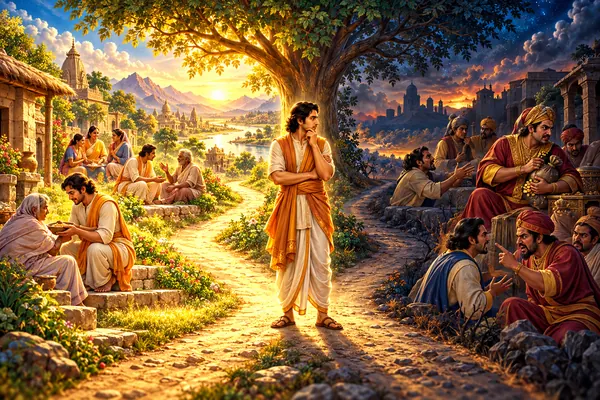
Krishna contrasts qualities that support freedom with those that deepen bondage. Fearlessness, honesty, generosity and non-harming are set beside arrogance, anger and cruelty.
Desire, anger and greed are identified as destructive openings. The teaching concerns recognizable patterns of conduct, rather than a licence to label other people as inherently evil.
Spiritual language does not excuse careless behaviour. A clearer understanding should be visible in how we listen, act and take responsibility. Chapter 16; especially 16.1–4 and 16.21.
17. Faith becomes visible in what we do
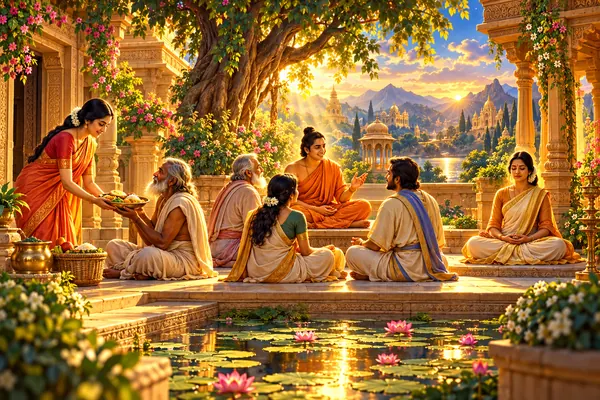
The chapter examines faith through the three gunas, and explores food, sacrifice, discipline and giving. Shraddha, often translated as faith, includes the trust and orientation through which a person lives.
It also distinguishes disciplines of body, speech and mind. Speech is to be truthful, beneficial and not needlessly disturbing. Giving is examined through its motive and manner.
The chapter ends with OM TAT SAT, sacred expressions associated with ultimate reality. It invites us to examine whether practice is sincere or chiefly a performance for approval. Chapter 17; especially 17.14–16, 17.20–22 and 17.23.
18. Integration, surrender and Arjuna’s choice
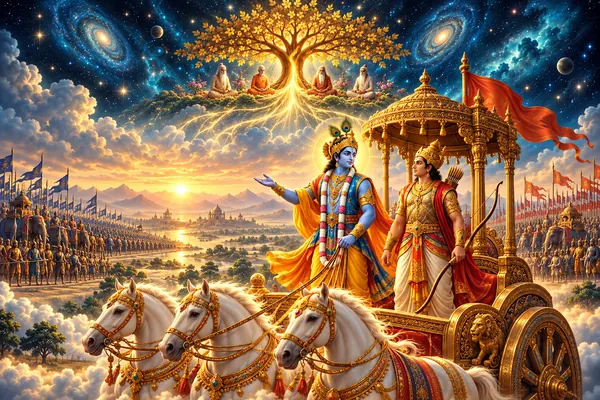
The final chapter gathers action, knowledge, devotion and renunciation into a comprehensive teaching. It distinguishes giving up action from relinquishing attachment to its fruits, and examines the conditions through which action occurs.
Krishna returns to acting according to one’s nature and responsibility, and concludes with a profound invitation to take refuge in him. The celebrated verse 18.66 receives different interpretations across Vedanta traditions; in an Advaita reading, surrender opens beyond the assumed independence of the separate self.
Crucially, Krishna asks Arjuna to reflect fully and choose. Arjuna says his confusion has cleared and that he will act. Sanjaya closes by recalling the dialogue with wonder. The Gita ends before the battle’s outcome. Its immediate resolution is a change in understanding and the capacity to respond. Chapter 18; especially 18.13–17, 18.63, 18.66 and 18.73–78.
How the Gita reveals Upanishadic wisdom
The Upanishads ask what remains when changing appearances are understood for what they are. The Gita carries that inquiry through the questions of a person who must live and act.
Atman names the essential Self. Brahman names ultimate reality—Source, by whatever name. In the Advaita understanding informing Being Yoga, Atman and Brahman are not-two. This recognition does not mean that the personality becomes all-powerful. It questions the assumption that a separate personality is the whole of what we are.
The Gita’s account includes devotion to Krishna, teachings about rebirth and liberation, and a disciplined ethical life. Its Upanishadic significance is therefore richer than a modern message about feeling calm. It addresses identity, reality and freedom.
Mithya: experienced appearances without independent existence
In Advaita, mithya describes appearances that are neither independently real nor sheer nonexistence. They are experienced, yet have no separate existence apart from their underlying reality.
A wave is experienced. Its form changes, but it never exists apart from water. Water and the wave are not-two things. This analogy helps explain the perspective, though no image completely captures Brahman.
Read through this lens, the Gita invites freedom from mistaking a changing appearance for an independently existing self. Mithya is an interpretive term used here to explain the Advaita perspective; the Gita’s own teachings should not be reduced to this one formulation.
Daily life still calls for care. Arjuna’s dilemma matters within the story. Recognition changes his relationship to action; it does not erase its consequences. The related article Are Dreams Real? Spiritual Awakening and Mithya explores this distinction further.
The battlefield and everyday life
We can also read the battlefield as an image of conflicting tendencies: loyalty and fear, clarity and attachment, responsibility and avoidance. This symbolic reading can illuminate our experience while respecting the story’s actual setting in war.
The Gita’s instruction to Arjuna belongs to that particular moral and narrative situation. It should not be generalized into a justification for harming others or obeying any authority without question.
For most readers, the immediate field of practice is ordinary life: a difficult conversation, an uncertain decision, a loss, a task that must be done. Can we meet it without requiring the outcome to confirm a separate identity?
Spiritual awakening in daily life includes this capacity to respond. Recognition and responsibility belong together.
A simple way to practise the Gita’s teaching
Return to the central question: you exist, therefore you have to act. How to act? Let Dharma—duty, Yajna—sacrifice, and Yoga—skill in action guide the reflection.
- Pause. Feel the body and allow breathing to be natural.
- Notice the situation. Separate what is happening from what you fear it means about you.
- Consider what is needed. Include the effect of your action on others.
- Act with care. Give the task your attention and the skill available to you.
- Release your claim on the outcome. Learn from the result without making it the measure of your essential worth.
- Inquire. What is aware of the changing experience? Does that awareness share the limits of the passing thought or role?
This brings action, devotion and inquiry into one ordinary moment. It is a practical reflection inspired by the Gita, rather than a replacement for studying its text.
Questions readers often ask
Is the Bhagavad Gita an Upanishad?
It is part of the Mahabharata, rather than one of the ancient Vedic Upanishads. It is called Gitopanishad because it conveys Upanishadic wisdom and is honoured as a teaching of ultimate reality and yoga.
Are the three groups of six chapters three separate paths?
They are a useful traditional framework. Action, devotion and knowledge recur throughout the text. They can be understood as mutually supporting aspects of a whole life.
Does non-attachment mean not caring?
No. It means caring for what is to be done without demanding that the result secure your identity. Attention and responsibility remain essential.
Does the Gita end with Arjuna escaping the battlefield?
No. His understanding becomes clearer and he chooses to act. The transformation occurs within the situation he faces.
How does the Gita relate to spiritual awakening?
It joins inquiry into the enduring Self with action, devotion, meditation and ethical conduct. In Being Yoga’s Advaita perspective, awakening is recognition of your essential nature, expressed through participation in everyday life.
Continue the inquiry
Read The Four Mahavakyas for the Upanishadic declarations, explore self-inquiry, or begin with the Being Yoga learning path.
Reading note: Chapter summaries above are original plain-English explanations, with links to the corresponding text. Interpretive passages identify the Advaita perspective informing Being Yoga. Hindu traditions differ in their explanations of the relationship between the Self, the world and the divine. Sanskrit names appear in simplified English spelling for readability.
Leave a Reply