Part 4 of 7 · BREATHE Framework
Explore the difference between collecting teachings and understanding what they point to. Mara brings reading, questioning, and contemplation into her own experience.
The Menu, the Meal, and the Hungry Seeker
Listening, Reflection, and Contemplation
Within a month, Mara could explain superimposition over lunch.
She had underlined passages about consciousness, bookmarked talks, and learned several Sanskrit terms. When friends asked how retirement was going, she described her spiritual inquiry with a fluency that surprised her.
Yet she still felt injured when nobody asked a follow-up question.
The contrast became obvious one afternoon while she was telling Leela why approval could not provide lasting fulfillment. Halfway through the explanation, Mara noticed herself checking whether Leela looked impressed.
They both laughed. It was an affectionate laugh, and it opened something.
The first Seven Stages guide uses a simple distinction: a menu can help you choose a meal, but reading it does not provide the experience of eating.
Imagine a diner who studies every description, learns the chef’s vocabulary, and then leaves hungry because ordering would interrupt the research.
The menu has served a purpose. The difficulty is asking it to perform a function it cannot perform.
In Error Experienced, Mara discovered that an identity built around being needed kept recreating distress. Teaching now gave her language for the pattern. But a new vocabulary did not automatically mean that she had understood the identity mechanism as it operated.
Nachiketas and the question worth keeping
In the Katha Upanishad, the young Nachiketas asks Yama, the Lord of Death, about the uncertainty surrounding death. Yama offers him wealth, longevity, and pleasures instead. Nachiketas remains with his question. A longer life filled with possessions would still leave it unanswered.
Yama distinguishes śreyas, the good or ultimately beneficial, from preyas, the immediately pleasant. Within BREATHE, this becomes a question about the purpose of our search: am I seeking understanding, or an answer that will briefly reassure me?
There is nothing wrong with enjoying life. The difficulty begins when we expect a passing experience to settle every uncertainty about who we are.
For Mara, this could be the turning point in her listening. She begins to examine what a teaching means, where she doubts it, and how her familiar assumptions shape what she hears. Assimilation asks for this patient attention.
Let a breath move naturally. Ask: What am I hoping my next achievement or experience will finally settle?
There is no need to force an answer. Notice what the question reveals, and carry that honestly into further inquiry.
Source: Katha Upanishad 1.1.20, 1.1.23–29, and 1.2.1–2. The application to Mara and BREATHE is a contemporary reflection.
Why secondhand knowledge matters
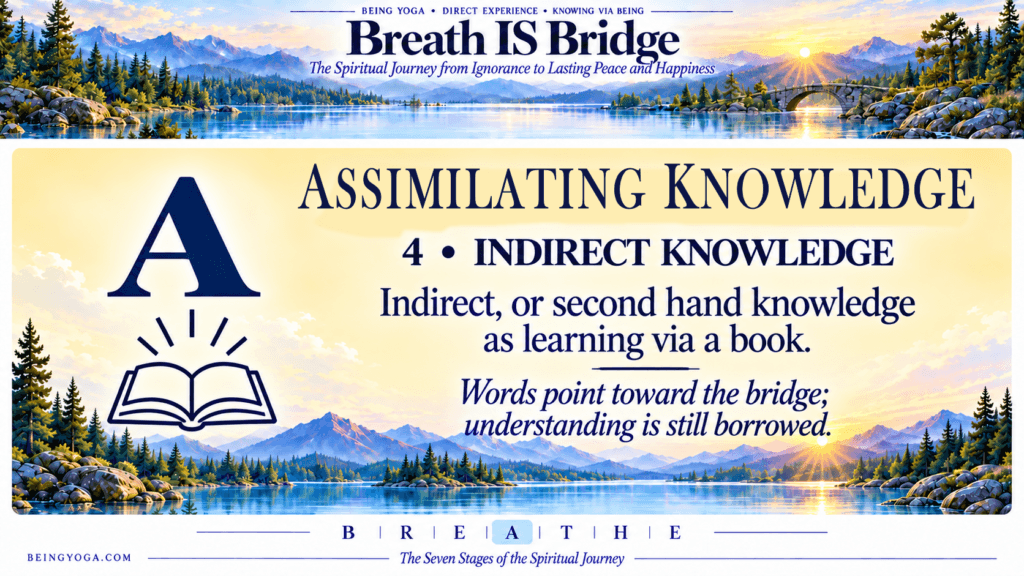
Indirect knowledge is an essential stage in this framework. Someone points out a possibility you have not considered. A book identifies the question hidden beneath your habitual answers.
In the rope-and-snake story, another person first reassures the frightened traveller. That reassurance can make looking again possible. The instruction has a real role before direct recognition occurs.
Traverse’s first guide introduces a threefold approach: hearing the teaching, questioning and contemplating it, and meditative assimilation. Often named shravana, manana, and nididhyasana, these movements give learning depth.
The Sanskrit terms Śravaṇam, Mananam, and Nididhyāsanam are not three unrelated steps. Śravaṇam gives the vision, Mananam tests and clarifies it, and Nididhyāsanam allows the personality to become aligned with what has been understood.
The point is to engage the teaching until its meaning becomes clear. Skepticism that refuses to look and belief that refuses to question can both prevent that engagement.
Shvetaketu returns home
In chapter 5 of Knowing Via Being, Traverse retells the story of Shvetaketu, who returns from study confident in his learning. His father, Uddalaka, asks about the understanding through which the underlying reality of appearances becomes known.
The question reveals a gap between mastery of teachings and recognition of what they indicate. Uddalaka then teaches through familiar things: clay and its forms, a seed, and salt dissolved in water.
These demonstrations bring the teaching into Mara’s immediate observation, where she can examine whether the words agree with what is actually known.
Mara recognized something of herself in the returning student. Her new education was becoming another identity she could present to the world.
Read one paragraph deeply
She began a different practice. Instead of finishing a chapter each morning, she sometimes stayed with one paragraph.
If it said that she was aware of thoughts, she noticed an actual thought. She then noticed that the thought was known, and asked whether the knower was altered by the thought’s appearance. If it questioned the sense of a separate observer, she looked for that sense rather than copying a sentence about it.
She wrote down genuine doubts. “I understand the words, but what does this mean in experience?” became a useful question rather than an embarrassing confession.
Being Yoga’s Being Okay with Not Knowing Is a Living Meditation describes this availability to look without rushing into psychological certainty. That openness helped Mara read without needing every passage to become proof that she was progressing.
The breath between sentences
Set a text down for a moment. Feel an ordinary breath. Let the words remain available without immediately explaining them to yourself.
Ask: What is this passage asking me to notice?
A quiet moment is not itself an answer. It makes room to discover whether the answer you were about to give came from clear understanding or memory.
Being Yoga’s The Physics of the Soul explores the shift toward Knowing via Being. Within this series, that shift means that teachings become invitations to recognition rather than items added to a collection.
The question that could not be answered by collecting
At the end of a conversation, Leela asked, “What is aware that you want to understand?”
Mara began to answer, then stopped. She knew several acceptable sentences. None felt like looking.
That hesitation was more useful than her quickest explanation.
A moment of inquiry
Select one passage. Restate it simply, identify a genuine doubt, and examine the experience it describes. Ask what is changing, what is being known, and what remains present through the change. Let reading, questioning, and contemplation support one another.
Note: Learning gives Mara language; inquiry reveals whether the language has become knowledge.
Continue to T — Truth Recognized: The One Who Was Already Present, where the one conducting the search becomes central to the inquiry.
Source notes: Seven Stages of the Spiritual Journey, PDF pp. 7, 33–34, 37–38; Knowing Via Being, chapter 5, PDF pp. 23–25. The lunch and reading scenes are original.
BREATHE Framework: all seven chapters
Previous: E — Error Experienced
Mara and Leela are fictional characters created for this series. Traditional teaching stories are retold from the sources identified above.
Put this chapter into practice: Open Part 4 in the BREATHE web app for the contemplative inquiry, breath pacer, and your private reflection space. You can export your notes and add the app to your home screen.