Teaching content by James Traverse; the companion video uses AI narration. Explore the written teaching below, watch the eight-minute explainer, or read the edited transcript. The practice is an invitation to inquiry, not a promise to resolve anxiety.
Watch: Not Knowing and Presence
This 8-minute teaching explores the difference between useful practical knowledge and the demand for psychological certainty. Watch the video, then try the short living-meditation practice below.
In the video: notice the urge to settle a question immediately, distinguish a practical decision from a fixed conclusion about yourself, and return to direct attention in everyday life. Jump to the living-meditation practice at 7:20.
We often imagine meditation as something we do apart from life.
We sit quietly, follow the breath, repeat a mantra, or observe the movement of thought. Then the meditation ends, and we return to a world filled with decisions, relationships, responsibilities, and unanswered questions.
But what if meditation does not end when we rise from the cushion?
What if one of the deepest forms of meditation is simply being okay with not knowing?
The Mind Wants Certainty
The mind finds security in knowing.
It wants to know what will happen, what something means, which choice is right, how a relationship will unfold, and where life is leading. It creates conclusions because conclusions seem to offer solid ground.
Yet life is not solid. It is living, moving, and continually revealing itself.
When we insist on knowing, we often replace the living reality of the present moment with an idea about it. We stop listening because we have already decided. We stop seeing because we believe we already understand.
Our conclusions may provide temporary comfort, but they can also prevent discovery.
Not knowing feels uncomfortable because it leaves us without the familiar protection of certainty. There is no rehearsed answer, no fixed identity, and no mental map telling us exactly where to go.
And yet this apparent uncertainty contains an extraordinary invitation: to be fully present.
Not Knowing is Not Ignorance
Being okay with not knowing does not mean refusing to learn, avoiding responsibility, or becoming indecisive.
It means recognizing the difference between practical knowledge and psychological certainty.
Practical knowledge is essential. We need it to communicate, work, travel, cook, build, and care for one another. But psychological certainty is often an attempt to make the unknown conform to what we already believe.
To say “I do not know” with complete honesty is not a declaration of weakness. It is an act of humility and intelligence.
It means:
“I am willing to look.”
“I am willing to listen.”
“I am willing to meet this moment without forcing it into an old conclusion.”
In this sense, not knowing is the beginning of direct perception.
The Space Before the Answer
When a question arises, notice how quickly the mind searches for an answer.
It reaches into memory, compares the present with the past, and produces a conclusion. This movement is useful when recalling a fact, but the deepest questions of life cannot always be resolved through memory.
Who am I?
What is love?
What does it mean to be free?
How should I meet loss, change, or uncertainty?
If we approach such questions with ready-made answers, we may never encounter the living truth behind them.
But when we remain with a question without rushing toward an answer, something changes. A quiet space opens between the question and the mind’s response.
That space is meditation.
It is not empty in the ordinary sense. It is awake, receptive, and filled with attention. In that silence, the question is no longer merely something to solve. It becomes something to live.
Living Without a Mental Conclusion
A living meditation is not an escape from ordinary life. It is the art of meeting ordinary life without being completely enclosed by our assumptions.
Can you listen to another person without immediately deciding what they mean?
Can you experience a difficult feeling without naming it, resisting it, or trying to make it disappear?
Can you enter a new day without carrying yesterday’s image of yourself into every encounter?
Can you allow a relationship to reveal what it is now, rather than seeing it only through what it has been?
To live this way is to become available to reality.
The moment is no longer filtered entirely through expectation. Perception becomes fresh because the mind is not constantly trying to confirm what it already knows.
Not knowing makes room for seeing.
Uncertainty and Fear
For many of us, not knowing awakens fear.
We believe that if we do not have an answer, we will lose control. But much of what we call control is only prediction based on the past. Life remains fundamentally unpredictable, regardless of how carefully we plan.
The invitation is not to eliminate uncertainty. It is to discover whether uncertainty must become anxiety.
Anxiety says, “I must know before I can be at peace.”
Meditation discovers, “Peace is possible even when I do not know.”
This does not happen through positive thinking. It happens through direct attention.
When uncertainty appears, instead of escaping into imagined outcomes, we can feel what is actually present—the breath, sensations in the body, surrounding sounds, and the movement of fear itself.
We do not need to suppress the fear or solve it immediately. We allow it to be seen without judgment.
In that seeing, uncertainty becomes spaciousness.
The unknown is no longer merely a threat. It becomes openness—the place from which something genuinely new can emerge.
From Knowing About Life to being Life
Thought gives us descriptions of reality, but a description is not the living thing.
The word “water” cannot quench thirst. The idea of love is not love. A concept of peace is not the stillness it describes.
In the same way, knowing about yourself is not the same as directly experiencing what you are.
We accumulate identities: our name, history, occupation, achievements, failures, beliefs, and roles. These have practical value, but none of them fully contains the living mystery of being.
When the mind becomes quiet—not forced into silence, but quiet because it is no longer grasping for certainty—there is a different quality of knowing.
It is not knowledge about life.
It is life knowing itself through presence.
Here, “I do not know” is no longer a deficiency. It is a doorway beyond the limited image we have created of ourselves.
We discover that we do not need a final definition of who we are in order to be whole.
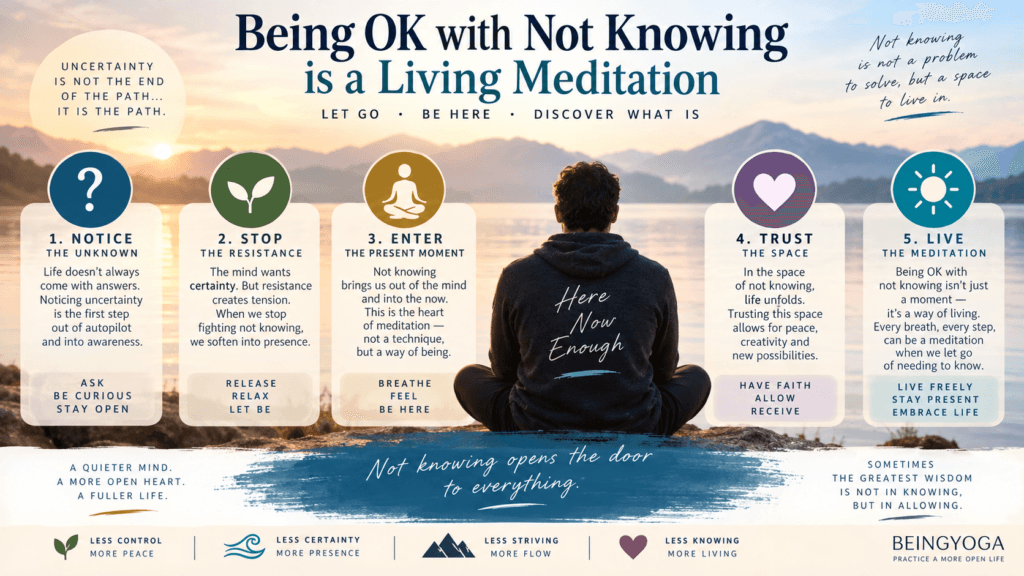
A Simple Living Meditation
The next time you encounter uncertainty, pause before searching for an immediate answer.
Take one conscious breath.
Feel your feet on the ground.
Notice any tension in the body.
Listen to the sounds around you.
Observe the mind’s desire to reach a conclusion.
Then quietly acknowledge:
“I do not know—and for this moment, that is okay.”
Do not turn these words into another belief. Let them be an invitation to remain open.
Allow the question to breathe.
Perhaps an answer will come. Perhaps action will become clear. Perhaps more information will be needed. Or perhaps the question will dissolve when it is no longer being driven by fear.
The purpose is not to remain permanently undecided. The purpose is to let action arise from attention rather than anxiety.
The Freedom of an Open Mind
A mind that believes it already knows is closed.
A mind that admits it does not know is available.
It can learn, discover, listen, and respond. It can meet life as it is rather than continually forcing life to resemble the past.
This openness is not passivity. It is a state of profound sensitivity. Because we are not defending a conclusion, we can respond more intelligently to what the moment requires.
Every encounter becomes an opportunity to see anew.
Every uncertainty becomes an invitation to presence.
Every unanswered question becomes a doorway into wonder.
You Are Already Whole
The compulsion to know is often connected to the belief that something is missing.
We imagine that one more answer, achievement, experience, or spiritual insight will finally complete us. We search for certainty because we hope it will deliver us to wholeness.
But wholeness is not waiting at the end of thought.
It is revealed when the search temporarily comes to rest.
In the silence of not knowing, nothing needs to be added to this moment. There is only breathing, feeling, listening, and being.
You are not a problem waiting to be solved.
You are life unfolding.
To be okay with not knowing is to trust this unfolding—not as an idea, but as a lived meditation. It is to meet each moment without demanding that it reveal the entire path ahead.
The next step may appear only when you are present enough to see it.
And sometimes the deepest answer is not a conclusion at all.
It is the silence in which you remember:
You are here.
You are aware.
You are already whole.
Carry this inquiry into everyday life with the BREATHE web app: seven contemplative parts, natural breath awareness, and a space for your own reflections.
Read the teaching: edited transcript
Teaching content: James Traverse. Video narration: AI. This abridged transcript follows the video’s seven sections. Filler and repetition have been removed, and wording has been edited for clarity. It is a reading version of the teaching, not a recording of James speaking.
0:00 — Meditation beyond the cushion
Meditation is often imagined as an activity separate from ordinary life: sitting quietly, following the breath and leaving the noise behind. But what happens when you stand up? You return to decisions, relationships, responsibilities and unanswered questions. Living meditation explores whether attention can continue into those moments. One invitation is to be okay with not knowing every answer.
0:54 — The demand for certainty
The mind seeks security in knowing what will happen, what things mean and which choice is right. Conclusions can feel like firm ground. Yet life keeps changing. When we insist on an immediate conclusion, we may replace present experience with a fixed idea. We stop listening because we have already decided what another person means; we stop looking because we believe we understand the whole picture.
1:56 — Practical knowledge and psychological certainty
Being okay with not knowing does not mean refusing to learn, avoiding responsibility or becoming indecisive. Practical knowledge helps us communicate, work, cook, build and care for one another. Psychological certainty is different: it demands that the unknown fit our existing beliefs. Honestly acknowledging that you do not know can open a willingness to look, listen and meet what is happening. It is an active inquiry rather than passive surrender.
3:29 — The space before answering
When a question appears, the mind often reaches into memory for an answer. That is useful for recalling facts. Questions about identity, love and freedom can also invite direct exploration. Pause before supplying a familiar definition. Notice the interval between the question and the urge to answer. Living meditation means meeting ordinary experience with room to observe the assumptions through which you interpret it.
4:46 — Meeting uncertainty with presence
Uncertainty can feel frightening. Planning remains useful, but no plan removes every unknown. The invitation is to explore whether you can attend to this moment without demanding complete certainty first. Notice the natural breath, bodily sensations and sounds around you. This is a contemplative practice, not a promise to eliminate anxiety or a substitute for appropriate care.
5:50 — A simple living meditation
Pause for one ordinary breath. Feel the contact of your feet with the ground. Notice tension without forcing it to disappear. Listen to a sound. Observe the desire to reach a conclusion. You can gently acknowledge that you do not know and that, for this moment, a question can remain open. Then take the practical next step the situation requires. An open mind can still learn, choose and act.
7:22 — Wholeness and self-inquiry
In this non-dual teaching, wholeness is not a reward added by another achievement or a perfect definition of yourself. Notice the assumption that one more answer will finally make you complete. Can you meet a moment without demanding that it reveal the entire path ahead? Let that question support careful attention to how you live.
Try it in a conversation: before deciding what someone means, feel your feet, hear the end of their sentence and ask a question if needed. Continue with the Yoga of Listening or Self-Inquiry Meditation.
Leave a Reply