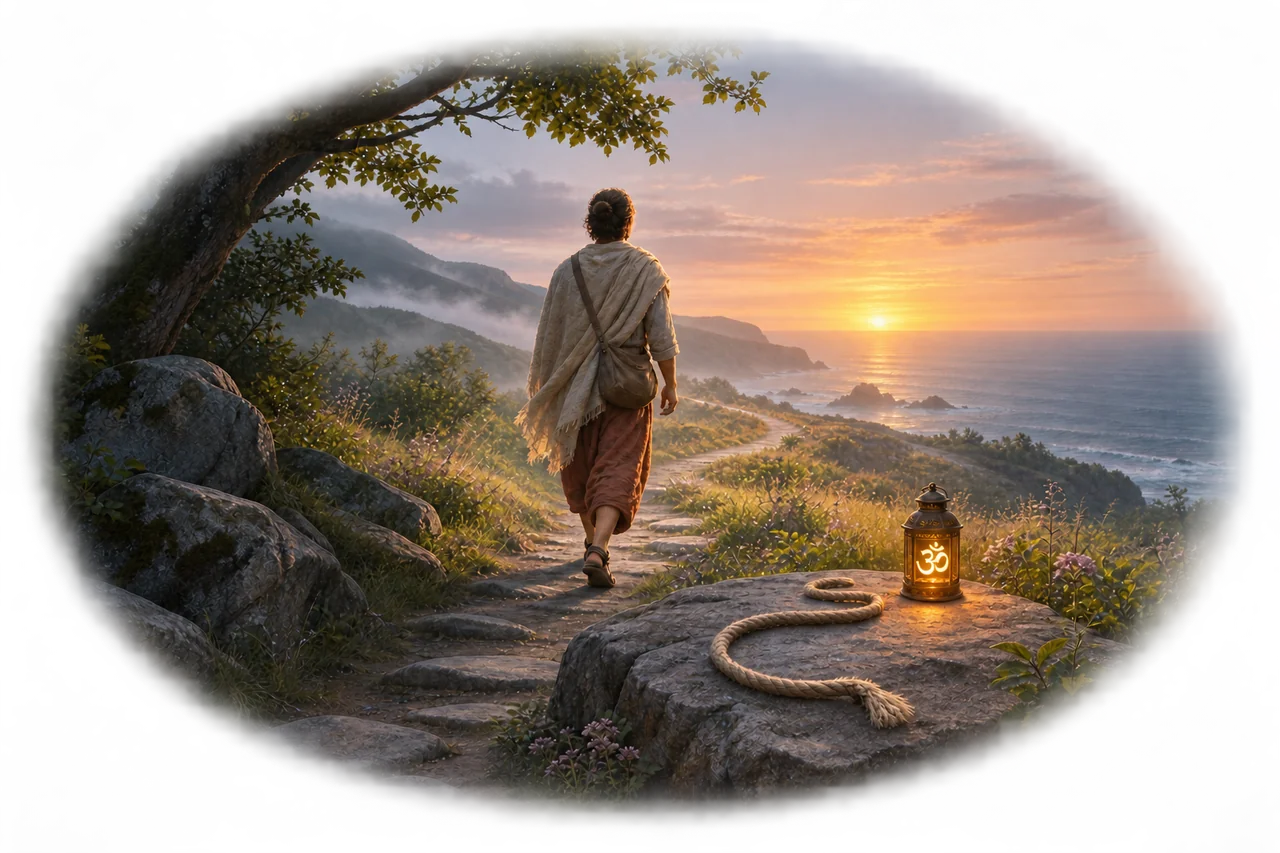
The spiritual journey begins with a question about what we are. In Being Yoga’s Advaita Vedānta approach, the seven stages trace how ignorance gives rise to a mistaken identity, how that error becomes suffering, and what changes when it is seen clearly. Insight is the turning point.
The order shows how one thing leads to another. In lived inquiry, we may return to the same question many times. The stages give us a way to understand that movement.
The Solution is Always in the Situation. I learned this from Jean Klein. Before we ask how to end suffering, we can look closely at the situation in which it arises. What have I taken myself to be, and how does that understanding shape what I feel and do? The seven stages begin there.
The seven stages at a glance
- Ignorance of the true nature of being
- The error that arises due to such ignorance
- Suffering due to that error
- Indirect, or second-hand knowledge, as in learning from a book
- Direct Knowledge as Insight and Understanding via Direct Experience — Knowing via Being
- The ending of the error that arose due to ignorance
- The ending of suffering and attainment of Lasting Peace and Happiness
1. Ignorance of the true nature of being
Ignorance is the condition of living without a clear understanding of what you are. Long before you ask the question, you learn to respond to your name and to recognize your face and family. Later you learn to describe yourself through work, temperament, memories and relationships. All of this helps you find your way in the world. The question of what you are is still open, even when the descriptions come readily.
In the Advaita Vedānta inquiry used here, ignorance has a specific meaning. We know a great deal about the person and overlook the nature of being through which the person and that knowledge are known. This can go unnoticed for years. Someone asks who you are and the answers come so easily that there seems to be nothing further to ask.
2. The error that arises due to such ignorance
Where understanding is missing, an assumption supplies an answer. The body changes, a mood passes, a role comes to an end, and the mind attributes these changes to what you essentially are. “I feel inadequate” becomes “I am inadequate.” That move from a felt condition to a definition of being is what we mean here by superimposition.
Imagine a curved rope on a path in dim light. You make out a shape and see a snake. The rope is present throughout, but your next thought and action are shaped by what you have taken it to be. In the same way, the mentally generated identity is experienced as entirely convincing. You organize your life around it because you believe it is you.
3. Suffering due to that error
Once you believe you are essentially separate or insufficient, ordinary situations carry a further burden. A mistake at work calls for a correction. It can also become evidence that you are a failure. You may keep replaying the moment long after the practical matter has been addressed. That added suffering is sustained through mental activity and can be felt as tension in the body.
It helps to distinguish pain and loss from the suffering added by a conclusion about who you are. There is room to grieve, seek help and take care of what hurts. Suffering can also become an invitation to look more closely. What hurts here? What am I being asked to meet? What have I concluded about myself? Those questions begin to show the connection between the suffering and the error.
4. Indirect, or second-hand knowledge, as in learning from a book
A book, a teacher or a conversation can bring an explanation you could not have arrived at from your usual assumptions. You hear that the apparent snake may be a rope, or that the feeling of incompleteness may be part of experience without defining who you are. The explanation gives you something specific to investigate. At this stage you understand it on the strength of what you have heard, read or reasoned through.
This knowledge has real value. Listening helps you hear the teaching accurately. Reflection gives you room to examine a doubt, and contemplation keeps the inquiry close to experience. The difference becomes clear when you can explain the teaching and still feel the old verdict come back the next time someone criticizes you. You have learned something that can guide the inquiry further. Explore Listening, Reflection and Contemplation in Advaita Vedānta.
5. Direct Knowledge as Insight and Understanding via Direct Experience — Knowing via Being
Insight is the turning point. In the story of the tenth man, a group crosses a river. The person counting sees nine companions and assumes one is missing. A passerby can tell him how the count went wrong. Insight comes when he includes himself in the count. The one he was searching for was already present as the one doing the searching.
I speak of this as the difference between seeing with the mind and seeing through the mind. In the first, the descriptions and assumptions we bring to the situation are the mental activity that veils it. In the second, the veil lifts and we see the situation clearly, as it is. The explanation reaches the tenth man as an idea. When he sees that he himself is the one he has been looking for, the knowledge is direct.
This is what I call Knowing via Being. In direct understanding, you recognize for yourself the wholeness the teaching speaks of. The words may have prepared the way, and the recognition may be accompanied by surprise or quiet. What matters is what has become clear about the one who was looking. Read From Intellectual Understanding to Insight.
6. The ending of the error that arose due to ignorance
Stage Five describes the recognition. Stage Six shows what follows. It is the nature of an error to cease once it is seen. Once you see the rope clearly, the question of how to remove the snake loses its foundation. The rope is the same rope, and you may still feel the body settling after the fright. You now understand what the fear was responding to.
In life, habits formed around the old identity may still arise. A criticism may bring a tight jaw or the urge to defend yourself. The reaction can be felt and considered without renewing the conclusion that your worth is at stake. You can listen, correct a mistake or set a boundary according to the situation. This is the practical meaning of identification losing its hold.
7. The ending of suffering and attainment of Lasting Peace and Happiness
When the error no longer determines who you take yourself to be, the suffering it sustained loses its ground. Lasting Peace and Happiness name the freedom of living from that understanding. They concern the ease of being already whole, even when an experience is painful or a situation needs attention. Grief, physical pain and the need for care have their place in life.
Ordinary activity continues. You do the laundry, meet a friend or face a difficult decision. The energy that once went into defending an identity is available for listening and for the action the moment calls for. This is Being Understanding, or wisdom lived. Explore how Insight finds expression in daily life.
How the stages connect to BREATHE
The seven stages can be read on their own. The BREATHE Framework gives the same movement a set of companion names, in order: Being Misidentified, Reality Misread, Error Experienced, Assimilating Knowledge, Truth Recognized, Halting Identification and Enduring Freedom. The guided Journey also includes a return, where understanding finds expression in ordinary life.
Follow the Spiritual Awakening Journey for the stories, readings and practical invitations associated with each stage.
A note on the teaching tradition
The sequence on this page is Being Yoga’s formulation. Chapter 7 of the Advaita text Pañcadaśī uses a related sevenfold account, with distinct places for obscuration and projection, and uses the story of the tenth man to illuminate the difference between indirect and direct knowledge. Read the related passage in Pañcadaśī, chapter 7.
Go Urgently Gently
I wrote Go Urgently Gently to tell this same journey in verse. Its first seven stanzas follow the seven stages. The eighth is the Return, Home in the Silence and Home in the Heart. Listen for the change in the final refrain, when “live in the light” becomes “Be the Light.”
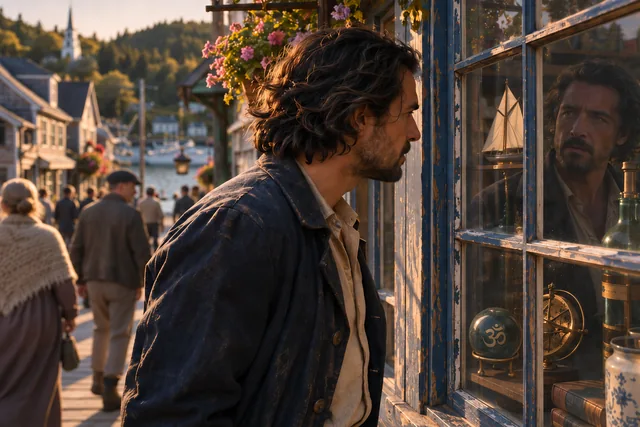
I’m flawed from birth, was given a name
Sought fortune and followers—took life as a game
Joy, joy, live in the light

Old words take root in the body I wear;
A shadow grows teeth in the rope lying there.
Joy, joy, live in the light.
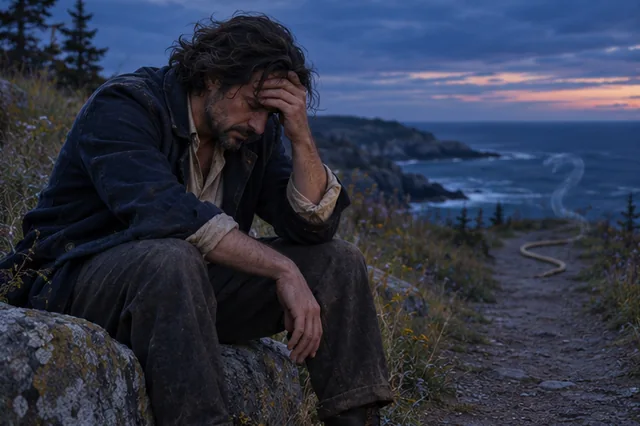
I labour for wholeness; I bargain for ease.
What hunger is this that no comfort can please?
Joy, joy, live in the light.
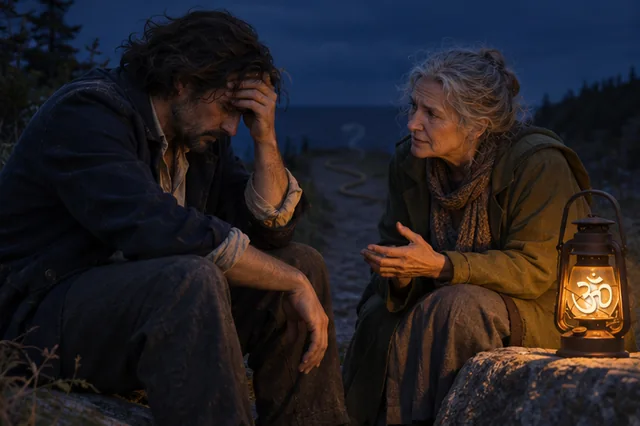
Listen and question; let words open doors.
Is Wisdom the learning that memory adores?
Joy, joy, live in the light.

The rope in the lamplight was rope all along;
No one was missing; the count was all wrong.
Joy, joy, live in the light.

No image to shelter, no worth to defend;
Hands meet the work – the work’s its own end.
Joy, joy, live in the light.

In Trust and in Love, we walk, sing and play;
Enough in our being to welcome the day.
Joy, joy, live in the light.

Home in the Silence, Home in the Heart;
The Sound of Om Embodying the Art.
Joy, joy, live in the light.
Joy, joy, Be the Light.