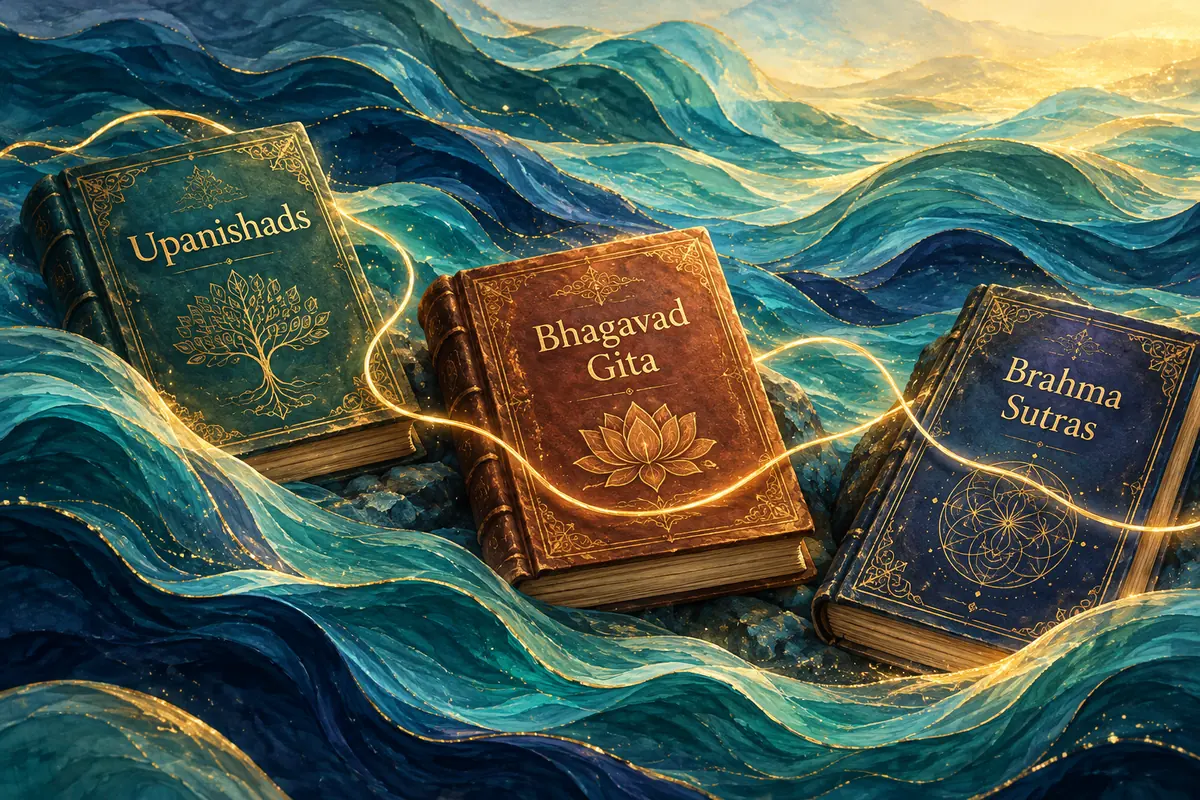
The Brahma Sutras examine the meaning of the Upanishadic teaching: What is Brahman? What is the Self? How can the many appearances of life be understood without losing sight of their Source? Their value lies in careful inquiry. A great statement may be heard in a moment, yet its meaning can remain obscured by assumptions about who we are and what the world is. The sutras invite us to examine those assumptions.
James Traverse’s teaching draws on many sources. Three of the most prominent are the Upanishads, the Bhagavad Gita and the Brahma Sutras, approached through Advaita Vedanta. This page offers a plain-English introduction to the third of these and connects it with spiritual awakening as recognition of your true nature.
Reading this page: The historical outline and numbered sutras introduce the traditional text. The examples and connections with Being Yoga are contemporary teaching reflections, not a word-for-word commentary. This is an Advaita reading; other Vedanta traditions interpret the text differently.
Three Sources, One Inquiry: The Prasthana Traya
The Upanishads, Bhagavad Gita and Brahma Sutras are known together as the Prasthana Traya, the three foundations of Vedanta. Traditionally, the Upanishads are the scriptural foundation, the Gita the foundation expressed through remembered tradition, and the Brahma Sutras the foundation of systematic reasoning. The Divine Life Society’s introduction to Vedanta explains this relationship.
For the reader of Being Yoga, a useful way to approach their relationship is this: the Upanishads point, the Gita brings the inquiry into life, and the Brahma Sutras examine the understanding. This is a teaching summary, not a division that confines each text to only one function.
The four Mahavakyas gather the Upanishadic recognition into great statements such as “You are That” and “I am Brahman.” The Bhagavad Gita presents Upanishadic wisdom in story form, through Arjuna’s question of how to act. The Brahma Sutras ask how the teaching is to be understood consistently. They complete an important relationship among recognition, inquiry and living.
What Are the Brahma Sutras?
The Brahma Sutras, also called the Vedanta Sutras, are traditionally attributed to Badarayana, associated in the tradition with Vyasa. A sutra is a thread: here, a very brief statement that holds an argument together. The work has four chapters, each divided into four sections. Many editions use a count of 555 sutras, although numbering and grouping vary among commentaries. Sivananda’s edition provides one such arrangement.
Their brevity is deliberate. A few words may refer to a passage of an Upanishad, an objection, or an answer developed across several sutras. Read alone, they can seem incomplete. A commentary restores that setting. Shankara’s commentary is central to the Advaita reading; Ramanuja and Madhva developed influential readings in other Vedanta traditions.
The Brahma Sutras are concerned with Brahman, ultimate reality. The title should not be confused with a collection of stories about Brahma, the creator deity. Nor are these Patanjali’s Yoga Sutras, a different text with a different structure and purpose.
The Opening Four Sutras: Entering the Inquiry
The opening four statements provide an orientation to the whole work. The English explanations below are plain-English renderings and teaching summaries. For the Sanskrit, translations and traditional discussion, see Sivananda’s commentary on Chapter 1, Section 1.
1. Athato Brahma Jijnasa — Now, Therefore, Inquiry into Brahman
अथातो ब्रह्मजिज्ञासा — athāto brahmajijñāsā — 1.1.1
In plain English: Now, therefore, let us inquire into Brahman. Traditional Advaita discussion connects “now” with preparation and readiness for inquiry. The invitation is to understand, rather than simply repeat a name.
In Being Yoga, the practical question can be immediate: What do I mean when I say “I”? A name, a role and a remembered history describe something useful, but do they exhaust what I am? The inquiry is not a demand to invent a grander personal identity. It asks us to examine the identification already operating. Explore this through self-inquiry meditation: Who am I?
2. Janmadyasya Yatah — That from Which This Arises
जन्माद्यस्य यतः — janmādyasya yataḥ — 1.1.2
In plain English: Brahman is that from which the origin, continuance and dissolution of this world proceed. The statement points to the ground of the world, rather than another object within it.
James uses the word Source as a pointer to Brahman, by whatever name. Source and how it appears are not-two. A wave does not have an existence separate from water, even while its form and movement can be described. The analogy invites understanding; it does not make Brahman into a material substance.
Space can serve as another illustration because appearances seem to arise within it. Yet Brahman is not physical space, a surrounding container or an empty background. In this teaching, Source is prior to space and time. An image can point; it cannot contain what it points to.
3. Shastra Yonitvat — The Role of the Teaching
शास्त्रयोनित्वात् — śāstrayonitvāt — 1.1.3
This compact sutra receives closely related explanations: Brahman as the source of scripture, and scripture as the source of knowledge of Brahman. In the Advaita approach, the Upanishadic teaching has a distinctive role in revealing what ordinary object-directed investigation does not disclose.
For Being Yoga, the point is not to accumulate sentences and mistake that accumulation for understanding. A statement directs attention. Its meaning must be heard clearly, questioned where necessary and understood. “I am Brahman” does not enlarge the person into a cosmic personality; it questions the assumption that personal identity is the whole of what “I” means.
4. Tat Tu Samanvayat — That Is the Consistent Teaching
तत्तु समन्वयात् — tat tu samanvayāt — 1.1.4
In plain English: Brahman is the central meaning, because the teachings converge upon That. The question is how to understand a passage in relation to the wider teaching.
Words such as Self, awareness and Source can seem to name different realities. In James’s expression, Atman and Brahman are not-two. The names allow the recognition to be approached from different perspectives. They do not require two independent things. The Mahavakyas page explores this directly.
The Four Chapters in Plain English
The chapter outline below follows the traditional divisions, which can be seen in the complete commentary’s contents. Each chapter contains detailed arguments; these descriptions are an orientation rather than an exhaustive account.
Chapter 1: Samanvaya — Understanding the Teaching as a Whole
The first chapter examines the Upanishadic passages and their common reference to Brahman. Its concern is coherence: what is being taught when different passages use different language?
A useful reflection is to notice how quickly a familiar word settles a question. If “consciousness” immediately means a private stream of thoughts, a statement about limitless Consciousness will be heard through that assumption. Inquiry asks whether the assumed meaning fits the teaching. Before agreeing or disagreeing, understand what the statement is pointing to.
Chapter 2: Avirodha — Examining Objections and Apparent Contradictions
The second chapter considers objections, competing philosophical accounts and apparent conflicts within the scriptural teaching. It examines how claims about the world, causation and the individual are to be understood.
In contemporary inquiry, an objection can be valuable. “If appearances are mithya, do they matter?” is a real question. It should receive an explanation, not be silenced by a spiritual slogan. Distinguishing independent reality from experienced appearance helps clarify why everyday responsibility remains meaningful.
Chapter 3: Sadhana — Preparation, Meditation and Knowledge
The third chapter examines the means associated with the inquiry, including meditation, knowledge, the individual’s condition and the relationship between teachings and practices. It is more extensive than a list of exercises.
Being Yoga brings this question into the body, breath and listening. Can a habitual reaction be noticed without immediately defending it? Can a natural breath be felt without turning it into an achievement? Preparation makes attention available to inquiry. It does not manufacture Source. The BREATHE course offers seven connected themes through which James explores misunderstanding and recognition.
Chapter 4: Phala — Liberation and the Fruit of Understanding
The fourth chapter examines the result of knowledge and meditation, including matters of liberation, death and the paths discussed in scripture. An Advaita explanation must distinguish direct knowledge from teachings about gradual liberation; the whole chapter cannot be reduced to a promise of a pleasant state.
In James’s teaching, recognition concerns what you are, rather than the permanent preservation of a mood. A quiet morning may give way to a demanding afternoon. The question is whether a changing condition has again become the definition of yourself. Spiritual awakening in daily life explores this through ordinary tasks and relationships.
How the Sutras Examine a Question
Traditional commentary organizes discussions into adhikaranas, or topics. A discussion identifies the subject, brings forward a doubt or objection, considers an opposing interpretation and establishes a conclusion in relation to the larger argument.
For a modern reader, this offers a useful discipline: state the question plainly; understand the strongest objection; examine the assumption behind it; and check the conclusion against the whole teaching. This is a suggested way of reading, rather than a substitute for the traditional commentary.
Consider “You are That.” What does “you” refer to? What does “That” refer to? Does the statement claim that a body or personal biography is limitless? Or does it remove a mistaken limitation placed upon the Self? A clear question makes room for a clear explanation.
Brahman, Appearances and Mithya
In the Advaita understanding expressed here, mithya means neither independently real nor wholly unreal. An appearance is experienced, yet it does not possess a separate existence apart from Source.
A wave is experienced. Its shape can be measured, and its movement can affect a boat. Yet where is the wave apart from water? Calling it a wave does not create a second substance. Similarly, recognizing appearances as mithya does not ask us to deny experience. It questions the independence attributed to it.
This distinction matters when speaking of awakening. “Everything is unreal” can become another rigid belief. James’s emphasis is that Brahman and how it appears are not-two. Naming an appearance lets us speak about it; the name does not establish separation. The companion article Are Dreams Real? explores dreaming, waking and this understanding of appearances.
Why Knowledge Does Not Remove the Need to Act
As the Gita makes clear through Arjuna’s situation, life requires response. You exist; now you have to act. The question is: How to act?
In James’s formulation: No action can be right unless the actor is right—when the actor is right, right action unfolds naturally, it leaves nothing lacking and no residue. Here, “the actor is right” concerns freedom from mistaken identification, rather than a claim that a person’s preferences are beyond question.
Listening, discernment and attention to consequences remain part of ordinary action. The Gita’s themes of Dharma, Yajna and Yoga connect duty, sacrifice and skill in action with this inquiry. The Brahma Sutras help examine the understanding; the circumstances of life give that understanding expression.
A Short Reflection: From a Label to Direct Attention
Choose an ordinary object: a cup, a chair or a tree outside the window. Notice its name and the practical information the name supplies. Then attend to what is actually present: colour, shape, sensation and the movement of thought.
Now notice the thought “I am looking.” What does “I” mean in this moment? Is it only another description appearing in thought? Allow the question without forcing an answer or trying to produce an unusual experience.
This reflection illustrates James’s approach to inquiry. It is not a practice prescribed by a particular sutra, nor a test of realization. Return to the teaching with the question made clearer. If an answer appears immediately, examine whether it is understood or merely familiar. For a gentle beginning, see How to Meditate.
Frequently Asked Questions
Do I need Sanskrit to begin?
No. A clear translation and a careful teacher or commentary can provide an entry point. Sanskrit becomes helpful when a distinction depends upon a word’s range of meanings. Keep the plain-English question in view rather than treating unfamiliar vocabulary as understanding in itself.
Are the Brahma Sutras exclusively Advaita?
No. They are a foundational text for several Vedanta traditions. This page follows the Advaita perspective associated with Shankara and connects it with James Traverse’s teaching. It does not claim that every commentator reaches the same conclusions.
Should I begin with the sutras or the Upanishads and Gita?
For many English readers, the Mahavakyas and Gita offer an accessible beginning. Return to the Brahma Sutras when questions about meaning and consistency arise. The texts can illuminate one another; they need not be treated as a rigid reading ladder.
Do the sutras describe seven stages of awakening?
Their four-chapter structure is not James’s Seven Stages presentation. Different accounts of the awakening journey may group common experiences into four to twelve descriptions. That varying numbering should not be confused with the chapters or sutras of this text. Explore James’s own framework through BREATHE.
Can reasoning alone turn Brahman into something I know?
In the approach expressed here, inquiry clarifies understanding; it does not turn Source into an object standing apart from you. The words point, the doubts are examined, and mistaken identification can be seen. What is recognized was not absent before the inquiry.
Continue the Inquiry
Return to one question rather than collecting every conclusion at once. Read a Mahavakya, consider what its words mean, and notice the assumption it brings into view. Explore how understanding meets a conversation, a responsibility or a moment of uncertainty through the Yoga of Listening and Being Okay with Not Knowing.
The purpose of these three great sources is not merely to give us more to say about reality. Within the teaching explored here, they invite recognition of what we are—and the living expression of that understanding.
Sources and Further Study
For traditional context, consult Swami Sivananda’s Brahma Sutras and its complete online text, especially the opening four sutras. These are resources for study, not a claim that James’s original writing is an adaptation of their commentary.
James’s contemporary explanations on this page connect the traditional inquiry with his own teaching. Read James Traverse’s background and teaching influences, browse Yoga Tools and spiritual awakening resources, or enquire about learning with James.