Start Here → Teaching Library → Meditation
Yoga Nidra offers an opportunity to rest the body while exploring sensation, sound, breathing and the changing activity of the mind. In Being Yoga, this guided rest becomes a doorway to Listening-Feeling and self-inquiry: what changes is known, but what is the Awareness because of which it is known?
The connection with spiritual awakening lies here. Rest can prepare the ground for understanding, while inquiry examines the assumption that you are only the body, the thoughts or the person described by them.
What Is Yoga Nidra?
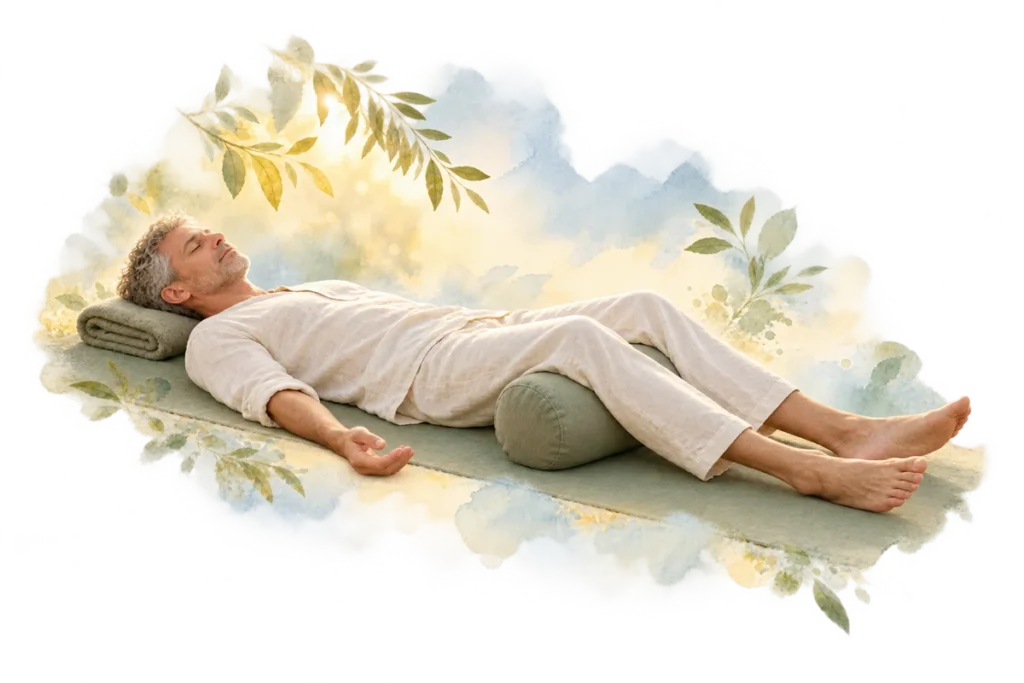
Yoga Nidra is commonly described as “yogic sleep.” In the approach offered here, you rest in a comfortable, supported position and listen to invitations that bring attention to the felt body, breathing and surrounding sounds. Imagery may also be used to invite fresh sensitivity.
The words are guides rather than instructions to manufacture an experience. Some moments may feel clear and spacious; others may include thought, restlessness or sleepiness. You can meet what is present without grading the session.
My Approach: Listening-Feeling
My teaching draws on my study with Jean Klein and the exploration of body-feeling. Instead of imposing an ideal image of relaxation, begin by listening to the body as it is. The contact of a heel, the weight of a hand and the movement of a breath can each invite attention.
Listening-Feeling includes more than physical sensation. Sounds, thoughts, feelings and silence can all be included. As attention opens, the effort to manage every experience may soften. The practice becomes less about achieving a result and more about meeting the immediacy of living.
Jean Klein pointed out that working with the energy body still involves a subtle separation. In my approach, embodied exploration prepares inquiry into that separation itself. Doing flowers as Being through understanding what has never been divided. Read more about this grounding in My Teaching.
A Simple Yoga Nidra Exploration
Choose a place where you can rest without needing to respond immediately. Lie down with suitable support, or sit comfortably if that suits you better. Adjust your position whenever needed.
- Receive the support. Feel where the body meets the mat, bed or chair. Allow its weight to be received.
- Listen to sound. Include nearby and more distant sounds without needing to follow their stories.
- Explore the felt body. Move attention gently through the feet, legs, pelvis, torso, hands, arms and face. Notice what is evident; vivid sensation is not required.
- Allow breathing. Feel its changing movement without trying to perfect it. Breathing can be encountered as an activity rather than an idea.
- Include the whole encounter. Let the body, sound and breathing be present together. A thought can appear without requiring you to complete it.
- Return unhurriedly. Notice the room, make small movements and give yourself time before standing.
You can open your eyes, change position, sit up or stop at any time. If you fall asleep, there is no need to turn this into a failure. Ordinary sleep remains important; Yoga Nidra does not need to replace it.
The Mountain Journey: The Body as Landscape
In Your Body as a Mountain, the body can take a supported legs-up-the-wall shape, with support beneath the pelvis, if you are physically able and comfortable in that position. You can also explore the imagery while resting in another comfortable position.
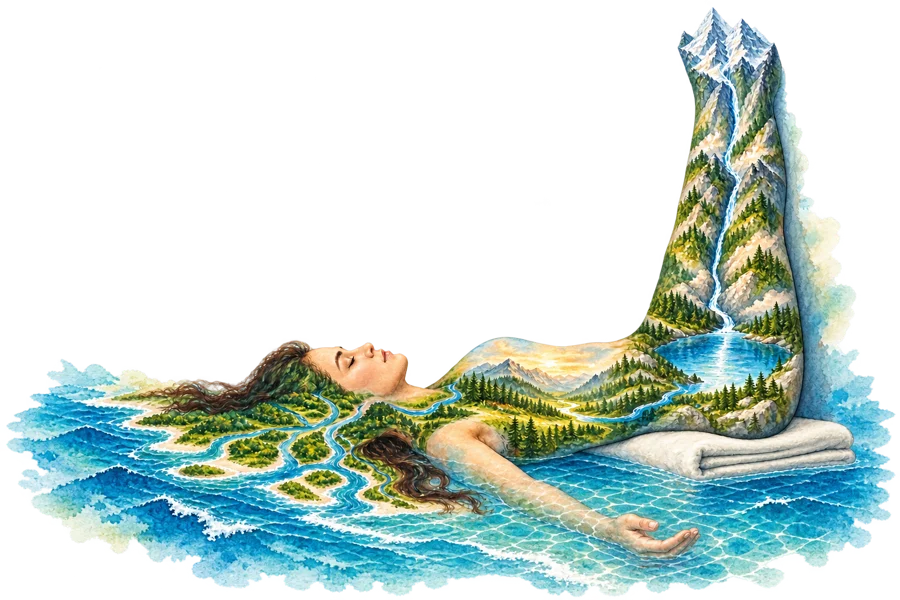
The tips of the toes are the mountain peak. The legs form the steep incline below it. The pelvic basin becomes a still, high mountain lake; the rib cage is the valley below. The head represents the rich river delta where the river meets the ocean, while the arms and hands open toward the surrounding ocean—space. The imagined journey of water connects the whole landscape.
The value is in the felt exploration. You need not produce a clear mental picture or make the body conform to the metaphor. Allow an image to invite sensation, then remain open to what is actually experienced.
The journey continues beyond the river delta. Water opens into the ocean, rises into clouds and returns to the mountains as rain and snow. In this contemplative lens, breathing is an inner tide within the larger movement of life. Feel the incoming breath, its natural turning, the outgoing breath and the opening toward another breath. Allow the rhythm to reveal itself. The body rests while Listening-Feeling remains open; the changing sensations are known in Awareness.
For the complete illustrated journey, including a photograph of me demonstrating the supported mountain posture, read The Inner Tide: Yoga Nidra—The Journey of Water (PDF).
How Does This Relate to Spiritual Awakening?
Relaxation and spiritual awakening have a relationship, yet they have different meanings. Relaxation describes a changing condition. In Advaita Vedanta, awakening concerns self-knowledge: seeing through mistaken identification and recognizing the wholeness already present.
During Yoga Nidra, a sensation arises, changes and fades. A thought comes and goes. A quiet interval may follow. Each is evident. This can invite the question: am I only one of these changing appearances, or are they known because Awareness is already present?
The inquiry is not a search for another sensation called Awareness. Atman names your true nature; Brahman names limitless Reality. The teaching points to their identity. A special state does not create that identity, and losing a pleasant state does not undo it.
This is where practice and understanding meet. Rest and Listening-Feeling can make habitual assumptions easier to notice. Insight concerns the removal of the error of misidentification. Yoga is the flowering of Being Understanding: the wholeness already present becomes evident as the error that veils it is seen and released.
Let the Practice Continue into Daily Life
After resting, notice what happens as you stand, walk or speak with someone. Can you feel your feet while listening? Can a thought such as “I must get everything right” be recognized as a thought while you respond to what is needed?
The invitation can accompany ordinary activity. Listening while washing a cup, meeting another person or pausing beside a window gives understanding room to find expression in living.
Explore Further or Learn with James
For a brief starting point, try the five-minute meditation introduction. Continue with Self-Inquiry Meditation: Who Am I? and the Spiritual Awakening guide.
Teachers and continuing students can explore Yoga Nidra: Principles and Practice. The BREATHE course offers related body-awareness, inquiry and listening lessons. To ask about current opportunities to study together, visit Learn with James.
For research and practical guidance, the National Center for Complementary and Integrative Health provides resources on yoga and meditation and mindfulness.
Leave a Reply