The Heart as a Verb: Form, Flow and Self-Inquiry
1. The Heart as Living Activity
The heart is a muscular pump. Yet the word “pump” need not reduce it to a rigid machine or a static object. Pumping is an activity: contracting, releasing, ejecting and filling.
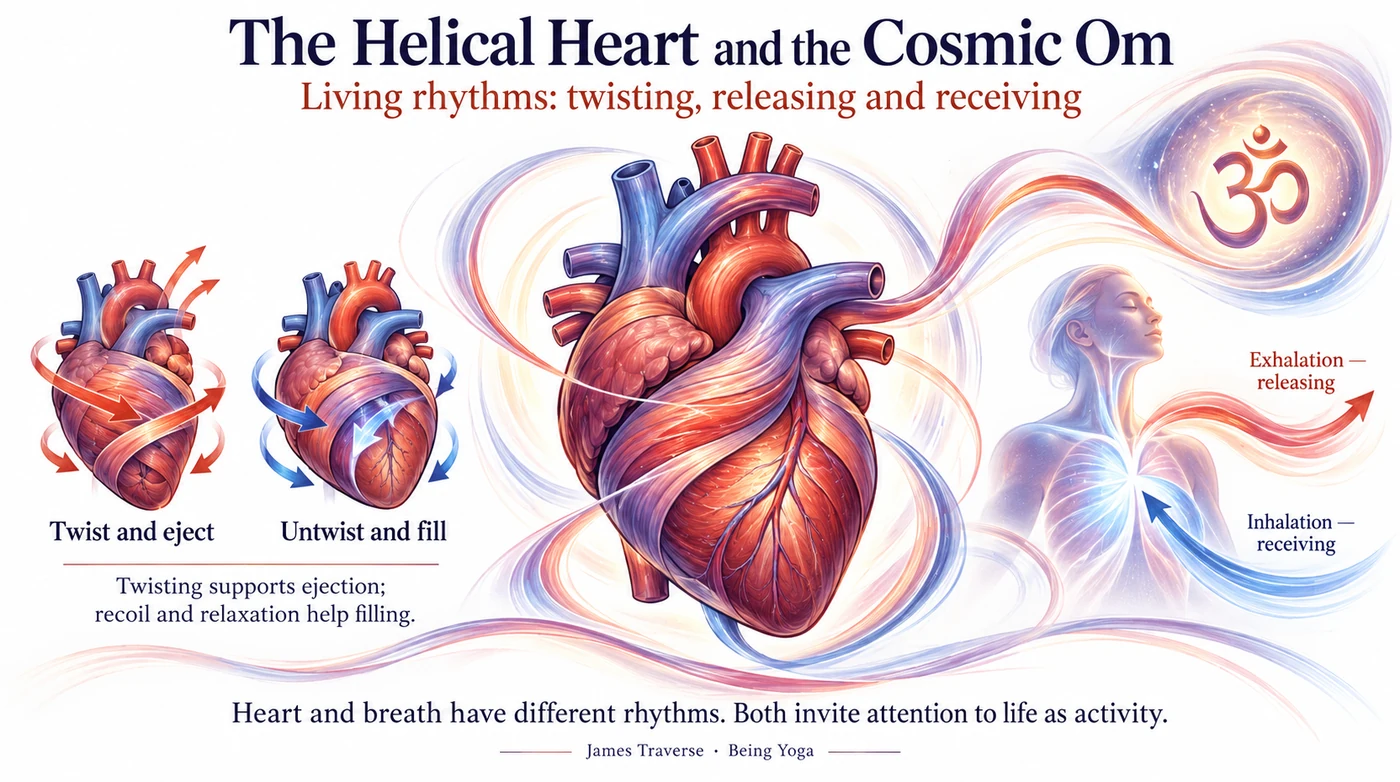
Its three-dimensional movement includes twisting during contraction and untwisting associated with relaxation and recoil. These movements belong to a coordinated living process. For the fuller explanation and research references, see The Helical Heart and the Cosmic Om.
Regarding the heart, we often treat a verb as a noun. The teaching invites us to feel the activity that the name points toward.
2. Revisiting the “60-Degree Secret”
The earlier wording of this article treated a 60-degree crossing angle as a universal key to heart function. The heart’s muscle architecture is more complex than a single fixed angle. The same care is needed with the claim that 90% of filling comes from suction: it should not be used as a universal account of cardiac filling.
“Twist-and-suck” remains a vivid way to contemplate expressing and receiving. The image does not require us to describe heart disease as a loss of spiritual efficiency. A person’s worth and connection are not measured by the shape of the heart.
3. The Myocardial Band as a Model
Torrent-Guasp’s myocardial ventricular band offers one influential model of the ventricular muscle. The question of whether this complex architecture forms a discrete, continuous band remains debated. Research on myocardial architecture explains the evidence and controversies.
A model can direct attention to something useful without containing the whole actuality. This is also a lesson for self-inquiry: notice when an explanatory picture becomes a conclusion that we stop examining.
4. Development: Form Taking Shape
The developing heart begins with an early tubular organization, then loops and develops its chambers and other structures. The developmental account describes this intricate process.
It is not a literal replay of adult worms, fish and amphibians within fifty days. The wonder is not diminished by describing development accurately: form takes shape through living activity.
5. Heart, Breath and Oṃ
I use “Om written in flesh” as a contemplative image. The heart and breathing invite attention to expressing and receiving, continuing and resolving. They have different rhythms, yet both can be encountered through Listening-Feeling.
A, U and M point to waking, dreaming and deep sleep. The correspondence I draw with bodily activity is a teaching lens, rather than an assignment of each state to a fixed phase of the cardiac cycle.
Turīya is called “the fourth” from the standpoint of the three changing statuses. It is not a separate fourth state or object, nor is it the heartbeat itself. It is the ever-present Awareness in which the changing states are known. The symbol’s curves, crescent and dot are themselves known by Awareness. Continue with The Universe is Sounded Om.
6. Prāṇa is Flow
Prāṇa is vital life-force energy. Like energy, we understand it through what it does—through its activity and expression. Prāṇa is Flow: breathing, sensing, moving, and the constant change of everyday life. The name points to this living activity; it does not contain or replace it.
Prāṇa is the breath within the breath. Prāṇa is Flow.
From the standpoint of awakened understanding, time and space are emergent properties of appearance. Time measures and describes how experience appears; space describes the apparent relations of forms. Brahman is beyond time and space.
7. The River and the Whirlpool
A whirlpool has a recognizable form, yet its substance is entirely river water. There is no separate “whirlpool water.” The distinct pattern does not divide the substance.
The body-mind can be contemplated as a changing pattern. Ātman points to the Awareness in which the pattern is known; Ātman is Brahman. The two names express teaching standpoints, not two separate realities.
Love finds expression in this ordinary life: hearing another person, responding with care and meeting what is needed. It is the nature of Love to Love.
8. Seeing and Releasing an Error
It is the nature of an error to cease once seen. This applies to an assumption about anatomy and to the deeper error of identifying what we are exclusively with a changing form.
The heart does not need a numerical secret to invite wonder. Feel the activity already present. Listening-Feeling brings the inquiry into living; Knowing via Being is understanding expressed in how we relate and act.
Leave a Reply