What appears as a thing is also an activity. Feel the difference between the word “body” and the actuality of breathing, sensing and moving. The name is useful; it does not contain the living encounter.
The heart’s spiral movement and the sound of Oṃ offer two ways into this inquiry. “The Vibrational Blueprint of Being” is a contemplative lens: a way of noticing form, rhythm and our relationship with life.
1. The Heart: A Pump with Living Movement
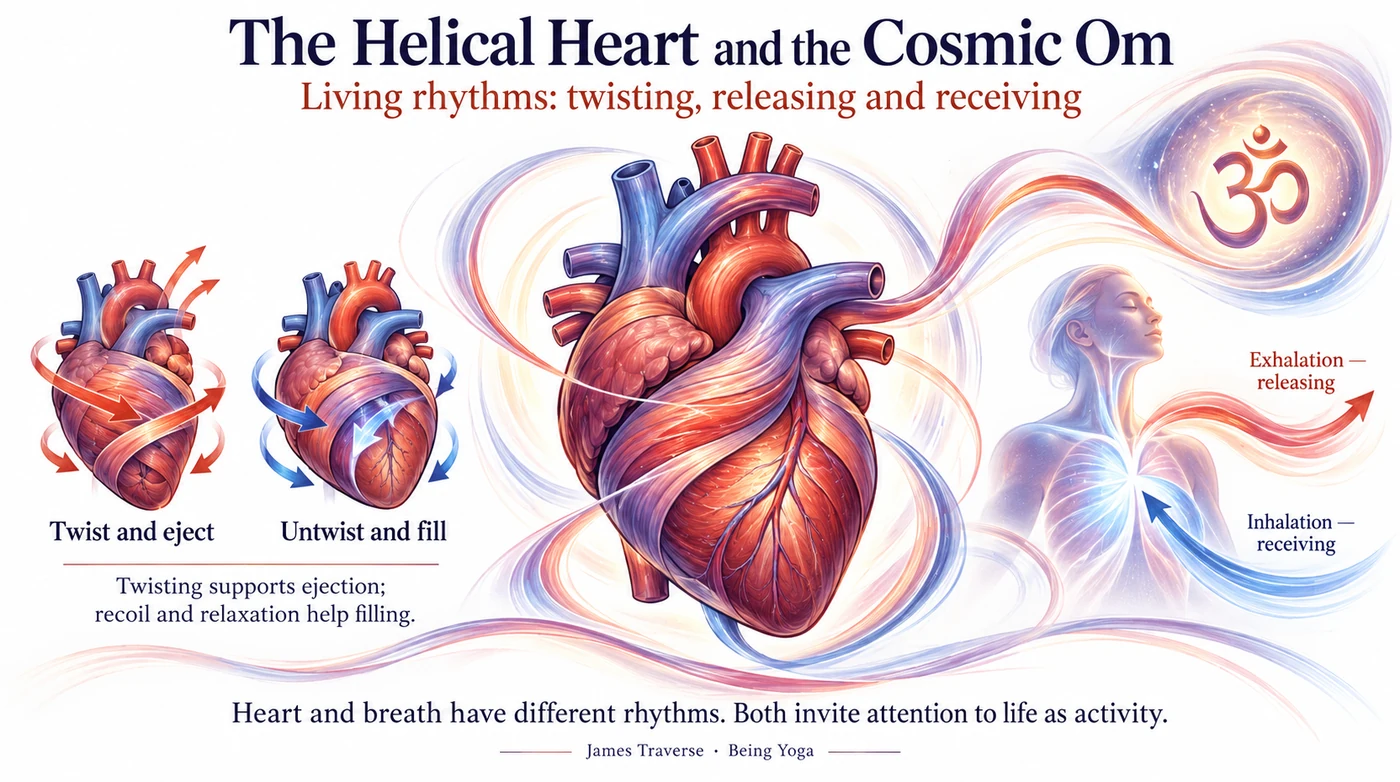
The heart is a muscular pump whose activity includes contraction, twisting, relaxation and filling. Calling it a pump need not reduce it to a static object. Regarding the heart, we often treat a verb as a noun: we name the organ and overlook its living movement.
Ventricular untwisting and elastic recoil contribute to the pressure differences involved in early filling. Research in humans relates ventricular twist to early filling. This does not establish a universal claim that suction accounts for 90 per cent of filling.
Francisco Torrent-Guasp’s helical ventricular myocardial band is one influential model. Whether the ventricular wall forms a single, discrete band remains debated; research on myocardial architecture describes the complexities. The movement can invite wonder without requiring one anatomical model to settle every question.
“Twist-and-suck” draws attention to expressing and receiving. For the fuller exploration, see The Helical Heart and the Cosmic Om.
2. Spirals, Form and Prāṇa
A shell, a hurricane, a DNA molecule and a spiral galaxy can draw our attention to recurring forms. Their resemblance invites contemplation, while their structures and the processes that produce them differ. The heart is not a miniature copy of every cosmic process.
Prāṇa is vital life-force energy. Like energy, we understand it through what it does—through its activity and expression. Prāṇa is Flow: breathing, sensing, moving, and the constant change of everyday life. The name points to this living activity; it does not contain or replace it.
Prāṇa is the breath within the breath. Prāṇa is Flow.
“Vibration” can describe a measurable physical movement, or it can serve as contemplative language for the activity we encounter. Here, the teaching turns toward Listening-Feeling: meeting living experience before a name becomes a fixed conclusion.
3. Oṃ: A Teaching Lens
A, U and M point to waking, dreaming and deep sleep. In my teaching, Silence-Space represents Source, by whatever name; the dot, crescent and curves offer a symbolic lens through which apparent manifestation can be explored.
Turīya is called “the fourth” when viewed from the standpoint of the three changing statuses. It is represented by the silence or, symbolically, the dot associated with Oṃ. But from the standpoint of Ātman or Brahman, Turīya is not a separate fourth state or object; it is the ever-present Awareness that illumines waking, dream, and deep sleep.
The curves, crescent, and dot may be used as a symbolic lens for teaching the relationship between experience and Turīya. But the symbol itself is anātman, known by Awareness. Turīya is Ātman when considered as the truth of the individual, and Brahman when considered as the limitless Reality of the totality. The difference is in the teaching standpoint, not in the Awareness itself.
For this interpretation in context, read The Universe is Sounded Om.
4. Breathing and Heartbeats: Expressing and Receiving
Exhalation can be felt as releasing; inhalation as receiving. The heart’s contraction and filling offer another rhythm of expressing and receiving. These processes have different timings. Their relationship is richer than a one-to-one assignment of Oṃ’s sounds to particular heartbeats or pauses.
Listen to a natural breath. Feel movement, warmth or contact with the ground. Allow the rhythm to reveal itself without forcing a pause or trying to make the body illustrate a theory. The heartbeat is a changing activity known by Awareness; it does not locate or produce Turīya.
From the standpoint of awakened understanding, time and space are emergent properties of appearance. Time measures and describes how experience appears; space describes the apparent relations of forms. Brahman is beyond time and space.
5. The River and the Whirlpool
A whirlpool has a recognizable form and location, yet its substance is entirely river water. There is no separate “whirlpool water.” The name points to an activity without giving it an independent substance.
Likewise, the body-mind can be contemplated as a changing pattern. Ātman points to the Awareness in which the pattern is known. Ātman is Brahman: two teaching standpoints, one Reality. The movement of appearance does not make Awareness another changing process.
The inquiry concerns the error of taking a changing form to be the whole meaning of “I.” It is the nature of an error to cease once seen. Spiritual awakening is the recognition expressed through Knowing via Being—in how we listen, relate and act.
Feel the living activity already present. The purpose is peace of mind, lasting contentment and well-being.
Leave a Reply