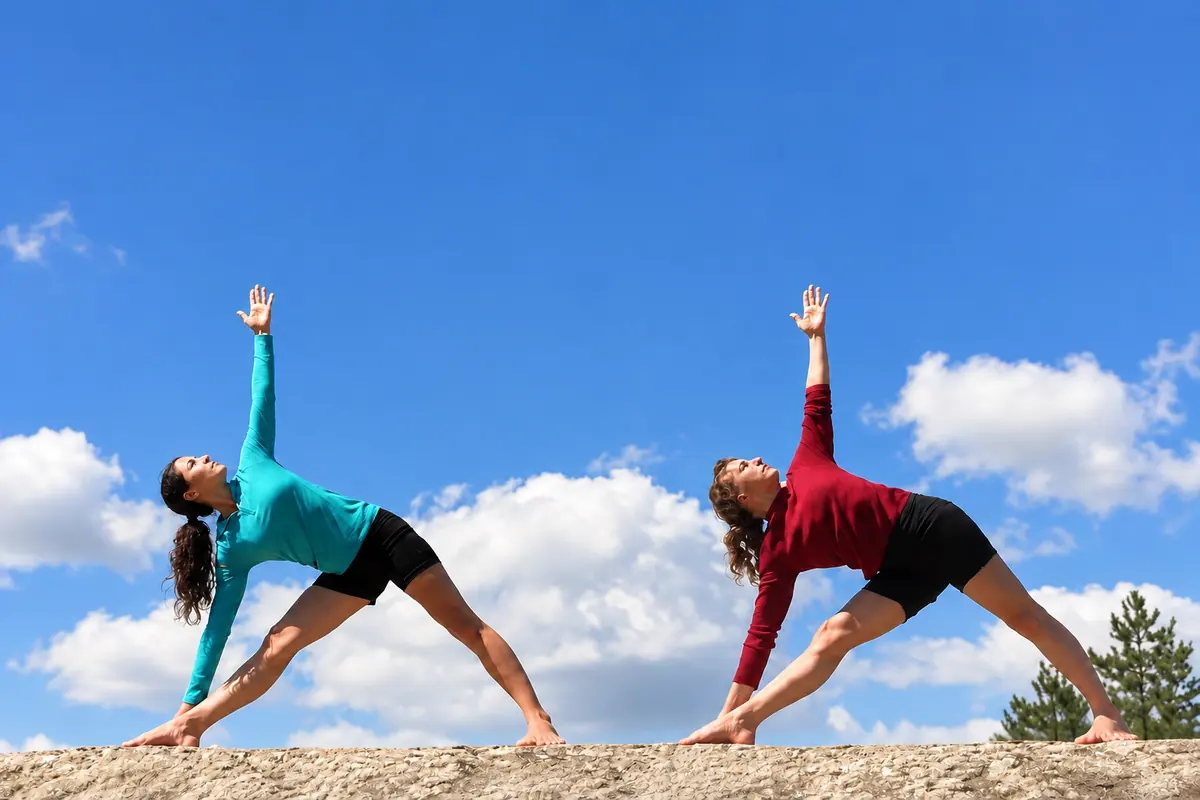
Based on a still from a Yoga video filmed at Portuguese Cove, Nova Scotia, in 2001. The practitioners stand on a rocky outcrop beside the ocean, with the camera looking upward from below. This version has been edited to provide more sky above them.
The power of Yoga is its experiential nature. A description of a pose, a verse from an ancient text, or an explanation of meditation can point the way. Yet the real challenge is to lift the words off the page: to allow intellectual understanding to flower into Knowing via Being.
Feeling Space is an invitation to this living Yoga. Begin with the felt presence of the body, the natural movement of breathing, and the space in which both appear. As Listening becomes global, the sense of being a separate form enclosed within its own boundaries can soften. Yoga is lived as being one with space.
Breath as Bridge brings this invitation into immediate experience. There is nothing remote about it. The next breath is already here.
What does Feeling Space mean?
Usually, attention settles on things: a hand, a foot, a muscle, an object, a thought. In asana, we may be occupied with the position of the body and whether the pose looks correct. Feeling Space invites attention to open beyond these separate details.
Feel the space between your hands. Feel the space beneath an extended arm, around the torso, and above the head. Rather than constructing a mental picture of emptiness, let the whole body participate in sensing the openness around it.
At first, this may be experienced through a change in body-feeling: less holding, a quieter effort, a more spacious sense of the hands or face. There is no particular sensation to manufacture. The invitation is to Listen to what is actually present.
The sky in the image offers a simple reminder. The practitioners have a shape, yet their practice need not end at the outline of that shape. The rock, the air, the open sky, the movement of breathing, and the felt body belong to one living experience.
Breath as Bridge
Breathing is familiar enough to be overlooked. Yet feel it directly and it becomes a bridge between a teaching understood and a teaching lived.
A breath moves. The ribs respond, the abdomen changes, and sensation unfolds through the body. The body receives and releases air in continuous relationship with its surroundings. Attend gently to this movement and the rigid distinction between an inside and an outside may become less compelling.
During the establishment of an asana, the exhalation may be gently lengthened as the stretch of the breath guides the form. Once the pose is established and the switchover unfolds, allow breathing to flow naturally. Feel inhalation and exhalation without managing them. If a quiet transition is naturally present, allow it to be felt without prolonging it.
Flow and space can be sensed together. The movement of breathing takes place in openness; openness is felt within the movement. In this way, Breath as Bridge is a living invitation into Listening.
For a simple beginning, see Breath Awareness Meditation: Let the Breath Be Natural. The broader Breath IS Bridge teaching explores the journey of awakening through the BREATHE framework.
From energy follows attention to attention follows energy
In the beginning of practice, energy follows attention. A teacher’s words or the form of an asana guide attention toward an archetypal shape. Yet establishing the pose is a release into that shape: the Energy Body leads the physical body into the form.
Stretching unfolds naturally, much as the body stretches while yawning. In practice, this yawn-stretch is guided through the stretch of the breath: gently lengthening the exhalation while the pose is being established. The movement arises through living body-feeling, allowing the physical form to follow. The shape opens from within rather than being imposed.
This guidance has value. It gives the practice a starting point. Once the pose has been established, the breath carries the switchover. Inhale and allow the space of the pose—the form—to fill out. As you exhale, release into the space around the form. Here the movement from energy follows attention to attention follows energy becomes experiential. After this switchover, let the breath flow naturally; the guided stretching of the exhalation has completed its work.
It is like the space within a pot merging with the space around it as the pot is broken open. The space was never truly divided; the pot gave it an apparent boundary. In asana, the body form flowers open into the space around it. This opening is gentle, like a flower unfolding.
The pose is no longer treated as a fixed arrangement to maintain by will. Attention follows the living movement of sensation, breathing, and body-feeling. There may be subtle adjustments, a release of excess effort, or an unfolding sense of spaciousness. The form becomes responsive.
This is the approach explored in Energy Body Yoga. The external shape offers a doorway into the subtler experience of the body. As attention becomes receptive, the doorway opens into Global Listening.
The Energy Body connects us with Feeling Space
The Energy Body is experienced as body-feeling: the living sensitivity of the form, rather than merely its visible outline. Breath, warmth, vibration, and the sense of aliveness offer ways of becoming acquainted with it. As that sensitivity awakens, the body can be felt as more spacious than the image we hold of it.
Here the Energy Body is a connection to Feeling Space. Instead of regarding the skin as the boundary at which experience ends, Listen to the whole felt body in relationship with its surroundings. Feel the openness around an extended hand and the space through which the breath moves. Allow body-feeling and surrounding space to be sensed together.
The Energy Body is subtler than the gross physical form and, in this experiential approach, closer to the recognition of one’s true nature. Attention can follow this subtler sensitivity from effortful positioning into receptive presence. Feeling Space then becomes a lived relationship, flowering into being one with space.
The physical body participates throughout. The invitation is to let the living sensitivity of the Energy Body guide the form, so that an asana opens from within rather than being imposed from an external picture.
Feeling Space in Trikonasana
Trikonasana, the triangle pose shown above, makes the relationship between form and space especially visible. The legs establish a base, the torso opens, and the arms extend. The spaces around the form are part of the invitation.
Use a version of the pose that is comfortable and familiar to you, with support where needed. The depth of the pose is less important than the quality of Listening. You can also explore the same inquiry while sitting or standing, with one arm gently extended.
- Feel support. Sense the contact of the feet with the ground, or the body with a chair. Allow the form to be supported.
- Establish the form through the stretch of the breath. Gently lengthen the exhalation and allow a guided yawn-stretch to unfold. Feel the Energy Body leading the physical body into the archetypal shape as you enter the pose via release. Stop, abide at the boundary between stretching and straining.
- Feel the surrounding space. Include the openness beneath the arm, between the hands, around the chest, and above the head. Let sensing widen without reaching for an imagined sensation.
- Allow the breath to carry the switchover. Once the pose is established, inhale and feel the space of the form filling out. As you exhale, release into the space around the form. Let the body-feeling flower outward, with attention following energy. Allow this through an easy breath, without forcing its depth.
- Listen globally. Allow support, breath, sensation, and surrounding space to be felt together. Then leave the pose gently and notice whether that openness continues.
Ahimsa, in my rendering, is without violating natural order. In practice, this includes respecting the body’s present capacity. Forcing the breath or the pose works against the sensitivity through which Yoga is experienced.
Listening flowers into Global Listening
Listening here engages the whole human form. It is meditation as being relaxed yet alert: receptive, present, and available to the whole field of experience.
In my teaching, Pratyahara is the switchover from energy following attention to attention following energy. Sensing Sensing is the beginning of Listening. It flowers into Global Listening as Samyama, the last three limbs of Yoga—Dharana, Dhyana, and Samadhi—come alive as total attention.
These words describe a possibility to explore. The test is experiential: can attention open from managing separate sensations into receiving the whole?
The Four Yogas are available through everyday experience as Listening, Beauty, Love, and Truth. Feeling Space brings Listening into the practice of asana; the same openness can inform action, relationship, and Self-Knowledge.
Lifting the words of a teaching off the page
A teaching can be approached in much the same way as a pose. Its words first give attention a form. Then the form of the words can open into the experience to which they point.
Consider the beginning of Patanjali’s Yoga Sutras, rendered through this experiential approach:
Now Yoga.
Yoga is the ending of identification via the whirling fluctuations of the mind.
Then true being—Consciousness—abides in its own nature.
Read the words slowly. Then set the explanation aside for a moment. Feel the body where you are. Feel the next natural breath. Allow the space around the form to enter the field of Listening.
Thoughts may continue. There is no need to fight them. Notice the difference between a thought appearing and becoming entirely occupied by its content. Let the living experience be more inclusive than the commentary about it.
In Jnana Yoga, lifting the teaching off the page is the moment of Insight: the switchover from intellectual understanding to Being Understanding. What had been understood through words is now directly Known via Being. The teaching comes alive.
“Now Yoga” can then become immediate. Intellectual understanding has prepared the way; in Insight, the meaning is lived. Just as exhalation allows the established asana to flower into surrounding space, Insight opens the form of the teaching into Being Understanding.
From feeling space to being one with space
Initially, it may seem that there is a body here and space over there. With Global Listening, that division can soften. Body-feeling, breath, sound, and openness are experienced together, without needing to be gathered into a separate observer’s account.
One with space names this experiential openness. The phrase need not be turned into a claim that the physical body has disappeared. Nor is physical space itself a definition of Brahman, which is prior to space and time. Space offers an immediate doorway; the teaching points through it.
Knowing via Being is this movement from describing the doorway to entering it. An explanation of openness cannot substitute for openness being lived. A description of Listening cannot substitute for Listening.
The invitation is simple: feel the form, feel the breath, feel space. Allow the whole to be present.
Living Yoga beyond the pose
Leave the mat and the inquiry continues. While walking, feel the space in which movement unfolds. While speaking with someone, Listen with the whole body. While reading a teaching, allow a sentence to become an invitation rather than another possession of the mind.
There is no need to carry a special state through the day. Return to the immediate: the felt body, the natural breath, the openness of this moment. This is how Yoga and spiritual awakening in daily life meet.
The pose gives attention a shape. The breath offers a bridge. Listening allows the shape to open.
The words come alive as Knowing via Being.
Leave a Reply