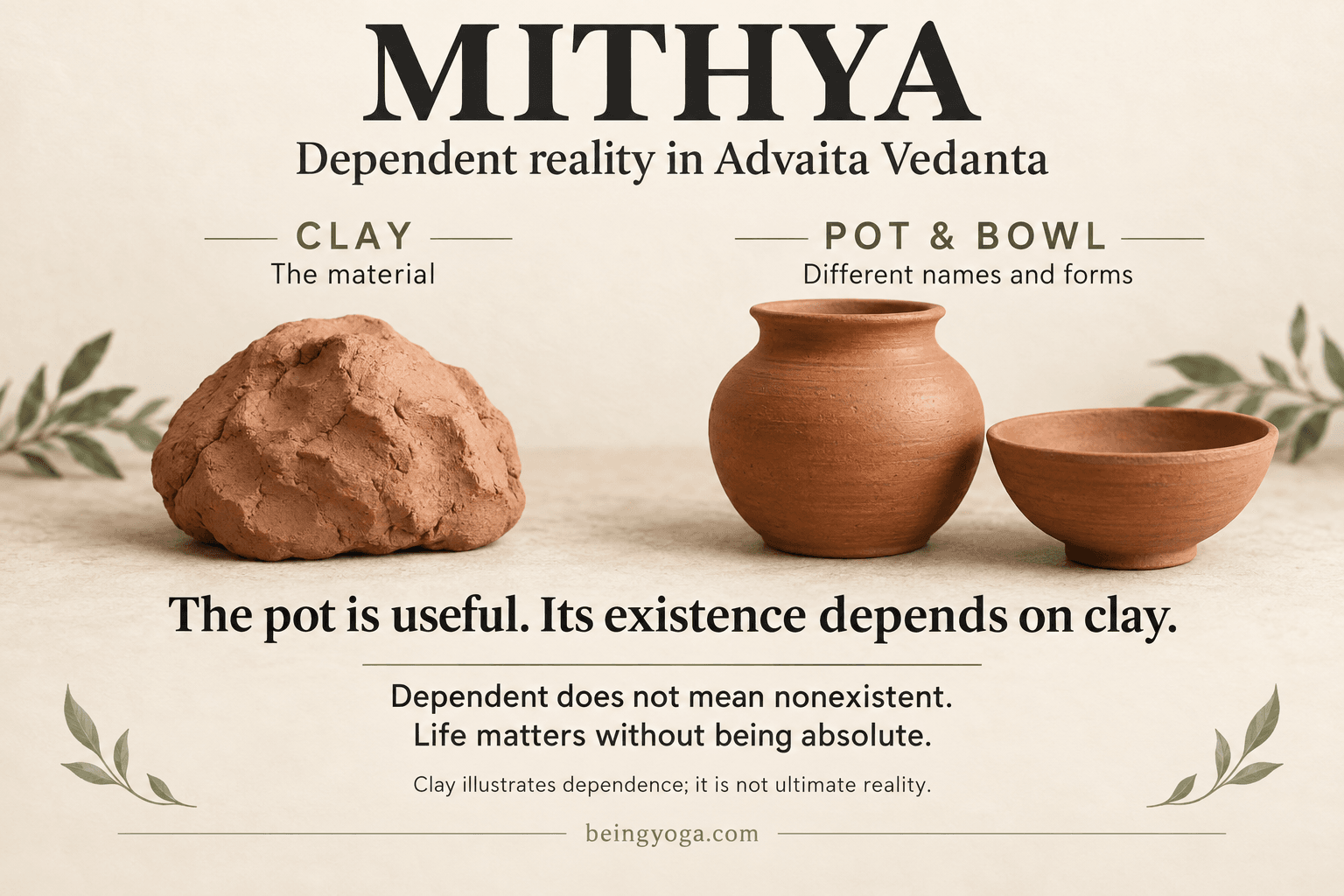
Mithya means dependent reality in Advaita Vedanta: something that is experienced and has practical significance, yet does not exist independently. It is neither absolute reality nor sheer nonexistence. Understanding this distinction helps us move beyond the question, “Is life real or fake?”
We often treat a passing emotion, a setback, or someone’s opinion as a final verdict on who we are. Mithya invites a closer look at that assumption. An experience can matter without defining our essential nature.
This is a central distinction in spiritual awakening through Advaita Vedanta. The invitation is to understand experience clearly while continuing to participate in everyday life.
1. Mithya: a reality that depends on something else
Advaita distinguishes satya, independently real being, from mithya, dependent names and forms, and asat, sheer nonexistence. Mithya is sometimes described as anirvachaniya: it cannot be adequately classified as either absolutely real or entirely nonexistent. This is a distinction about the status of an appearance, rather than a claim that there are three separate substances.
Consider a clay pot. You can fill it with water, carry it, and use it. Yet there is no pot apart from the clay shaped into that form. “Pot” names a useful configuration; clay supplies its substance. The Chandogya Upanishad 6.1.4 uses clay and its modifications to introduce this inquiry into name, form, and underlying reality.
Within this illustration, clay is the reality on which the pot depends. Clay itself is not being declared the ultimate, independent reality of the universe. Advaita carries the inquiry further: all changing names and forms depend on Brahman, the nondual reality understood as existence-consciousness.
The pot is useful, but it has no separate substance of its own. Its dependence does not make it worthless.
2. Dependent reality does not mean life is fake
A nonexistent object, such as a square circle, cannot hold water. A pot can. Calling the pot mithya preserves that practical distinction. Relationships, responsibilities, and the consequences of our actions remain meaningful within everyday life.
Traditional illustrations illuminate different aspects of appearance and knowledge:
The dream: A dream can feel convincing while it is happening. Waking changes our understanding of the dream’s status. The example asks us to examine whether the intensity of an experience establishes its ultimate reality.
The snake and the rope: In dim light, a rope may be mistaken for a snake. Fear arises, but clearer seeing corrects the mistake. Knowledge changes what we take the appearance to be.
The moving firebrand: A glowing point moved rapidly can appear as a circle of light. The circle is seen, yet there is no separate, stationary ring there.
These examples have different purposes. A useful pot is not an optical mistake in the same sense as a rope mistaken for a snake. Nor does Advaita require us to treat waking life as merely a private dream. For a closer exploration of misinterpretation, read Reality Misread in the BREATHE Framework.
3. The difficulty is taking changing experience as absolute
Pleasure and pain, gain and loss, praise and criticism occur in human life. Mithya does not mean that suffering is harmless or that a difficult situation needs no response. It questions the additional conclusion that a changing circumstance determines the whole truth of who we are.
For example, “This conversation went badly” describes an event. “I am permanently inadequate” turns an interpretation into an identity. Recognizing the difference leaves room for an apology, a practical adjustment, or a fresh conversation without making the event an absolute definition of the self.
In Advaita, self-inquiry examines identification with the changing body and mind. The teaching concerns the nature of the Self, not the suppression of ordinary feelings. Halting Identification develops this distinction within BREATHE.
4. Three questions for exploring dependence
You can begin the inquiry with three observations used in Vedantic reflection: change, impermanence, and composition. Treat these as prompts for reflection, rather than a mechanical test that proves the whole teaching.
Does it change? A thought, mood, or bodily sensation undergoes modification. Notice what is present now without assuming it must remain the same.
Does it come and go? A particular experience has a beginning and an ending. Consider whether something intermittent can provide a permanent definition of yourself.
What does it depend on? An object may depend on materials and parts; an event on circumstances; an interpretation on memory and assumptions. Look at those dependencies before treating the appearance as self-sufficient.
These questions open an investigation. In Advaita, listening to the teaching, examining doubts, and assimilating understanding give that investigation depth. See Assimilating Knowledge for the place of sustained reflection.
5. Understanding Mithya supports fuller participation in life
The point of this inquiry is freedom in living. We can care for people, meet commitments, and enjoy the world while questioning the demand that changing experiences provide lasting completeness.
Understanding a teaching intellectually does not guarantee that anxiety, grief, or habitual reactions immediately disappear. Assimilation takes attention. The language of mithya becomes unhelpful when it is used to dismiss another person’s pain or avoid our own responsibilities.
A simple reflection is to pause when an experience feels all-defining. Name the event, notice the interpretation, and ask what appropriate action is needed. Then explore whether the awareness in which the experience is known can itself be reduced to that passing experience.
Mithya and spiritual awakening
Advaita expresses its central vision in the traditional formulation Brahma satyam, jagan mithya, jivo brahmaiva naparah: Brahman is real; the world is dependent reality; the individual self is not other than Brahman. The statement calls for careful inquiry into identity and reality, rather than disbelief in the world.
Start with one ordinary example today: a cup, a thought, or a role you play. What does it depend on? What changes? What have you assumed it says about you?
For a guided reading path, begin the seven chapters of the BREATHE Framework. You can also explore the Spiritual Awakening video collection with James Traverse.



Leave a Reply