Part 6 of 7 · BREATHE Framework
Notice when spiritual understanding becomes another identity to defend. Mara explores the difference between seeing an error and demanding that every familiar reaction disappear.
Taking Down the Invisible Painting
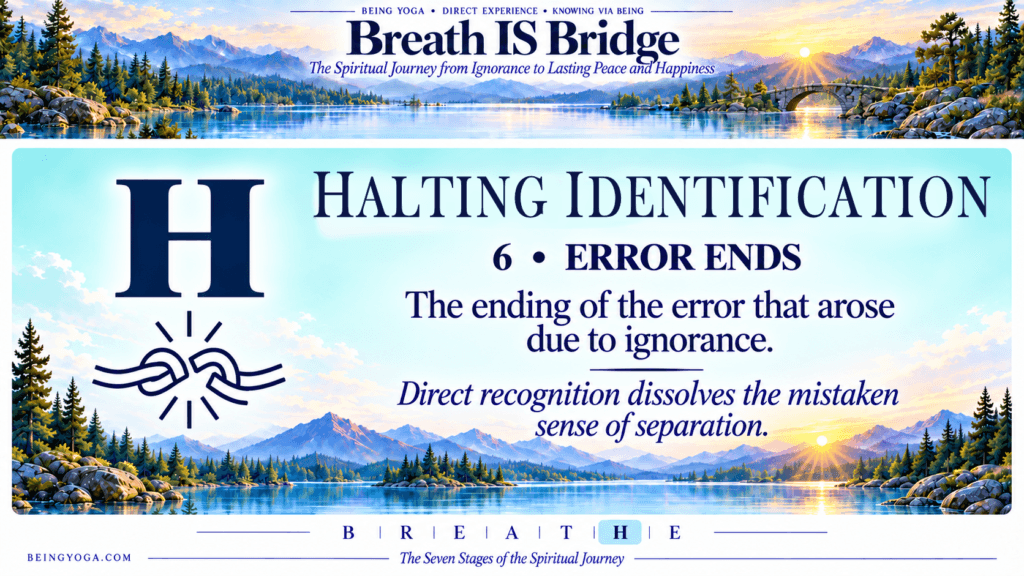
Assimilating Knowledge – Disidentification
Disidentification does not mean withdrawing from the body, mind, or relationships. It means no longer confusing the changing instruments with the Awareness in whose presence they are known.
Mara began to notice how often she checked whether she was peaceful.
During breakfast, while waiting in a queue, even halfway through a conversation, a quiet assessment appeared: “Am I still understanding? Have I lost it?”
The old project of proving her worth had found a new subject. Instead of checking whether she was useful, she was checking whether she was spiritually clear.
One day her husband said, gently, “Sometimes it feels as if you’re watching yourself listen to me.”
She wanted to explain why that was unfair. Then she recognized the truth in it.
The painting that remained after it was removed
Part 2 of Seven Stages of the Spiritual Journey recounts an example Traverse attributes to his teacher Jean Klein.
A much-loved painting is taken away for cleaning. Although the wall is empty, the person looking at it continues to fill the space mentally with the painting’s absence. The picture is gone, but the reference to what should be there remains.
Traverse develops this into an inquiry about the “absence of absence”: the ending of both the familiar identification and the subtle mental occupation with its supposed disappearance.
Mara saw the relevance. She was less attached to her former professional identity, but an invisible frame still hung in its place. The final freedom was not the achievement of a better picture. It was the recognition that Awareness had never been the picture on the wall.
When the correction becomes another conclusion
In Truth Recognized, the inquiry moved beyond collecting experiences toward examining the one who searched for them.
That discovery can itself be converted into a possession: “My insight. My clarity. My awakening.”
The words are not inherently a problem. The question is whether a new image must be defended against life.
Mara noticed that irritation seemed unacceptable because it contradicted the person she imagined she ought to be. She began concealing it beneath carefully measured replies. Her composure had become another performance.
Seeing this did not require replacing the performance with deliberate spontaneity. It required recognizing what she was protecting.
When understanding becomes an identity
Kena also questions the confidence that claims to have fully grasped Brahman. This is useful when the thought “I have understood” becomes a position to defend.
Notice what happens when someone questions your understanding. Can you hear them, acknowledge uncertainty, or correct a mistake?
Let even the image of yourself as someone who knows become available for examination. Understanding can remain useful without becoming another identity to protect.
Source: Kena Upanishad 2.1–3. The application to everyday relationships is a contemporary reflection.
What it means for an error to end
The first guide states: It is the nature of an error to cease once it is seen.
Return to the rope. Once clearly recognized, it does not need to be killed as a snake. The mistaken interpretation has lost its basis. The traveller may still notice a racing heart, but the rope no longer supports the conclusion that a snake is present.
The distinction helps us speak carefully about understanding and conditioning. A claim may be seen through while familiar reactions still deserve attention. Conversely, repeating that the error has ended is not evidence that it has been understood. The error ends when the mistaken conclusion is removed, not when every emotional reaction immediately disappears.
In the framework, this stage names the actual correction of mistaken identity. The story’s everyday moments illustrate its direction; they are not a certification of final realization.
Two steps toward not-two
Part 2 distinguishes the thought-based identity carried through personal history from the more subtle felt position of a separate centre witnessing experience.
Its inquiry addresses both. The narrative “this is the person I am” can soften while a private observer remains at the center. The later invitation is to examine that apparent separation too. The witness position is useful as an initial discrimination, but if it is treated as a separate inner entity, it becomes another form of dvaita (duality).
This matters in relationship. If the spiritual position becomes “I am safely inside awareness while your difficult emotions are outside,” the language of nonduality can preserve distance.
The text points instead toward unfragmented participation: knowing and its appearance understood without installing another entity between them.
Listening without rehearsing the listener
That evening, Mara asked her husband to tell her what he had meant.
She noticed the impulse to explain herself, let him finish, and heard that he missed their ordinary conversations. He was not asking for a spiritual account. He wanted to tell her about his day without feeling observed from a distance.
She apologized. They talked about a leaking gutter and a family visit. Nothing looked especially profound. Yet she was more available.
Being Yoga’s Being Okay with Not Knowing Is a Living Meditation offers a related invitation to meet a situation without defending a ready-made conclusion. Here, that meant allowing feedback to arrive before deciding what it threatened.
First, Mara stops taking the old identity to be herself. Then she notices the subtler identity of “the one who has stopped identifying.”
A moment of inquiry
Notice an image of yourself as a spiritual person. Ask what happens when experience does not match it. Can the image be recognized without creating a second image of someone who has successfully dropped it?
Mara no longer needed every quiet moment to prove she had arrived.
Continue to E — Enduring Freedom: The River Was Never Missing, where the inquiry returns to the ordinary life from which it began.
Source notes: Seven Stages of the Spiritual Journey, PDF pp. 21, 37–38; Part 2, PDF pp. 32–37, 47–48. The painting example is paraphrased from Traverse’s account of Jean Klein; Mara’s conversations are original.
BREATHE Framework: all seven chapters
Previous: T — Truth Recognized
Mara and Leela are fictional characters created for this series. Traditional teaching stories are retold from the sources identified above.
Put this chapter into practice: Open Part 6 in the BREATHE web app for the contemplative inquiry, breath pacer, and your private reflection space. You can export your notes and add the app to your home screen.