1. The Hook of the “Static” Trap
Most of us navigate existence under the heavy illusion of the “static.” we treat our identities, our anxieties, and our physical health as fixed objects—solid nouns that we must carry through time. We speak of “my stress” or “my personality” as if these are permanent structural pillars in a frozen landscape.
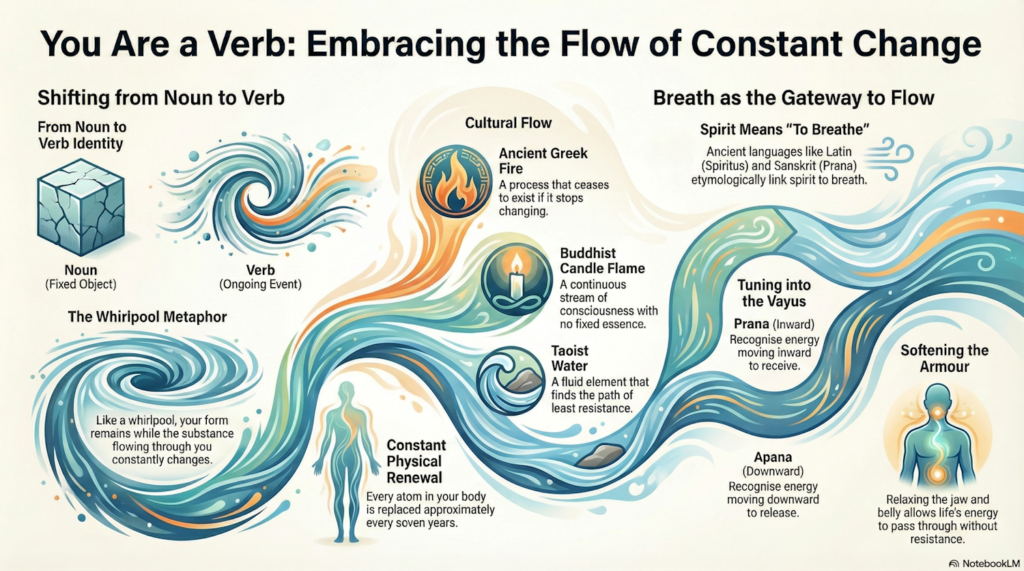
However, both ancient wisdom and modern physics reveal that this “static” view is merely a psychological construct. To exist is to fluctuate. As the philosopher Heraclitus observed through the concept of the Logos, reality is a “seamless transition”—a process rather than a collection of things. When we stop viewing ourselves as “nouns” and embrace our nature as “verbs,” we transition from a state of resistance to one of resonance.
2. You Are an Ongoing Event, Not a Finished Product
We often mistake the physical body for a solid, permanent vessel. In reality, you are an emergent property of movement, much like a whirlpool in a river. The shape of the whirlpool remains consistent, yet the material composing it is a unified, continuous flow of rushing water.
Biological science confirms this “process-based reality.” Every atom in your body is swapped out approximately every seven years; your skin refreshes in weeks, and your red blood cells in months. Beyond biology, we see a “universal self-similarity” in the math of existence. There is an unexpected agreement between the fractal geometry of the neuronal network in your brain and the cosmic web of galaxies. You are not a separate entity, but a localized expression of the universal current.
“Yesterday I was clever, so I wanted to change the world. Today I am wise, so I am changing myself.” — Rumi
3. The Hidden Etymology of Your Breath
The connection between spirit and movement is architected into our very language. Across ancient cultures, the word for “spirit” is synonymous with “breath,” representing the invisible force that animates the material.
- Spiritus (Latin): Literally “breathing,” from the root spirare.
- Pneuma (Greek): “Wind” or “air,” the vital life force in early theology.
- Ruach (Hebrew): A triple meaning of “breath,” “wind,” and “spirit.”
- Prana (Sanskrit): Derived from Pra (constant) and An (movement).
This is not merely poetic; it is physiological. The “asymmetric geometry” of the human lung is specifically designed to influence pulsatile flow fields, creating secondary vortex structures during respiration. Breathing is the “software” of life—the bridge between the conscious and unconscious—that steers the “Energy of Constant Change” through your system.
4. The “Micro-Reset” Strategy for Daily Chaos
In the friction of daily life, we often become “static”—we freeze, clench, and “armor” ourselves against stress. To maintain flow, we must engage the Five Vayus (winds) of Prana. You can utilize a “Micro-Reset” to prevent stress from creating “dams” in your internal river.
- The 10-Second Transition: Every time you switch tasks, take one conscious breath. Visualize the previous moment dissolving so you don’t carry the “static” of the last hour into the next.
- Softening the Lock Points: Periodically scan your jaw, shoulders, and belly. These are the primary sites where we block the flow.
- Tuning the Vayus: As you inhale, focus on Prana Vayu (inward/upward), sensing coolness and expansion. As you exhale, focus on Apana Vayu (downward/out), feeling warmth, heaviness, and the release of what is no longer needed.
5. Language Shapes Your Reality (The “Experiencing” Shift)
The way we label internal states can trigger “superimposition”—mistaking a temporary appearance for our fundamental nature. In the yogic tradition, the Chakras are not static disks but vortices or whirlpools in the river of Prana. Stress is simply a “turbulent” state of the nervous system where energy is stuck in a loop of fear.
To return to a state of flow, shift your language from “I am” to “I am experiencing.” Instead of saying “I am stressed,” try: “I am experiencing a wave of stress.” The logic of the “wave” implies a peak and an inevitable dissipation. This linguistic shift reminds you that you are the ocean—the vast, deep witness—rather than the temporary disturbance on the surface.
“The lord of the senses is the mind, the lord of the mind is the breath.” — Hatha Yoga Pradipika
6. The “Neti Neti” Method for Ultimate Clarity
To find stability in a world of constant change, the Advaita Vedanta tradition suggests Neti Neti (“Not this, not this”). This is a systematic peeling of the “ego-onion” to reveal the Eternal Witness beneath the “superimposition” of identity. You are invited to negate each layer:
- The Body: It changes and decays; you are its constant owner.
- Sensations: Heat and cold come and go in your awareness.
- Emotions: These are weather patterns; you are the sky.
- Thoughts: They arise and dissolve like clouds.
- The Mind: It is a collection of memories, an object you perceive.
- The Ego: Even the sense of “me-ness” is an appearance within consciousness.
What remains is Pure Awareness—the “no-thing” that knows all things. This awareness is unseizable, indestructible, and unlimited.
7. Becoming the “Silent Center”
True stillness is not the absence of movement; it is the perfect balance of it. Think of the eye of a hurricane—it is still only because the energy around it moves with such incredible velocity. By embracing your nature as a “verb,” you create a Toroidal Field around yourself—a self-sustaining “donut” of energy that recycles the chaos of the world into your internal flow.
When you stop trying to “own” your life and start observing yourself being “breathed” by the universe, the “dams” in your river dissolve. You become the “Silent Center” of the storm.
If you stopped trying to own your life and started observing yourself being “breathed” by the universe, what would change today?
Leave a Reply