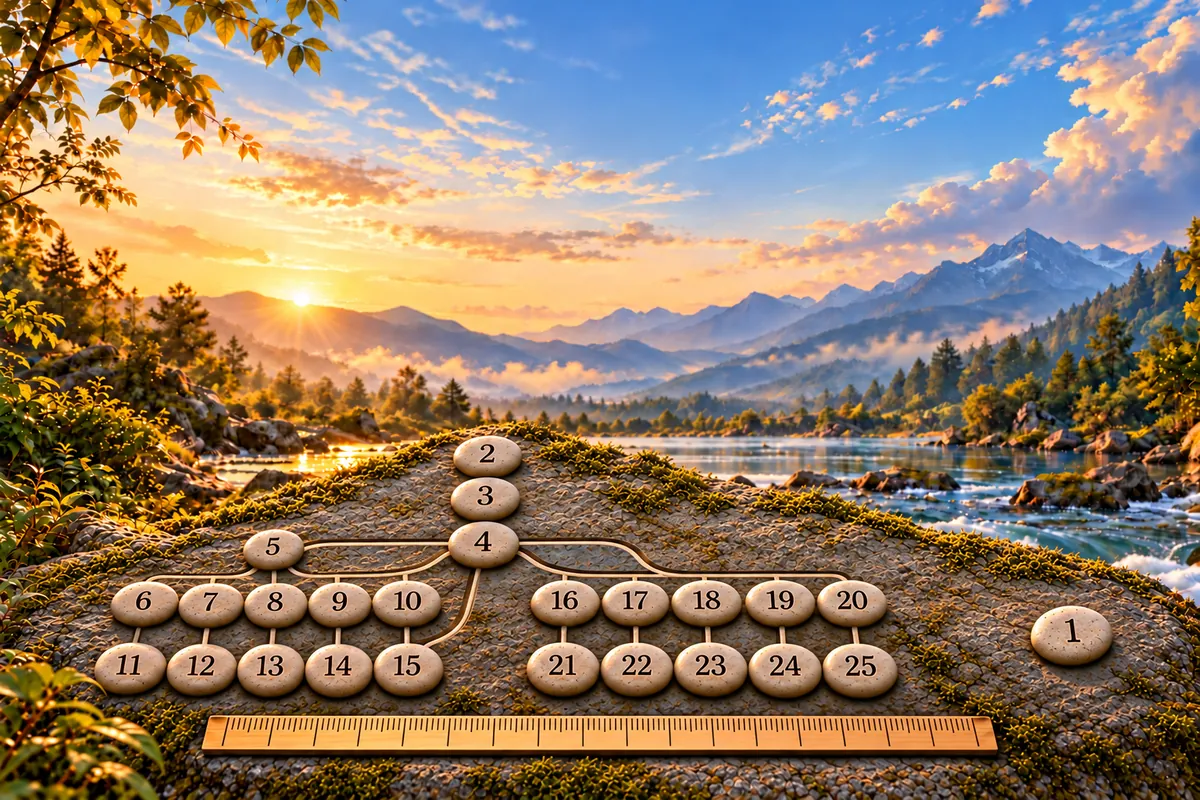
The Twenty-Five Tattvas — AI-generated illustration.
Image key: 1: Purusha; 2: Prakriti; 3: intellect (buddhi/mahat); 4: ego-sense (ahamkara); 5: mind (manas); 6–10: five sensory faculties; 11–15: five action faculties; 16–20: five subtle elements (tanmatras); 21–25: five gross elements (mahabhutas). The numbering identifies the groups in this illustration. Purusha stands apart from Prakriti and its developments. The arrangement is stylized: the sensory and action faculties both arise from ego-sense, rather than from each other.
Sankhya is a classical Indian philosophy that distinguishes consciousness, purusha, from nature, prakriti. It provides an important framework for understanding classical Yoga. Studying it also helps us see why related spiritual traditions can share vocabulary while reaching different conclusions.
Being Yoga focuses on spiritual awakening in the Vedantic tradition, particularly Advaita Vedanta, expressed through my teaching of Knowing via Being. Sankhya is considered here as a distinct philosophy in conversation with that focus. We can learn from its questions without assuming that its account of reality is the same as Advaita’s.
What is Sankhya?
The name is also written Samkhya or Sāṃkhya. It is associated with enumeration: making an ordered account of the principles of experience. A central classical text is Ishvarakrishna’s Samkhya Karika. The Centre for Yoga Studies provides its Sanskrit text and study references.
The starting concern is suffering and the search for freedom from it. The inquiry is not merely a catalogue of cosmic ingredients. It asks what is changing, what knows that change, and how misidentification contributes to bondage.
Purusha and prakriti
Purusha names consciousness: the witnessing principle, rather than a changing mental activity. Classical Sankhya recognizes a plurality of purushas. Prakriti names nature, including both the material world and the instruments of experience—mind, intellect and senses. Nature is not limited to what we ordinarily call the outdoors.
Classical Sankhya treats purusha and prakriti as distinct, independent realities. Freedom involves discerning consciousness from nature’s activity. The Internet Encyclopedia of Philosophy’s introduction explains these central distinctions and their historical setting.
Notice the thought “I must solve this immediately.” The thought has a pace, a tone and an accompanying bodily feeling. It can be known. This is a useful doorway into the question of identification, although noticing one thought is not the same as completing Sankhya’s philosophical argument.
The three gunas
Sankhya describes prakriti through three interacting gunas: sattva, associated with clarity and illumination; rajas, with activity and movement; and tamas, with heaviness and obscuration. The Karika develops their qualities in verses 12–13. They are constituents of nature, not three separate kinds of person.
As a contemporary reflection, consider preparing for a conversation. There may be clear attention, restless rehearsal or a heavy reluctance to engage. These descriptions can invite observation. They should not become labels by which to rank yourself or someone else.
In Being Yoga, the practical question is simple: can the present quality receive attention? If there is restlessness, feel its movement. If there is heaviness, acknowledge it. Clear seeing need not begin by condemning what is present. These are my teaching reflections, rather than instructions quoted from the Karika.
The twenty-five principles: an orientation
Sankhya’s familiar enumeration counts purusha alongside twenty-four principles of nature. The map includes primordial prakriti; intellect, ego-function and mind; five capacities of perception and five of action; five subtle sensory potentials; and five gross elements. The Karika’s verses 3 and 22–38 develop this account.
The count helps show the scope of the inquiry. Thinking, deciding, sensing and acting all belong to nature’s organization. Consciousness is distinguished from those functions. These traditional principles should not be presented as a modern anatomical chart or equated casually with particular organs.
The five gross elements are traditionally named space or ether, air, fire, water and earth. Here they belong to a philosophical account of manifestation; they are not the elements of the chemical periodic table. A metaphor can be valuable while remaining different from a scientific classification.
Sankhya and classical Yoga
Classical Yoga associated with Patanjali shares much of Sankhya’s philosophical vocabulary and its discrimination between consciousness and nature. Yoga’s presentation also gives a distinctive place to Ishvara. It is therefore useful to speak of a close relationship while recognizing differences.
This does not mean that every contemporary yoga class teaches classical Sankhya. “Yoga” is used for many approaches. Ask which text, lineage or understanding is being discussed before assuming that one label carries a single philosophy.
How does Sankhya differ from Advaita Vedanta?
The decisive difference is the account of ultimate reality. Classical Sankhya maintains the distinction between purusha and prakriti and recognizes multiple purushas. Advaita Vedanta points to Atman and Brahman as not-two. It does not recognize consciousness and nature as two independently existing ultimate realities.
Advaita can use discernment between awareness and changing experience as a teaching step. Its nondual understanding does not end with a separate observer standing apart from an independently existing world. Appearances are experienced, yet their existence is dependent. This is part of what the word mithya helps articulate.
The Vedanta Society of New York’s introduction to Vedanta provides context for this discussion. Within my teaching, Brahman and how Brahman appears are not-two. Source is not another object hidden behind its expression.
A whirlpool can be distinguished as a pattern in a river. Its apparent individuality does not introduce another water. I use this illustration to point toward nonseparation. It expresses Being Yoga’s perspective; it should not be substituted for Sankhya’s own account of purusha and prakriti.
What overlaps can help our inquiry?
Both discussions invite us to examine identification, attend to the difference between knowing and what is known, and take freedom seriously. Shared questions allow a meaningful conversation. They do not require us to erase disagreements.
When reading, keep two questions open: “What is this tradition actually saying?” and “What does this invite me to examine in my own experience?” Answering the second does not excuse us from attending carefully to the first.
Is Sankhya the same as Kundalini Yoga?
No. Sankhya is a philosophical system. Kundalini teachings concern particular accounts of subtle power and practice, especially in Tantric and yogic traditions. Teachers may bring their vocabularies together, but their relationship must be explained rather than assumed. Neither is simply another name for Advaita Vedanta.
Knowing via Being: bringing study into life
Intellectual understanding gives us language and helps expose mistaken assumptions. Self-knowledge is wisdom that includes and transcends that understanding. Can study become a clearer way of listening rather than another identity to defend?
- Notice one changing event: a thought, sensation or impulse.
- Allow it to be felt without immediately calling it “me” or “mine.”
- Ask what your description leaves out of the immediate encounter.
- Return to an ordinary responsibility. See whether this attention allows a less automatic response.
This is a Being Yoga reflection, not a condensed method of Sankhya liberation. Its purpose is to keep learning close to lived experience. There is no need to manufacture a special state or withdraw from ordinary care.
Continue within Being Yoga’s Vedantic focus
Read Aparokshanubhuti: Direct Self-Realization through Knowing via Being for a direct discussion of Advaita inquiry. The Spiritual Awakening guide and Self-Inquiry Meditation offer further entrances into the site’s central teaching.
Leave a Reply