Yoga can support spiritual awakening by making the body, breath and habitual reactions available to inquiry. In Being Yoga’s non-dual approach, practice prepares us to examine mistaken identification; it does not create the awareness that is already present. The question is how we understand experience, rather than whether we can achieve a perfect posture or a permanently silent mind.
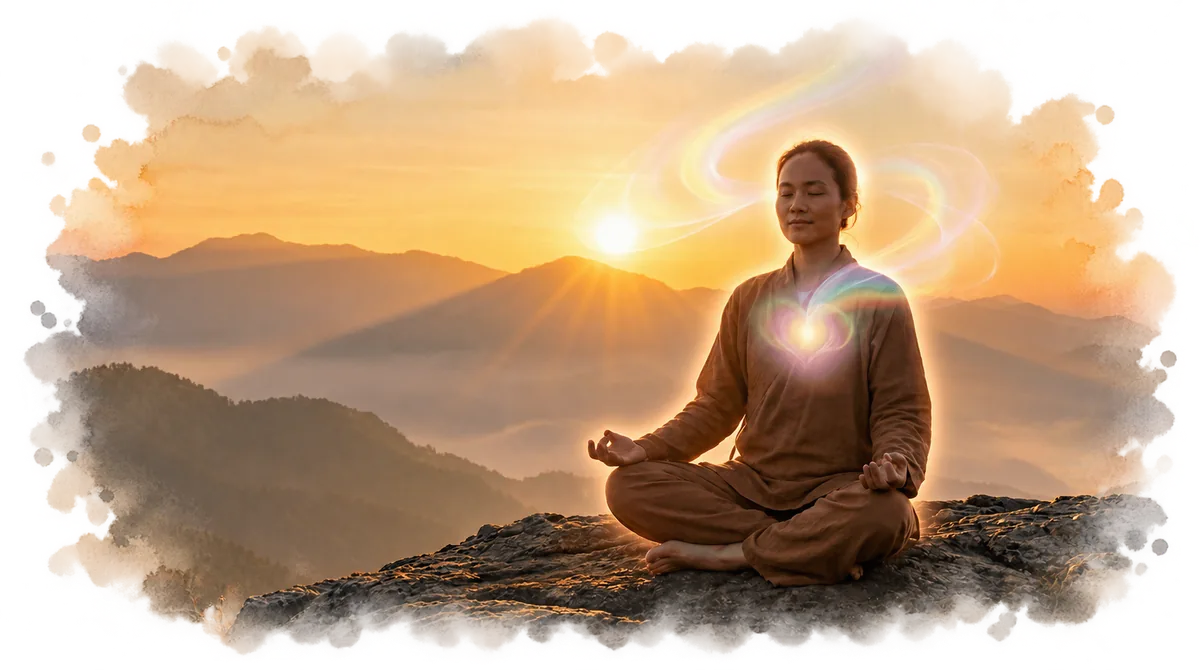
What can yoga practice help us notice?
A posture reveals sensation and the stories we attach to it. While sitting, you might notice tight shoulders and immediately think, “I am doing this badly.” The sensation and the judgement are different events. Listening to both can reveal how quickly a changing experience becomes a conclusion about who we are.
This article focuses on the role of practice. For the wider teaching, read Spiritual Awakening with James Traverse. To compare styles and approaches, use the guide to spiritual yoga styles.
Choosing yoga for spiritual awakening
Begin with the question you want to explore. If you are drawn to movement, choose a class that includes time to feel sensation and rest. If your question concerns thought or identity, a comfortable sitting and self-inquiry may be a useful starting point. Ask a teacher how their approach connects posture, meditation and everyday conduct with the understanding they teach. A style name alone does not tell you this.
For a small practice you can try today, explore spiritual yoga practices for everyday life. Choose one exploration and notice how it meets your actual experience.
Body awareness: a comfortable posture as an inquiry
Sit on a chair with your feet supported, or choose another comfortable position. Feel the contact with the seat and floor. Notice a sensation before naming it. If you adjust your position, feel what changes. The aim is sensitivity to experience rather than reproducing an ideal shape.
Notice the impulse to compare your posture with someone else’s. Is the comparison useful for making a practical adjustment, or has it become a judgement about your worth? This is one way embodied practice brings self-inquiry into an ordinary moment.
Breath: observation and gentle participation
In James Traverse’s teaching, watching the breath changes it quantitatively and qualitatively: it slows and deepens as it is watched. You can begin by noticing breathing rather than imposing a pattern.
If you intentionally regulate breathing, comfortably lengthen the exhalation and let the inhalation follow naturally into the space made by breathing out. Keep the breath easy and return to comfortable breathing if it feels strained. Read breath awareness meditation for a focused exploration.
Meditation: a wandering mind can be included
Thoughts do not disqualify you from meditation. When planning or remembering appears, notice it and return gently to the sensation of sitting or breathing. The return is part of practice. You do not need to turn each distraction into another failure to correct.
Begin with How to Meditate, or use meditating with a busy mind when wandering attention is your main question.
Self-inquiry: what do you mean by “I”?
Mindfulness notices the experience; self-inquiry examines the identity assumed within it. If a thought says, “I am failing,” ask what “I” refers to in that moment: a role, a memory, or an image you feel obliged to maintain? Let the question invite looking rather than a quick philosophical answer.
Explore self-inquiry meditation: Who am I? and the seven-part BREATHE Framework for further guidance. These explorations concern recognition and understanding; a pleasant or unusual experience alone does not establish self-realization.
Ethics and everyday listening
Practice also concerns how we act. In a conversation, feel the support beneath you and listen to the speaker’s whole sentence. Notice whether you are hearing what is said or rehearsing a reply. Afterward, distinguish what you heard from what you assumed.
The yoga of listening connects attention with care in relationships. Responsibilities and practical decisions remain part of the exploration.
Questions about yoga and awakening
What is spiritual yoga? The term is used in different ways. At Being Yoga, it describes an exploration of our true nature through body awareness, meditation, listening and self-inquiry. A posture can support this exploration, while the understanding is brought into work, relationships and ordinary decisions. Ask how a particular teacher uses the term rather than assuming every spiritual yoga class has the same purpose.
Does being flexible mean I am spiritually progressing? Flexibility describes a physical capacity. It does not establish clarity about who you are. A comfortable chair can provide a useful starting point for inquiry.
Must I stop thinking? No. Notice thoughts and the habit of identifying with them. Meditation can include a busy mind.
Is there a timetable? Practice can support learning and reflection, but this teaching does not promise awakening after a specified number of sessions.
Explore James Traverse’s approach
James Traverse is a yoga educator and writer in Halifax, Nova Scotia, with more than 50 years of yoga experience. His teaching explores listening, meditation and embodied self-inquiry, drawing on his study with Jean Klein. Read What Is Being Yoga? or enquire about yoga sessions to continue.
Leave a Reply