The spiritual journey unfolds through Listening, Inquiry and Self-Knowledge, finds its turning point in Insight—the AHA Moment of recognizing that you are Already Whole—and flowers as Lasting Peace as that recognition becomes fully established in living—Being Understanding.
A significant part of finding a true answer is understanding the problem. This is especially important in spiritual inquiry, where an effective question can well-establish us on the spiritual journey while a less effective one can leave us whirling in mental circles.

Suffering as an invitation to look deeper
The inquiry may begin in a very human way. Something hurts. A familiar achievement no longer satisfies. A relationship changes, or the need for reassurance returns despite all our efforts to settle it. We may initially ask how to make the discomfort go away. Then another possibility opens: to understand what is happening.
Pain and difficult circumstances are part of life. The suffering explored here is psychological: the distress added via mental activity as we react to pain or life’s circumstances. Interpretation and identification can turn what happens into a verdict about who we are. The restlessness that returns after an achievement becomes “I am still not enough”; the desire for another success becomes “Something in me is lacking.” This added suffering can be examined and understood; it is not a reason to blame ourselves for feeling distress.
What is suffering? Who is suffering? Why am I suffering?
These questions invite Listening. What is actually being felt? What interpretation has been added? What have I taken this experience to establish about me? We begin to distinguish a painful circumstance, the feeling it evokes and the conclusion that our essential being is somehow diminished.
Suffering can be heard as a call from your true nature: an invitation to question what you have taken yourself to be. In this sense, it can prompt a self-correction in understanding. Your true nature has never needed repair; the misunderstanding becomes available to inquiry.
This invitation includes care for the person and the situation. Grief may need companionship; a difficult circumstance may require practical action. Listening makes room for that response while allowing the deeper question to remain open.
The question changes the journey
“How can I become whole?” appears to be a reasonable spiritual question. Yet it assumes that I am fundamentally incomplete and that some future achievement will supply what is missing. Even meditation can become another way of pursuing that imagined completion.
A different question opens a different inquiry: “What am I taking myself to be that makes me believe I am incomplete?”
The question turns attention toward the assumption itself. A role, a feeling, a judgment or an image of the body may have been accepted as the whole truth of who I am. Asking clearly brings that identification into view. The words are useful because of the looking they invite.
The journey may begin with a question, or a glimpse that the problem has been misunderstood. Listening, Inquiry and Self-Knowledge allow that inquiry to deepen. Insight is the turning point at which the error of Superimposition is seen through; living in the light of that recognition is Being Understanding.
The rope, the apparent snake and the misunderstood problem
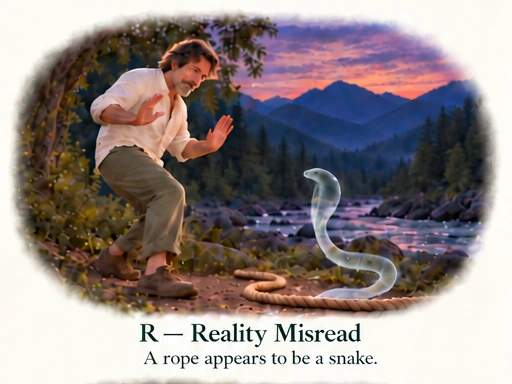
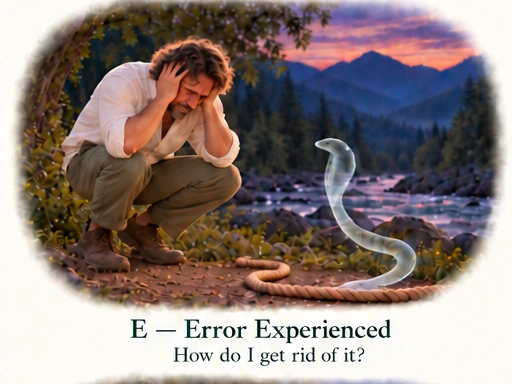
Imagine seeing a curved rope on a path in dim light and taking it to be a snake. Fear arises, and the question becomes, “How do I get rid of it?” Every proposed solution now depends on the same assumption: there is a snake that must be dealt with.
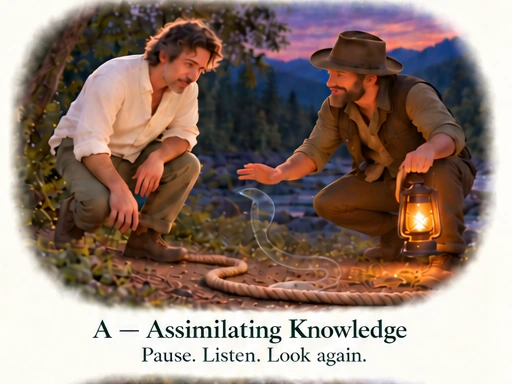
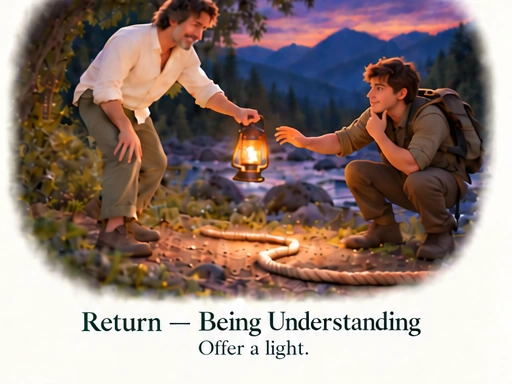
Someone brings a light. The image of a rope becomes clear. The rope has not been changed into something safer; the mistaken perception has been understood. The question “How do I remove the snake?” has lost its foundation.
The two panels make the turning point visible. In the first, the transparent snake depicts the mistaken appearance superimposed on the solid rope, and the man responds with fear. In the second, another man brings a lantern. Its light reveals the rope, the apparent snake is absent, and fear gives way to relief. The rope itself has remained unchanged.
In Advaita Vedanta, adhyasa, or Superimposition, helps us inquire into misidentification. We attribute the limitations of a changing body, thought or role to the Self. A description acquires a burden it cannot carry: it is asked to define the whole of our being. Explore this through Reality Misread and the central Spiritual Awakening page.
Notice the mistake in an ordinary moment
You achieve something you have wanted for years. There is satisfaction and, for a while, the familiar sense that something is missing falls quiet. Then the restlessness returns: “What next?” You begin looking for another achievement, relationship or experience to make you feel complete.
The achievement is real, and its enjoyment has a place. The misunderstanding lies in the assumption beneath the search: “As I am, I am not enough. Something outside me must complete me.”
Instead of immediately pursuing the next thing, pause and ask: “What am I taking myself to be that needs completing?” Feel the longing without rushing to satisfy or dismiss it. Does the feeling of incompleteness establish that your being is incomplete—or has that conclusion been added?
The inquiry turns toward the identity assumed within the search. Insight is the recognition that the wholeness you sought was never absent. Achievement can still be enjoyed, without being asked to supply your essential being. The Practice of Welcoming supports this willingness to meet what is felt while allowing the assumption “I am not enough” to be questioned.
If you are Already Whole, why practise?
Practice has a meaningful place when its purpose is understood. Yoga, meditation and bodywork can support attention and sensitivity. They help us notice contraction, expectation and the impulse to turn an experience into a statement about ourselves. A steadier availability makes Listening and Inquiry possible.
The teaching then addresses the misunderstanding. Listening carefully, questioning doubts and contemplating what is being pointed to allow Self-Knowledge to become clear. This is the difference between collecting explanations and Assimilating Knowledge.
Practice also gives understanding expression. In conversation, you hear someone to the end. When defensiveness appears, you recognize the image being protected. When a familiar reaction returns, you can meet it with curiosity and care. The doing flowers as Being.
Already Whole does not mean that every skill is developed, every difficulty resolved or every relationship easy. Learning and practical care continue. The inquiry concerns whether these unfinished matters establish an essential lack in what you truly are.
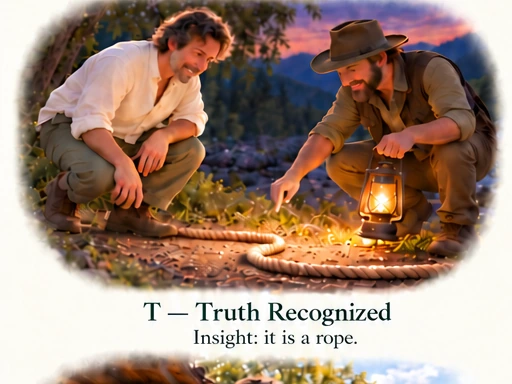
Insight — the turning point: Truth Recognized
What is sought is Insight: the AHA Moment of clarity in which you recognize the wholeness that was never absent. Listening, Inquiry and Self-Knowledge prepare the ground. Insight is the turning point—the error is seen through, and what the teaching points to is directly understood.
In the rope-and-snake example, the decisive moment is seeing, “It is a rope.” The apparent snake loses its claim on understanding. In self-inquiry, the turning point concerns the one who has felt separate and incomplete: the knowing by which every experience is known is recognized as your own nature. It is knowing that knows itself. Knowing does not need to stand apart and look at itself as an object; you recognize that you are that knowing.
It is not that “I” become awakened; there is awakening. The recognition is not another accomplishment added to a separate self. The assumption of being only that separate self is seen through. Living in the light of that understanding is Being Understanding.
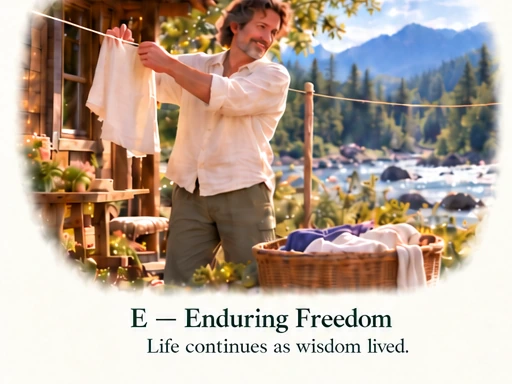
After Insight, there is still the laundry. Clothes need washing, meals need preparing, messages need answering and people need care. The ordinary activities of life continue. Things may appear much as they did before Insight; the difference is the clarity of doing without a separate doer. Action continues, while the claim that an independent, separate “me” owns and originates it is no longer taken as the truth of your being. Attention, responsibility and care still have their place in living.
The Bhagavad Gita brings this understanding into the midst of action. In the reading offered here:
Arjuna fulfils his duty, with action, devotion and knowledge coming together as wisdom lived. The sacrifice is the surrender of false identity; action continues without attachment to its fruits—again, a doing without a separate doer.
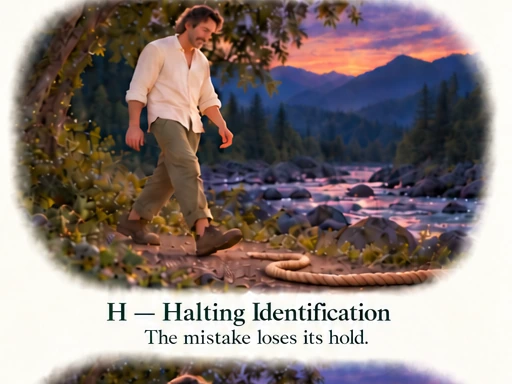
Insight is the decisive recognition. Assimilation is its flowering in everyday life: familiar habits can be met in the light of what is understood, without turning enlightenment into a new identity to defend. This is the movement in the spiritual journey from Truth Recognized toward Halting Identification and Enduring Freedom.
Seven themes, one living inquiry
The BREATHE framework gives the reading a direction. Its seven themes can also be recognized together within one encounter:
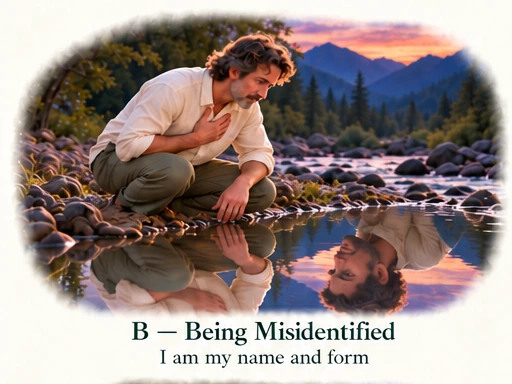
- B — Being Misidentified: a changing description is taken as the whole of who you are.
- R — Reality Misread: an interpretation is mistaken for the situation itself.
- E — Error Experienced: the misunderstanding is lived as contraction, lack or the demand for reassurance.
- A — Assimilating Knowledge: Listening and Inquiry bring the teaching into your own understanding.
- T — Truth Recognized: Insight is the turning point—you recognize the wholeness that was never absent, the knowing that knows itself.
- H — Halting Identification: the mistaken identity loses its authority as it is seen.
- E — Enduring Freedom: understanding finds expression as Lasting Peace within changing life.
These are themes of inquiry and understanding, not seven separate selves to become. The map is not the territory. The foundational statement gathers their movement into one sentence without requiring that every encounter unfold in a fixed order. Follow the Spiritual Awakening Journey for the full reading route.
The journey in eight pictures
Follow BREATHE through seven themes and a return to ordinary life. Click or tap a panel to open an enlarged view. Press Escape or use the close button to return.
A short invitation: understand before answering
Sit comfortably and feel the support beneath you. Hear the room and let breathing happen naturally. Recall a small, ordinary upset that is comfortable to explore now.
Ask, “What happened?” Give the simplest factual description you can. Then ask, “What did I take it to mean about me?” Let the feeling and the interpretation be noticed without rushing to correct either.
Now ask, “Is that description the whole of what I am?” Listen. Feel the body and the space around it. Allow the question to open attention beyond the familiar answer. If practical action is needed, consider one clear next step.
You can continue with Who Am I? A Gentle Self-Inquiry Practice, or use the BREATHE app to record what you noticed privately in your browser.
Takeaways
A true answer becomes possible when the problem is understood. Suffering may prompt the question; Listening allows the experience to be met; Inquiry reveals the assumptions within it. Self-Knowledge addresses the error of Superimposition. Insight is the turning point: Truth is recognized. Living in the light of that recognition is Being Understanding.
Lasting Peace points here to freedom from the fundamental misunderstanding of essential separation and lack. Human feelings and responsibilities continue to deserve care. What changes is the authority given to the mistaken identity through which they were interpreted.
When you no longer limit your identity to the body, mind and senses, freedom can be recognized even when the body is in pain. Pain may still call for treatment, rest and practical care. What ends, in the sense intended here, is the psychological suffering rooted in taking yourself to be only this changing body and mind. Your being is no longer understood as confined to their condition.
You are Already Whole. The journey gives us a way to understand that invitation and let it flower in living.
Leave a Reply