Ramana Maharshi’s teaching of “Who am I?” has been a strong influence on my own inquiry and teaching. I studied much of his work, and in 2010 that interest brought me to Arunachala, the sacred hill at Tiruvannamalai in South India. I stayed at Sri Ramanasramam for ten days, walked around the hill and visited both Virupaksha Cave and Skandashramam.
This is a reflection on that visit, on the death experience that transformed Ramana’s life, and on a connection I explore through Savasana and Yoga Nidra: allowing the body to rest while questioning the identity we habitually take ourselves to be.
My ten days at Sri Ramanasramam
A friend of the administrator at the time helped arrange my stay at Ramanasramam. For ten days, I had the opportunity to be close to the place that had drawn Ramana and shaped the outward circumstances of his teaching.
During that visit I attended many satsangs in Tiruvannamalai. Two stood out particularly: meetings with V. Ganesan, Ramana Maharshi’s grandnephew, at his home. He sat outside on a patio at the front of his house, with his back to Arunachala. As we listened to him, the hill remained in view behind him the whole time.
That setting gave his words an even more profound impact. It was as if Arunachala itself were echoing and corroborating what he was saying. The hill was more than a backdrop: its presence was part of the encounter, bringing the teaching I had studied into the immediacy of Listening.
I also walked around Arunachala. To walk around a hill is a simple physical activity, yet the meaning of a pilgrimage cannot be measured only by the distance travelled. In my experience, Arunachala invited a different kind of attention: Listening.
Twenty minutes alone at Skandashramam
One of the most memorable moments came at Skandashramam, the hillside hermitage where Ramana lived from 1916 to 1922. I visited both Skandashramam and Virupaksha Cave during my stay. At Skandashramam, where there were usually many visitors, I arrived just as a large group was leaving. I found myself inside, alone, for about twenty minutes.
I truly felt a connection to the hill itself—the connection Ramana had spoken about. What had been something I had read about became something immediate. The silence of Skandashramam was inseparable from being there.
I remember the image of the hill as the body of Shiva and the cave as its heart. I offer that as my recollection and paraphrase, rather than a quotation. For me, it conveys the intimacy of that moment: resting within the hill rather than simply looking at it from outside.
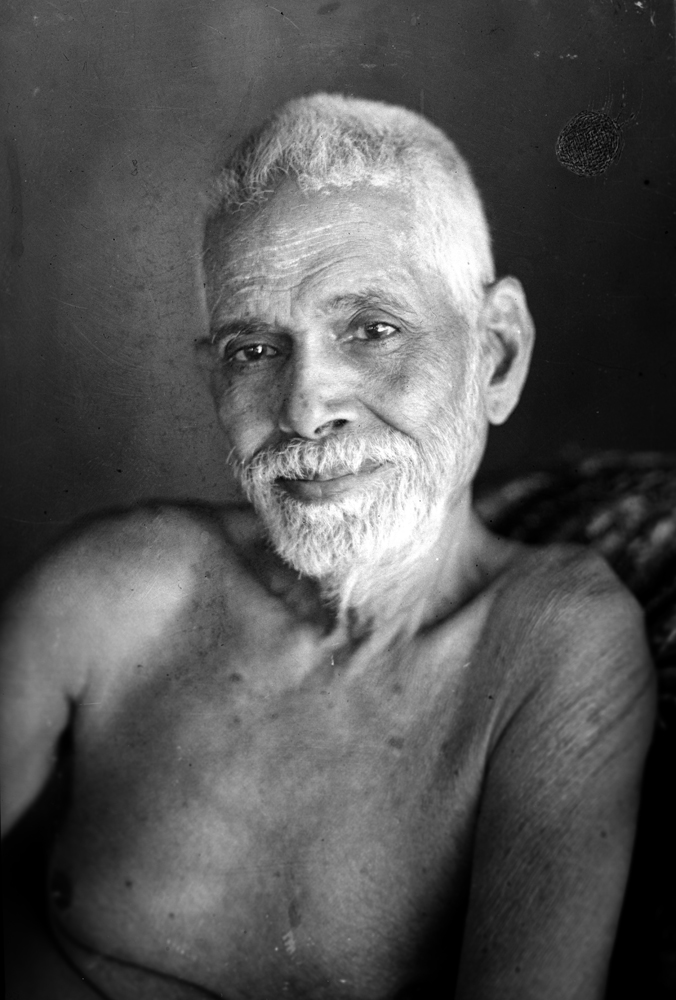

Arunachala: the hill as Guru
In Ramana’s teaching, Arunachala is much more than a setting for his life. His hymns address the hill with the love of a devotee and point through its visible form to stillness, Being and Awareness. His Eight Stanzas to Arunachala bring devotion and self-inquiry together: the search turns toward the one who sees. Read the hymns at Sri Ramanasramam.
The Heart in this teaching is not confined to a physical location. The inward invitation is to know what we truly are. My time at Skandashramam gives me a living way of speaking about that invitation, without making a journey to India a requirement for it.
Ramana Maharshi’s death experience
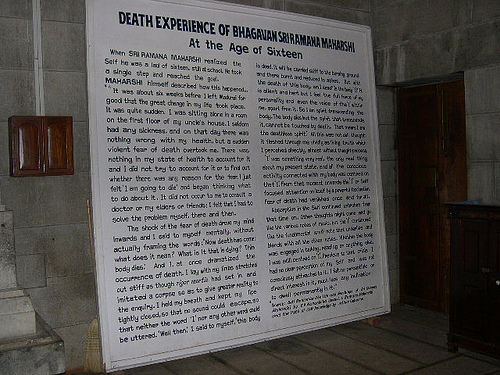
In July 1896, when he was sixteen, the young Venkataraman—later known as Ramana Maharshi—was suddenly overcome by a fear of death while alone in his uncle’s house in Madurai. He later described lying down and imitating a corpse, directing his attention toward what death would actually mean.
The question was whether the death of the body would also be the death of the “I.” In his account, the answer came as immediate recognition rather than a chain of intellectual conclusions: his true nature was not limited to the body. He described the fear of death falling away and a lasting absorption in the Self. This turning point transformed his outlook and became central to the teaching he later shared. Sri Ramanasramam preserves his account of the death experience.
The inquiry reaches beyond an explanation about death. It asks us to examine the apparently obvious assumption: I am this body, this history, this separate person. What do we actually mean when we say “I”?
“Who am I?”: turning toward the one who knows
Ramana’s self-inquiry, often called atma-vichara, turns attention toward the source of the sense of “I.” In Who Am I?, thoughts become an occasion to inquire to whom they arise, rather than an invitation to follow every thought into another story. Read a translation of Ramana’s Who Am I?.
A description—my name, profession, age or personal history—has its place. Yet each description is known. Inquiry asks about the knowing of it. Repeating a spiritual answer is different from looking directly into the assumption that a description contains the whole of what I am.
In my teaching, Listening and Welcoming support this exploration. A sensation, a thought or a fear can be welcomed into the space of attention. We do not have to push it away before inquiring into what we truly are. Explore a practical introduction to self-inquiry.
Savasana: the Corpse Pose as an invitation to release
The outward image of Ramana lying as a corpse suggests a connection with Savasana, yoga’s Corpse Pose. The connection I draw is contemplative: the body is laid down, habitual activity quietens, and the need to keep doing can begin to release.
Savasana gives us an opportunity to feel how much unnecessary effort we carry. The ground supports the body. The face can soften; the hands can rest. We can notice the impulse to manage the next moment and allow room for it to settle.
Ramana’s spontaneous encounter was not a Savasana lesson. His account includes stiffening the body and holding the breath; those details are not instructions for this practice. Here, the body rests comfortably and the breath flows naturally. There is no need to simulate dying.
What interests me is the release of identification. As activity rests, can the familiar story of “me” also be seen and welcomed without being mistaken for the whole of being? The stillness of a posture becomes an invitation to inquiry.
Yoga Nidra: resting without making a new identity
In the Yoga Nidra I teach, the same foundation of relaxation and release can deepen through guided Listening and feeling. Sensations, breathing and the changing movements of experience become available to attention while the body is supported.
Savasana names a posture; Yoga Nidra names a practice that may use that posture. They meet in release, yet the posture alone does not define the whole practice. A comfortable supported position can serve the inquiry when lying flat is unsuitable.
A pleasant or unusually quiet experience may come and go. The deeper question remains: what is it that knows the changing experience? In this sense, relaxation can prepare the ground for self-knowledge—a doing that flowers as being.
This is the connection I make with Ramana. We need not reproduce the intensity of his experience. We can let his inquiry illuminate an ordinary moment of resting, Listening and Welcoming. Explore Yoga Nidra for Spiritual Awakening for the way I bring this into guided practice.
Full moons, the festival of light and Ramana’s Jayanti
Arunachala continues to draw pilgrims, especially for the monthly full-moon walk around the hill, known as giripradakshina or girivalam. This honours the sacred hill and Shiva; it is broader than a monthly celebration of Ramana alone.
The great Karthigai Deepam festival takes place in the Tamil month of Karthigai, in November–December. Its most familiar image is the beacon lit on the summit of Arunachala. Sri Ramanasramam’s guide describes the hill’s festivals and full-moon pilgrimage.
Ramana’s Jayanti, the observance of his birth, is a separate celebration. Its traditional date can fall in December or January; for example, the ashram observed his 146th Jayanti on 4 January 2026. Visitors should consult the ashram’s current calendar for the year they plan to attend. See Sri Ramanasramam’s Jayanti announcement.
Bringing Arunachala home
I remember the privilege of those twenty minutes alone at Skandashramam, the walks around the hill and the satsangs with V. Ganesan. These are part of the lived background of my teaching.
The invitation is available here, too. Feel the support beneath the body. Let breathing be natural. Welcome the way this moment appears. Listen before supplying an answer. Who am I, before the descriptions begin?
Listen with your whole being. What you truly are and how you appear are not-two.
Continue with My Teaching or the guide to spiritual awakening.
Leave a Reply