What do you mean when you say “I”?
You may mean your body, your history, your thoughts or the person others recognize. Yet each of these is known to you. Advaita Vedanta invites an inquiry into the Awareness because of which they are known.
In my teaching, this inquiry includes recognizing living activity where we habitually imagine a fixed thing. The body is breathing, sensing and responding. A noun can be useful, yet it can conceal the activity it names.
This does not mean that Ātman is a changing process. We need to distinguish the living body from the Awareness in which bodily change is evident. That distinction opens the inquiry into spiritual awakening through self-knowledge.
1. The body as a whirlpool: living activity
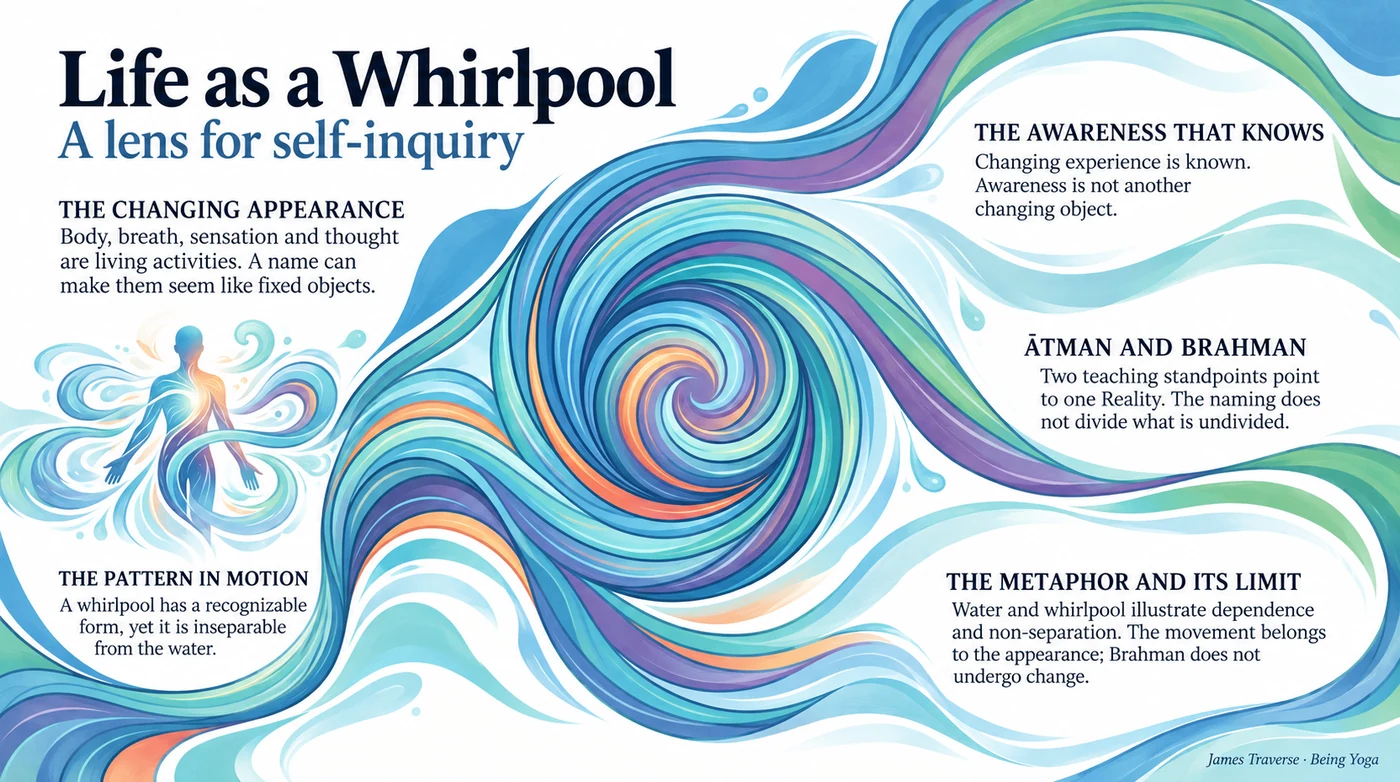
Consider a whirlpool in a river. Its recognizable form depends upon flowing water. The pattern appears distinct, yet it cannot be separated from the river that gives it expression.
The image offers a way of contemplating the body as living activity. Breathing, nourishment, movement and relationship belong to its life. We often treat a verb as a noun: a living event becomes, in thought, a fixed object.
The whirlpool is an analogy, not a complete biological explanation. Nor does bodily change establish the truth of Advaita. Its value is in loosening a familiar assumption: that the body is a self-contained thing, separate from its surroundings.
From the standpoint of the body, we can speak of an unfolding process. From the standpoint of Ātman, the inquiry concerns the Awareness by which this process is known. Awareness is not another changing pattern.
For a fuller exploration of these teaching standpoints, see Ātman and Brahman: Two Teaching Lenses, One Reality.
2. The tenth person: an error removed
Ten people cross a river. Each counts the others and finds only nine. Fearing that someone has drowned, they grieve—until a passerby points out the error: the person counting has omitted himself.
“You are the tenth.”
No missing person has to be created or brought back. A mistaken conclusion is corrected.
This parable provides a useful pointer for self-inquiry. You may search for the Self as though it were an object still to be discovered, while overlooking the Awareness already present in every act of knowing.
The body is known. Thoughts and feelings are known. The sense of being a particular person is also known. What is it because of which they are evident?
Drig Drishya Viveka offers a related inquiry through the distinction between the seer and the seen. This distinction is a teaching step; it does not finally establish two independent realities, a witness here and a world elsewhere.
It is the nature of an error to cease once seen. Self-knowledge does not produce Awareness. It removes misidentification.
3. Awareness: the Advaita standpoint
Advaita presents consciousness as fundamental, rather than as one more object within experience. This is the teaching standpoint being explored here; a metaphor or an unanswered scientific question does not by itself establish it.
Listen to a sound. Notice a thought. Feel a bodily sensation. Each changes, yet each is known.
Awareness does not have to become a sound to know hearing, or become a thought to know thinking. Calling it the Witness points toward this fact. It does not mean that there is a small observer hidden inside the body.
The light analogy can help: a light reveals different objects without becoming those objects. Like every analogy, it has limits. Awareness is not a physical light shining on a separate universe.
4. Renunciation in everyday life
Renunciation can be explored as freedom from the demand that possessions, recognition or circumstances must complete you.
This does not require neglecting work, relationships or responsibilities. It invites you to notice how easily a useful preference becomes a condition placed upon your well-being: “Only when this happens can I be at peace.”
Listening-Feeling allows the demand to be noticed without immediately obeying or suppressing it. Practical action can still follow. What changes is the assumption that your essential completeness depends upon its outcome.
The fullness pointed to in Advaita belongs to Ātman, not to an ego that has become spiritually superior.
5. Pain and the additional struggle
The image of two arrows distinguishes pain from the further struggle that resistance and interpretation can add.
A difficult event may be followed by a story: “This should never happen to me,” or “This proves that I am incomplete.” Inquiry allows that story to be examined.
This is not a promise that understanding eliminates grief, distress or every habitual reaction. Nor does it ask someone in pain to dismiss their needs. Care, support and appropriate practical help remain part of living.
The invitation is to see whether a mistaken identification is adding to the difficulty—and whether that error can be released.
Self-knowledge lived
Why study all this?
For peace of mind, lasting contentment and well-being.
The point is not to replace a personal identity with a more impressive spiritual identity. It is to recognize what has never depended upon either.
The body continues as living activity. Thoughts, relationships and responsibilities continue. Self-knowledge concerns the error through which these changing appearances are taken to define or limit Ātman.
Explore the broader teaching in the Spiritual Awakening guide, or begin with self-inquiry: Who am I?.
Leave a Reply