
1. Introduction: The High Cost of the Mental Hustle
In the relentless “busy day-to-day hustle,” it is a common pathology to find your mind “spinning.”
You are physically present—at the dinner table with your spouse or on the playground with your child—but mentally, you are miles away, lost in a to-do list or an internal “rabbit-hole” of ruminative thought.
As a strategist, I categorize this not just as a distraction, but as a high-cost deficit.
You are trading precious, unrecoverable time for mental noise.
Reclaiming the “Now” is not about a vague pursuit of relaxation; it is a tactical reorientation.
Grounding is the discipline of “catching” the moment experientially rather than trying to understand it intellectually.
To stop the spin, you must move from the abstract mind to the real physical world.
2. Intuition Isn’t Free: Paying the “Tuition” of Mindfulness
We often mistake intuition for a free “superpower”—a gut feeling that arrives without effort.
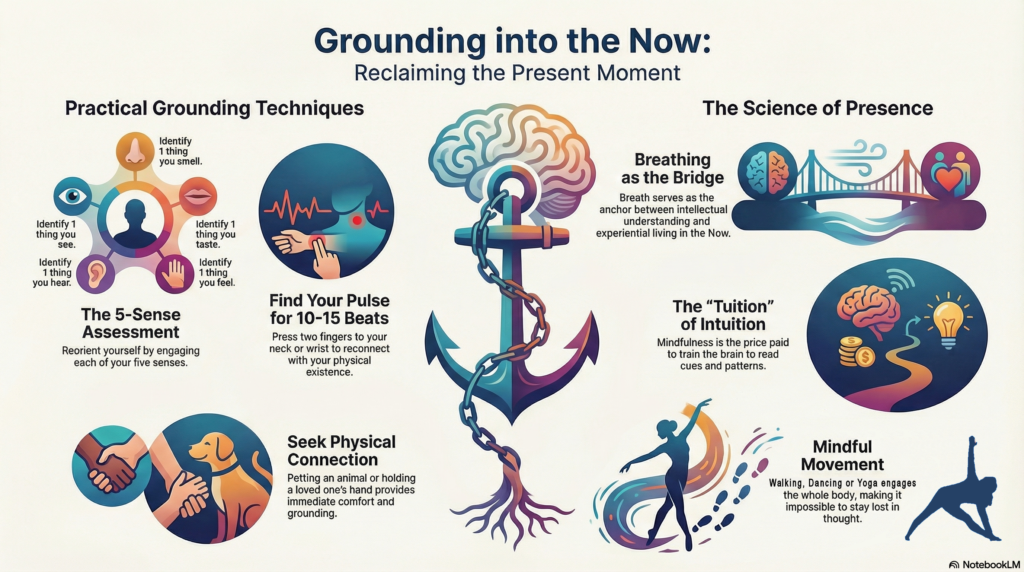
In reality, intuition is a sophisticated skill developed through the brain’s processing of patterns from earlier experiences.
To access this subconscious knowing, you must pay the “tuition.” In the words of the Roman satirist Juvenal: “All wish to possess knowledge, but few, comparatively speaking, are willing to pay the price.”
The specific currency of this tuition is pain, suffering, and the willingness to facilitate growth by sitting with discomfort.
True intuition is honed by carefully attuning to cues that we often try to ignore—such as the vulnerability of emotional closeness or the sting of criticism.
When you bypass these difficult signals to avoid temporary distress, you undermine your intuition.
You cannot train your mind to understand the nuances of the future if you are unwilling to pay the price of being mindful of the present’s hardest cues.
3. The Intellectual Trap: Why You Can’t Think Your Way Into “Now”
The primary obstacle to presence is the attempt to analyze it.
Intellectual understanding and experiential living are mutually exclusive states.
The moment you attempt to label, identify, or rationalize the “Now,” it has already vanished.
“You cannot catch the current moment intellectually, because in the time it takes to think about or say it, it has already past.”
To bridge this gap, we utilize breathing.
Breathing is a unique physiological anchor because it is an involuntary physical act that occurs strictly in the present.
You cannot breathe in the past or the future.
By focusing on the breath, you provide a physical tether for a mind that is trying to “think” its way into existence, effectively transitioning from an intellectual state to an experiential one.
4. The 15-Heartbeat Reset: Finding Reality in Your Pulse
To bypass a spinning prefrontal cortex or de-escalate a burgeoning panic attack, you must engage a biological anchor.
The 15-Heartbeat Reset provides an undeniable data point of your physical existence, forcing the brain to acknowledge the “here and now.”
The Protocol: Place two fingers on your neck, specifically where your chin meets your neck, or on the opposite wrist.
Commit to a period of 10 to 15 heartbeats.
Do not count for time; count the sensations.
This act of intentional acknowledgement forces the mind to reorient to your current physical existence.
Within a few pulses, the heart rate typically begins a downward regulation, and the “spinning head” is grounded by the reality of the pulse.
5. Listening to the “Danger” Signals: The Mindful Side of Anger
A common strategic error in mindfulness is viewing anger as a failure of presence.
Many rush toward immediate forgiveness to restore an illusion of calm.
However, I define immediate forgiveness as a “trap” that distracts us from confronting the underlying issues.
Anger is a “grounding invitation.”
It is a sophisticated cue that flags an imbalance in your values or a breach of your boundaries.
You must slow down and investigate this signal.
Ask yourself: What circumstances flagged a sense of danger or imbalance?
By staying in the “Now” to examine the source of the anger rather than escaping into a premature, performative forgiveness, you facilitate a process that is infinitely more complex and meaningful.
6. The “Analog” Anchor: The Power of Physical Sequencing
Digital convenience is the enemy of grounding.
“One-click” digital actions require almost zero motor cortex engagement, allowing the mind to remain in a “swirl.”
To anchor yourself, you must utilize Physical Sequencing—multi-step, complex tasks that force the mind to coordinate with the body.
- The Vinyl Sequence: The process of selecting a record, removing it from its sleeve, placing it on the turntable, and precisely setting the needle requires total sensory engagement. This physical sequence draws the mind into a specific time and place in a way a digital playlist never can.
- The Bottom-Up Walk: A 5-10 minute walk serves as a reset, provided you follow a strict experiential loop.
- Feet: Notice the impact and sensation against the ground.
- Breath: Observe the air temperature and lung expansion.
- Posture: Note how you carry yourself and the swing of your arms.
- Wide-Angle View: Observe the movement of trees, clouds, or colors without labeling them.
- Check-In: Return your awareness to your body to note what physical sensations have shifted.
Strategic Constraint: You must leave the phone behind. Digital interruptions are “mental rabbit trails” that break the anchor. If you are focused on a screen, you lose the engagement between your body and the earth.
“…the practice of mindful walking is a profound and pleasurable way to deepen our connection with our body and the earth.” — Thich Nhat Hanh
7. Speaking the “Swirl” Out Loud: Externalizing the Rabbit-Hole
Internal thought loops thrive in the vacuum of the mind, where they lack boundaries and can expand into irrationality.
To break the cycle, you must externalize the “swirl.”
When you are alone, speak your racing thoughts out loud.
Bringing these thoughts into the physical world of sound acts as an immediate reality check; the transition from internal rumination to externalized vibration often exposes the thoughts as extreme or unrealistic.
Once the “swirl” is externalized, occupy the auditory space with specific, audible affirmations: “I am present right now.”
8. Conclusion: The Gift of Presence
Presence is not a medical panacea, but it is the essential toolkit for a lived life.
By moving from the abstract “swirl” of the mind to the real, physical world, you reorient yourself toward what matters: your work, your health, and your loved ones.
Grounding is the practice of recognizing cues and engaging your environment before the mental spin carries you away.
——————————————————————————–
Final Reflection: What “tuition” in the form of discomfort or growth are you willing to pay today, so that you may better hear your own intuition tomorrow?

Leave a Reply to Stop Being a Noun – Cancel reply