You are a Living Vortex [Audio]
Introduction: The Illusion of the Static Self
We inhabit a world that feels deceptively firm beneath our feet, yet we often struggle to reconcile this apparent solidity with the primordial reality of constant change.
Most of us move through our days under a quiet spell—the “illusion of solidity”—believing we are fixed, separate entities.
We imagine ourselves as passengers on a great boat, safely contained within a hull, travelling down the river of life.
In this dream, the river is something external that happens to us, a backdrop we observe from the deck, distinct from our own static identity.
But the boat is a phantom.
To wake up from the static dream is to realize a more profound truth: you are not on the river; you are of the river.
Both ancient metaphysical wisdom and the visceral, evidence-based reality of your own biology suggest that you are not a biological object moving through an environment, but a vibrant, ever-changing process.
You are not a “noun,” but a majestic “verb.”
This is an invitation to enter the stream—to see your life as a localized expression of a continuous, universal current, a rhythmic dance of the cosmos masquerading as a solid person.
Takeaway 1: You are a Verb, Not a Noun (The Grammar of Existence)
The source of much human suffering lies in a fundamental linguistic and metaphysical error: we treat verbs as nouns.
In what we might call the “Grammar of Existence,” we use names as labels for finished products—nouns that must be protected, preserved, and kept from changing.
The ego clings to these labels because it fears the impermanence of the flow.
However, naming a thing “freezes” it, and as the Taoists teach, the true Tao—the organic, flowing whole—cannot be named or frozen.
In reality, your form is a continuous process of birthing, breathing, and becoming.
Breathing and blood flow are not things you have; they are things you are.
Because the movement that sustains you is a verb [Source by whatever name is a verb], it naturally follows that the form sustained by it is also a verb.
This shift is profoundly liberating.
If you are a verb, you no longer have to “hold on” to a past version of yourself, for that version was merely a previous movement of the current.
You are no longer a victim of time, but the current itself.
“You are not a stationary observer of life, but the very movement of life itself.”
Takeaway 2: The “Whirlpool Secret” (Form vs. Substance)
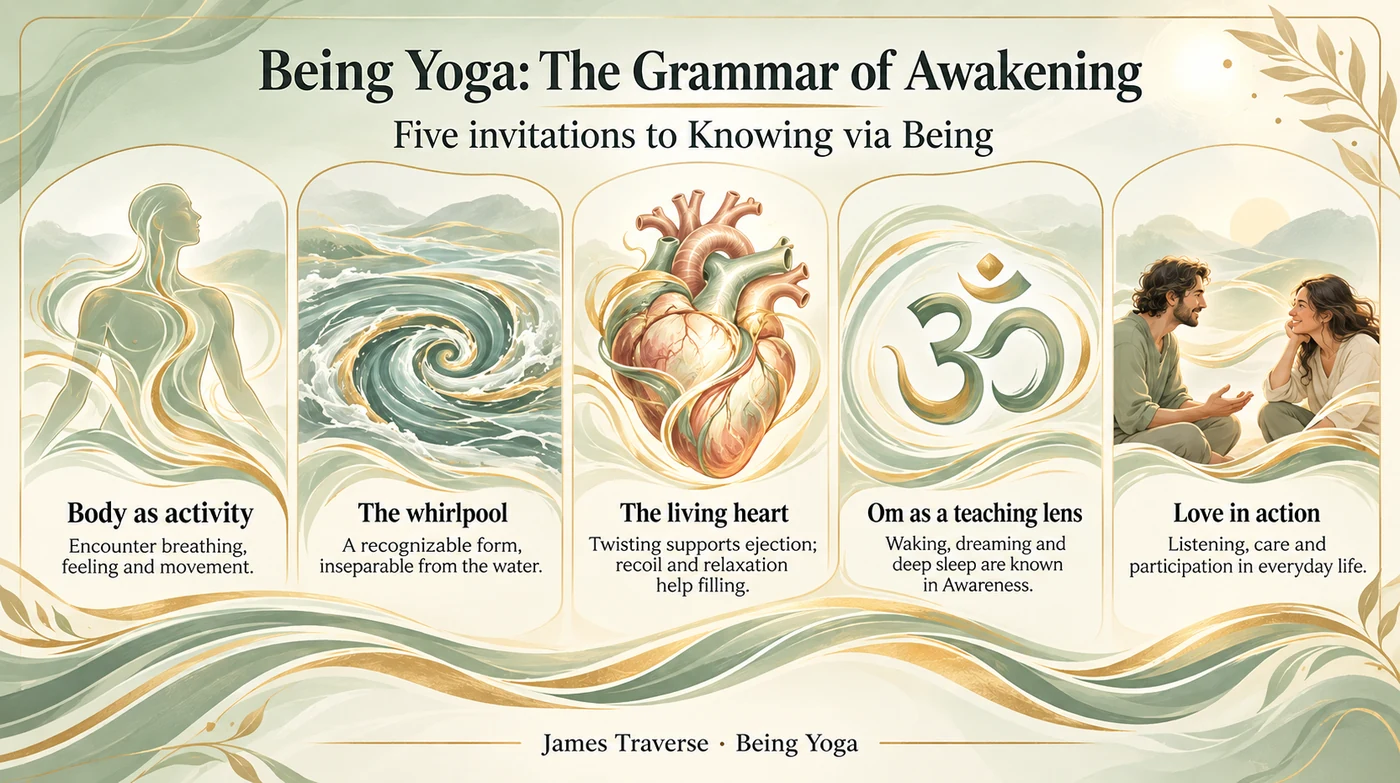
The relationship between the individual and the cosmos is most elegantly captured through the analogy of the river and the whirlpool.
This illustrates the concept of Nonduality—the realization that Reality and how it appears are inseparable.
A whirlpool appears to be a distinct entity with a clear shape and location—this is the “Appearance” or the “Form.”
Yet, when you look closer, the whirlpool has no independent substance.
It is 100% river water.
There is no “whirlpool water” distinct from “river water.”
This reveals our “Total Dependence” on the universal current: if the river stops flowing, the whirlpool does not simply slow down; it instantly ceases to be.
- The Appearance: The unique, localized, spinning shape we take in space and time—the “Form.”
- The Reality: The “One Substance” of Love and flow that powers the shape—the “Substance.”
Takeaway 3: Your Heart is Om Written in Flesh
The heart is a muscular pump whose living movement includes twisting, relaxation and recoil. Twisting supports blood ejection; untwisting and relaxation help filling. Research on ventricular twist mechanics explores this coordinated activity.
Torrent-Guasp’s helical ventricular myocardial-band model offers an influential way of picturing the heart’s organization. The interpretation of the heart as one discrete muscular band remains debated; its architecture is more complex than a single rope or one fixed crossing angle.
In my teaching, this living movement becomes an image of releasing and receiving. Heart and breath have different rhythms, yet both invite us to encounter activity before thought gathers it into a separate “thing.” The phrase “twist-and-suck” points toward that encounter.
I contemplate A-U-M (Om) as a teaching lens: A points toward waking, U toward dreaming, and M toward deep sleep. The dot, or Bindu, can symbolize immediacy. These correspondences invite inquiry into experience and Awareness.
Turīya is called “the fourth” from the standpoint of the three changing states. It is the ever-present Awareness in which they are known. A heartbeat and the Om symbol can be teaching pointers; they are themselves known in Awareness.
“The heart is the biological bridge where the Divine Word is uttered into the world of matter.” This is how I express the contemplative connection. Read The Helical Heart and the Cosmic Om for the fuller heart–breath inquiry and its anatomical context.
Takeaway 4: Don’t Mistake the “Debris” for the Water
If the heart is the engine of the flow, the “Debris of Identity” provides its unique texture.
As a whirlpool spins, it catches twigs, leaves, and sediment.
In our lives, this debris represents our ego-driven narratives, historical grievances, traumas, and roles.
It is crucial to understand that this debris is only visible because of the water’s movement.
Your individuality is not a mistake or a separate “solid” thing; it is a “localized context.”
While the twigs and sediment give your form its unique appearance and allow you to engage with the world, they are not your substance.
We suffer when we cling to the debris, forgetting that we are the purity of the water carrying it.
You can appreciate the unique shape of your “twigs” without forgetting that your essence is the river.
Takeaway 5: Love is a Universal Architecture, Not a Feeling
In this tapestry of existence, Love is redefined as a “spiritual force” and a “tireless activity” rather than a mere sentiment.
It is the very nature of Love to Love – Love is a Verb.
In everyday life, this teaching finds expression through listening, care and participation. Love is lived in how we meet one another and respond to what is needed.
Love acts as the Central Neutral Current—the Middle Pillar or equilibrium that prevents the “spinning rings” of our existence from flying apart.
It is the force that balances the polarities of our lives, ensuring that the spiritual world remains grounded in the physical.
When we choose to love, we align our individual will with this universal architecture, transforming a world of “dead things” into a living, vibrant reality.
“Individual forms appear different yet the One Substance of everything is Love.”
Entering the Stream
The move from being a “passenger on a boat” to being the “flow of the river itself” is the ultimate act of liberation.
This realization grounds us in a multi-millennial lineage of wisdom.
We see it in Heraclitus’s Panta Rhei, where he famously taught that “no man ever steps in the same river twice,” for both the river and the man have changed.
We see it in the Buddhist concept of Anicca (impermanence) and the Taoist pursuit of Wu Wei (effortless action).
By recognizing that you are the energy of constant change, you stop fighting the current.
You are a temporary gathering of the infinite, a biological stream where the universe has chosen to feel its own rhythm.
Leave a Reply