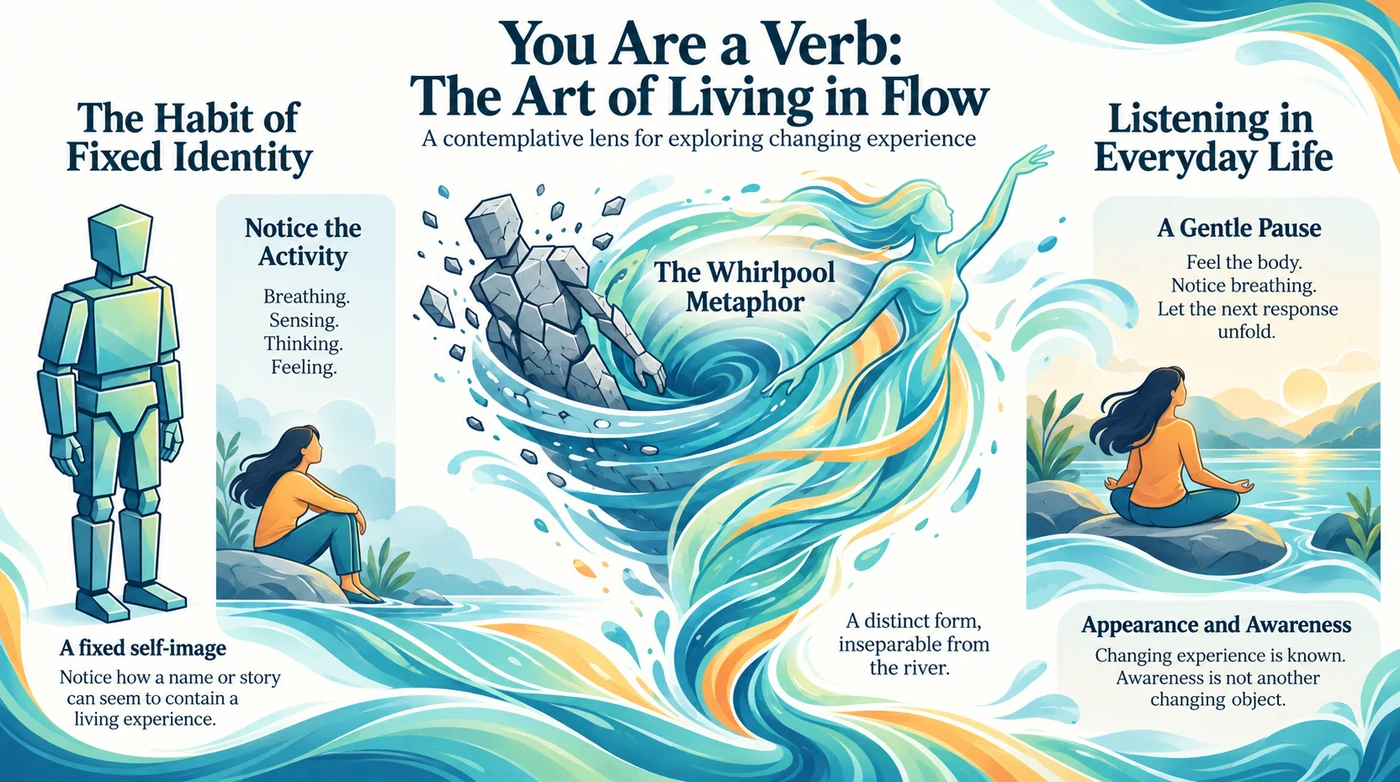
1. Introduction: The High Cost of the Mental Hustle
In the relentless “busy day-to-day hustle,” you may notice your mind “spinning.”
You are physically present—at the dinner table with your spouse or on the playground with your child—but mentally, you are miles away, lost in a to-do list or an internal “rabbit-hole” of ruminative thought.
Notice what this distraction costs in an ordinary encounter: the words you do not hear, or the expression you overlook.
You are trading precious, unrecoverable time for mental noise.
Returning to the “Now” begins with attention to the encounter already taking place.
Grounding is the discipline of “catching” the moment experientially rather than trying to understand it intellectually.
Feel the body and notice your surroundings. Thought can be included without having to follow every thought.
2. Listen Before Reaching a Conclusion
Intuition is not a demand to accept every first impression. It can be explored through patient attention: notice what is felt, listen to the circumstances and leave room for your understanding to change.
The play between “intuition” and “tuition” offers an invitation to learn from living. The learning need not be purchased through suffering. A difficult feeling may deserve attention, and so may the need to pause, seek support or step away.
Ask: what is actually here, and what am I adding? Listening-Feeling allows a response to emerge without turning discomfort into a spiritual requirement.
3. Thinking About Now and Meeting It Directly
A description of the present moment is useful, yet it does not contain the living encounter. “Breath” names something whose actuality is breathing.
Thought and experience are not mutually exclusive: thinking is itself an experience occurring now. The invitation is to notice when a description becomes a substitute for looking and feeling.
You cannot breathe yesterday’s breath or tomorrow’s breath. Notice this breathing, without forcing it into a special pattern. Let sensation, sound and thought be included.
In Being Yoga, this is Knowing via Being: understanding that includes thought and is not confined to it.
4. A Gentle Sensory Pause
When attention feels caught in a mental loop, try a brief pause. Feel the support of the chair or the contact of your feet with the ground. Notice a sound and something you can see.
If attending to breathing feels comfortable, notice a few natural breaths. There is no target heart rate, special count or required feeling of calm.
You can also explore the NHS sensory grounding exercise. Choose an approach that helps you meet your surroundings; if inward attention increases distress, keep attention on an ordinary sound or visible object.
This is an invitation to everyday attention. If anxiety or panic is recurring or difficult to manage, consult a qualified health professional; professional assessment and treatment can help.
5. Listening to the “Danger” Signals: The Mindful Side of Anger
A common strategic error in mindfulness is viewing anger as a failure of presence.
Many rush toward immediate forgiveness to restore an illusion of calm.
Forgiveness need not be hurried. First allow room to understand what happened and what response or boundary is needed.
Anger is a “grounding invitation.”
It may draw attention to hurt, a perceived threat or a boundary. The feeling deserves listening; the conclusion attached to it can still be examined.
You must slow down and investigate this signal.
Ask yourself: What circumstances flagged a sense of danger or imbalance?
Listening allows you to examine the anger without having to suppress it or act from it immediately.
6. The “Analog” Anchor: The Power of Physical Sequencing
An ordinary physical task can invite attention to sequence, contact and movement.
A quick digital action may pass almost unnoticed. Try slowing down enough to feel the action you are taking.
Explore physical sequencing: give attention to the small steps of an ordinary task.
- The Vinyl Sequence: The process of selecting a record, removing it from its sleeve, placing it on the turntable, and precisely setting the needle requires total sensory engagement. Listen to the sound as well as the movements of your hands. A digital playlist can also be listened to with care.
- The Bottom-Up Walk: On a short walk, when comfortable and practical, explore these invitations without needing to follow a rigid sequence.
- Feet: Notice the impact and sensation against the ground.
- Breath: Observe the air temperature and lung expansion.
- Posture: Note how you carry yourself and the swing of your arms.
- Wide-Angle View: Observe the movement of trees, clouds, or colors without labeling them.
- Check-In: Return your awareness to your body to note what physical sensations have shifted.
A practical choice: Put unnecessary notifications aside when you can. Keep your phone available when you need it for safety or accessibility.
Walking can be an opportunity to feel your relationship with the ground, the surroundings and the activity of the body.
7. Speaking the “Swirl” Out Loud: Externalizing the Rabbit-Hole
A thought can repeat until its interpretation feels like the only possible one.
One way to explore the “swirl” is to give it words.
When you are alone, speak your racing thoughts out loud.
Hear the words as you speak them. Does the statement describe what is happening, or does it add a prediction, judgment or assumption? You can also write it down.
Afterwards, pause and listen. “I am here” can be a gentle reminder, without needing to repeat it until a particular state appears.
8. Conclusion: The Gift of Presence
Presence is not a medical panacea, but it is the essential toolkit for a lived life.
By moving from the abstract “swirl” of the mind to the real, physical world, you reorient yourself toward what matters: your work, your health, and your loved ones.
Grounding is the practice of recognizing cues and engaging your environment before the mental spin carries you away.
——————————————————————————–
Final Reflection: What becomes evident when you listen before deciding what this moment means?
Leave a Reply