Yoga and the Phiposopher’s Stone
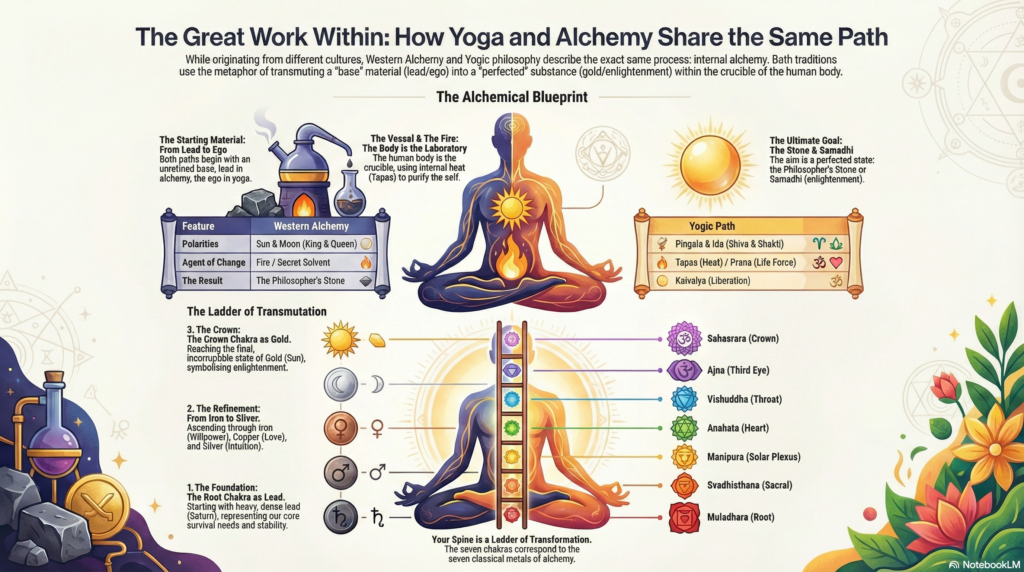
While at first glance they seem to belong to entirely different worlds—one a physical practice from India and the other a medieval European legend—Yoga and the Philosopher’s Stone are actually two different metaphors for the exact same process: Internal Alchemy.
In both traditions, the “lead” or “base metal” represents the unrefined human ego and physical body, while the “gold” or “Philosopher’s Stone” represents the enlightened, immortal soul.
1. Hatha Yoga as “Internal Alchemy”
The word Hatha itself is alchemical. In Sanskrit, Ha means “Sun” and Tha means “Moon.” Hatha Yoga is the “yoking” or joining of these two polarities.
- The Alchemical Marriage: Western alchemists sought the Mysterium Coniunctionis—the union of opposites (Sun/Moon, King/Queen). In Yoga, this is the union of Ida (lunar energy) and Pingala (solar energy) into the central channel, the Sushumna.
- The Result: When these energies merge, they “cook” the practitioner’s consciousness, transmuting it from a state of duality and suffering into a state of unity.
2. The Body as the Crucible
In Western alchemy, the “Great Work” (Magnum Opus) was performed in a laboratory furnace called an Athanor. In Yoga, the body is the Athanor.
- Tapas: This yogic term literally means “heat.” Through breathwork () and discipline, a yogi generates internal “psychic heat” to burn away mental and physical impurities (called dross in alchemy).
- The Philosopher’s Stone: In the Indian tradition, this is often referred to as the Cintamani (the wish-fulfilling jewel) or the Amrita (the nectar of immortality). It is not a physical rock, but a stabilized state of pure consciousness that can “transmute” any experience into wisdom.
3. Historical Overlaps
- The Nath Siddhas: There was a specific branch of medieval yogis in India known as the Siddhas who were literal alchemists. They practiced Rasa Shastra (the Science of Mercury), believing that by purifying mercury and the human body simultaneously, they could achieve physical immortality.
- Mercury and Shiva: In Hindu alchemy, Mercury is considered the “semen of Shiva,” and Sulfur is the “menstrual blood of Shakti.” The Philosopher’s Stone is the perfect stabilization of these two divine substances.
4. Psychological Transmutation (The Jungian View)
Psychologist Carl Jung spent years studying both Yoga and Alchemy. He argued that neither was truly about making gold or doing “stretches.” Instead:
- The Stone is a symbol for the Self—the integrated center of the psyche.
- The Yoga is the Process—the method of reaching that center.
Comparison at a Glance
| Feature | Western Alchemy | Yoga (Internal Alchemy) |
| Base Material | Lead / Prima Materia | Ego / Heavy Physical Body |
| The Goal | The Philosopher’s Stone | Samadhi / Kaivalya (Liberation) |
| The Agent | Fire / Secret Solvent | Tapas (Heat) / Prana (Life Force) |
| The Polarities | King & Queen (Sun & Moon) | Shiva & Shakti (Pingala & Ida) |
| The Vessel | The Alchemist’s Retort | The Human Body |
Symbolism of the Seven Chakras and the Seven Alchemical Metals
In both the Indian and Western traditions, “seven” is the magic number of transformation. Just as there are seven chakras (energy centers) in the body, there are seven classical metals and seven celestial bodies in alchemy.
Each metal represents a state of “vibration.” As you move up the spine in Yoga, you are essentially “refining” the metal of your soul—moving from the heavy, dull density of lead to the radiant, incorruptible light of gold.
The Ladder of Transmutation
| Chakra | Sanskrit Name | Alchemical Metal | Planet | Spiritual Quality |
| Crown | Sahasrara | Gold | Sun | Enlightenment; the “Great Work” complete. |
| Third Eye | Ajna | Silver | Moon | Intuition; the reflection of divine light. |
| Throat | Vishuddha | Mercury | Mercury | Communication; the “fluid” bridge between worlds. |
| Heart | Anahata | Copper | Venus | Love and balance; the metal of harmony. |
| Solar Plexus | Manipura | Iron | Mars | Willpower and action; the heat of the forge. |
| Sacral | Svadhisthana | Tin | Jupiter | Expansion and creativity; the social metal. |
| Root | Muladhara | Lead | Saturn | Survival and stability; the heavy “Prima Materia.” |
Key Symbolic Correspondences
1. The Foundation: Lead (Root Chakra)
In alchemy, lead is the “base” metal—heavy, dark, and associated with Saturn (the god of time and restriction). In Yoga, the Root Chakra deals with our most basic survival needs. To begin the Great Work, you don’t throw the lead away; you transmute it. You take your heaviest fears and turn them into the “ground” upon which you stand.
2. The Power Center: Iron (Solar Plexus)
Iron is the metal of Mars, the warrior. In the Solar Plexus (Manipura), we find our “fire.” Just as iron must be heated and hammered to become a tool, our ego and willpower must be disciplined through Tapas (yogic heat) to become a force for spiritual growth rather than just selfish desire.
3. The Bridge: Mercury (Throat Chakra)
Mercury is the only metal that is liquid at room temperature. It represents “quickness” and the ability to move between the physical and spiritual. In the Throat Chakra, Mercury allows us to translate our inner truths into outward speech. It is the “Messenger of the Gods.”
4. The Goal: Gold (Crown Chakra)
Gold never rusts or decays. It is “perfection.” When the Kundalini energy reaches the Crown, the yogi achieves a state of . In alchemical terms, the “Lead of the Ego” has been fully refined into the “Gold of the Spirit.” You are no longer reacting to the world; you are radiating like the Sun.
The “Sovereign” Marriage
Alchemists often spoke of the Sun (Gold) and the Moon (Silver) coming together. In Yoga, this is the union of the Ajna (Third Eye/Silver/Intuition) and the Sahasrara (Crown/Gold/Spirit). When these two highest centers are activated, the “Stone” is found—meaning your consciousness becomes stable, eternal, and “perfect.”
The “Three Primes” of Alchemy and the “Three Gunas” of Yoga
This is where the philosophical architecture of both systems really clicks together. In alchemy, the Three Primes (Salt, Sulfur, and Mercury or Tria Prima) are the basic ingredients of all matter. In Yoga, these correspond almost perfectly to the Three Gunas, the fundamental forces that weave the fabric of the universe.
The Trinity of Transformation
| The Alchemical Prime | The Yogic Guna | The Quality | The Function |
| Sulfur | Rajas | Fire / Motion | Expansion, passion, and the “combustible” drive. |
| Salt | Tamas | Earth / Inertia | Stability, density, and the “fixing” of spirit into matter. |
| Mercury | Sattva | Water / Air / Spirit | Harmony, lucidity, and the “mediator” between extremes. |
1. Sulfur & Rajas: The Spiritual Fire
Sulfur is the “soul” of the matter. It is oily, flammable, and represents the masculine, active principle.
- In Yoga, Rajas is the energy of movement and desire.
- The Connection: You cannot have transformation without heat. In the “Great Work,” sulfur provides the fire to burn away impurities; in Yoga, Rajasic energy provides the motivation to get on the mat and do the work. Without “Sulfur,” the practitioner remains stuck.
2. Salt & Tamas: The Body of the Matter
Salt represents the “body” or the physical vessel. It is the principle of fixity and crystallization.
- In Yoga, Tamas is the quality of darkness, heaviness, and stability.
- The Connection: While often seen as “negative” (laziness), salt/tamas is essential for grounding. Without the “Salt” of the physical body, the spirit has no “laboratory” to work in. The goal is not to destroy the salt, but to purify it until it is a clear crystal.
3. Mercury & Sattva: The Fluid Intelligence
Mercury (the “Spirit”) is the mediator. It is the only element that can join the volatile Fire (Sulfur) with the fixed Earth (Salt).
- In Yoga, Sattva is the state of balance, light, and clarity.
- The Connection: The alchemist uses Mercury to dissolve and reunite elements; the yogi seeks Sattva to harmonize the body and the mind. Sattva is the “clear mirror” through which the soul can finally see itself.
The Alchemical Equation of Yoga
In alchemical texts, they say:
“Body (Salt) + Soul (Sulfur) + Spirit (Mercury) = The Philosopher’s Stone”
In Yoga, this translates to:
“Stability (Tamas) + Energy (Rajas) + Awareness (Sattva) = Samadhi”
When these three are perfectly balanced, the “cooking” process is complete. The yogi no longer swings between being hyper-active (Rajasic) or depressed (Tamasic); they reside in the “Mercurial” center—the seat of the Philosopher’s Stone.
The “Steps of the Great Work” and how they relate to the stages of a spiritual awakening?
In Western Alchemy, the process of creating the Philosopher’s Stone is divided into three distinct chronological stages, each identified by a specific color. These colors—Black, White, and Red—perfectly mirror the psychological and spiritual “death and rebirth” experienced in a serious Yoga practice.
1. Nigredo (The Black Work)
The State: Putrefaction and dissolution.
- In Alchemy: The raw material is broken down, “killed,” and rotted in the crucible. It is a dark, messy, and foul-smelling stage where the “lead” loses its shape.
- In Yoga: This is the Dark Night of the Soul or the initial “crashing” of the ego. When you first begin a deep practice, you often face your “shadow”—your traumas, repressed emotions, and the “dross” of your personality.
- The Goal: You cannot build a new house until the old one is demolished. Nigredo is the necessary surrender of the old self.
2. Albedo (The White Work)
The State: Purification and washing.
- In Alchemy: The ashes from the Nigredo are washed and purified until they turn brilliant white. This is the stage of “Silver” or the “Moon.”
- In Yoga: This corresponds to Sadhana (disciplined practice) and Shaucha (purity). Through Pranayama (breathwork) and Asana, the yogi “washes” their nervous system. The mind becomes calm, reflective, and clear like a mirror—the state of Sattva.
- The Goal: Achieving a state of “unshakable calm.” You are no longer a victim of your emotions; you have reached the “lunar” clarity of the mind.
3. Rubedo (The Red Work)
The State: Final synthesis and “The Reddening.”
- In Alchemy: The white matter is “cooked” at the highest heat until it turns deep red. This is the birth of the Philosopher’s Stone and the attainment of “Gold” or the “Sun.”
- In Yoga: This is the awakening of Kundalini and the state of Sahaja Samadhi. It is not just a quiet meditation; it is the “fire” of the spirit descending into the physical body. The spiritual and the material are no longer separate.
- The Goal: Total Integration. In the Red stage, the yogi doesn’t just escape the world; they return to it, fully “transmuted,” living with the power and radiance of the Sun.
The Synthesis: The “Diamond Body”
In the Tibetan and Tantric traditions, this final “Red” state is often called the Vajra Deha or the Diamond Body. Like the Philosopher’s Stone, a diamond is:
- Indestructible (Immortal consciousness).
- Translucent (Clear, ego-less awareness).
- Born from Heat and Pressure (The result of Tapas).
The “Stone” is not something you find; it is something you become.
The “Emerald Tablet”- how “As Above, So Below” applies to the map of the human body in Yoga
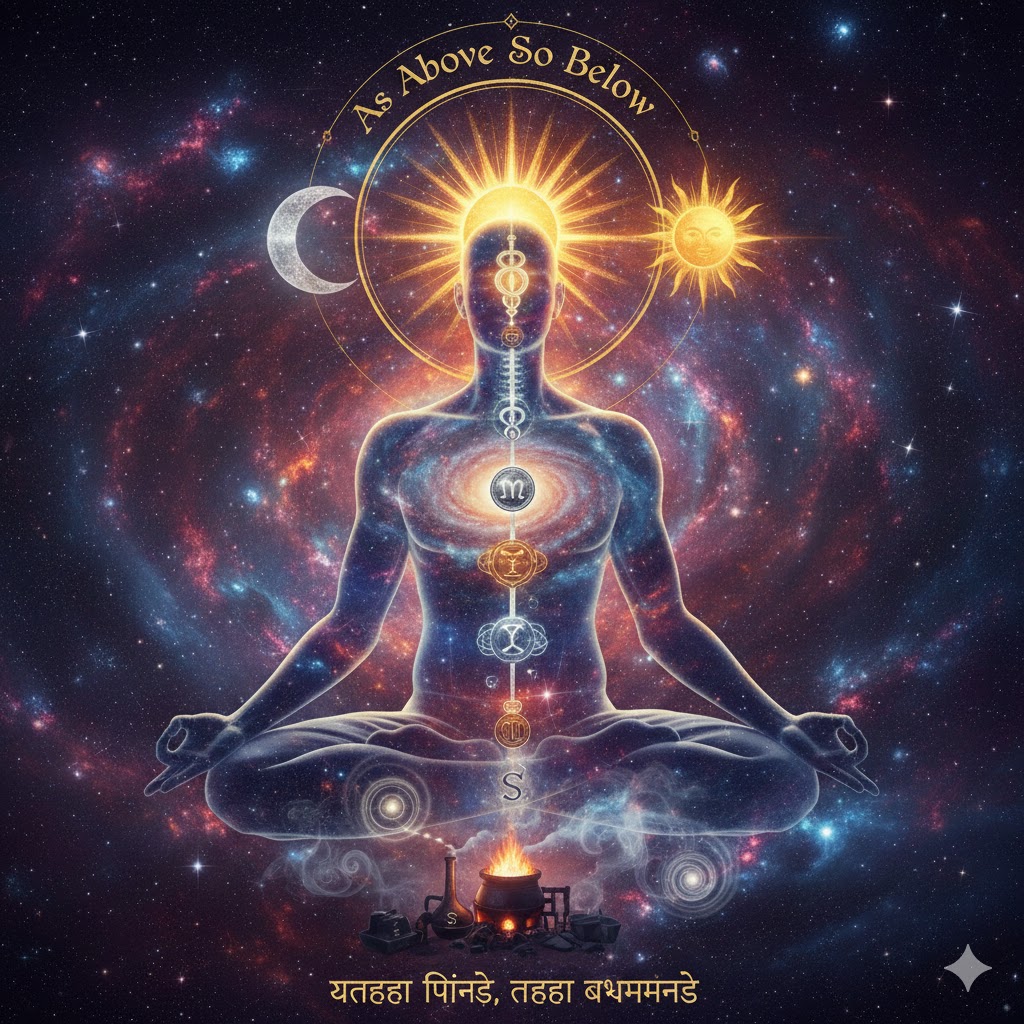
The Emerald Tablet is the foundational text of Western Hermeticism, and its most famous maxim—“As above, so below”—is the bridge that connects the vast cosmos (the Macrocosm) to the human body (the Microcosm).
In Yoga, this same principle is the core of Tantra, which teaches that the entire universe—with all its planets, stars, and gods—exists in a miniaturized form within your own spine.
1. The Microcosmic Map
The Emerald Tablet says: “That which is above is like to that which is below… to accomplish the miracles of one thing.” In the yogic view, your body is a “living laboratory” where the laws of the universe can be studied and mastered.
- The Spine as the Axis Mundi: In Yoga, the spine () is viewed as the Mount Meru (the cosmic mountain) of the body.
- The Sun and Moon: The tablet mentions, “Its father is the Sun, its mother the Moon.” This is a direct parallel to the Pingala (Solar) and Ida (Lunar) channels in Yoga. Your breath and energy are the “children” of these two celestial forces.
2. “The Wind Carried it in its Belly”
This line from the Tablet is a perfect description of Pranayama.
- In Alchemy, the “Wind” is the volatile spirit or the air that nourishes the “Stone.”
- In Yoga, Prana (the breath/wind) is the vehicle that carries consciousness into the “belly” (the lower chakras) to wake up the sleeping power of Kundalini. You use the wind to stoke the internal fire ().
3. The Operation of Sol (The Great Work)
The Tablet concludes by saying: “Separate the earth from the fire, the subtle from the gross.” This is the literal definition of Viveka (Discernment) in Yoga.
- The Gross: Your physical attachments, habits, and heavy ego (the “Earth”).
- The Subtle: Your pure awareness and energy (the “Fire”). By practicing Yoga, you are “separating” your identification with the heavy, mortal body and realizing your nature as the “subtle” eternal spirit.
Comparison of the “Great Work”
| The Emerald Tablet | The Yogic Path | Meaning |
| “As Above, So Below” | “Yatha Pinde, Tatha Brahmande” | The universe is inside the body. |
| “Its father is the Sun” | Pingala Nadi | The masculine, active, heating energy. |
| “Its mother the Moon” | Ida Nadi | The feminine, receptive, cooling energy. |
| “Separate the subtle from the gross” | Viveka / Vairagya | Distinguishing the Soul from the Body. |
| “It ascends from Earth to Heaven” | Kundalini Awakening | Energy rising from the Root to the Crown. |
The Ultimate “One Thing”
The Tablet refers to the “miracle of one thing”—the Stone. In Yoga, this is Advaita (Non-duality). The moment you realize that the “Above” (God/Cosmos) and the “Below” (You/Body) are not just similar, but identical, the transmutation is complete. You have found the Philosopher’s Stone within your own heart.
Pingback: Flow as Constant Change – You are That -