The most valuable things in life are Priceless—and they are not “things.”
There are times when we forget to count the time. Listening deeply. Meeting a newborn child. Standing beside someone who is dying. Loving without holding back. Becoming so absorbed in an activity that the thought of ourselves doing it falls quiet.
The clock continues, yet our experience is no longer organized around its measure. These are Timeless Times.
Beside the River
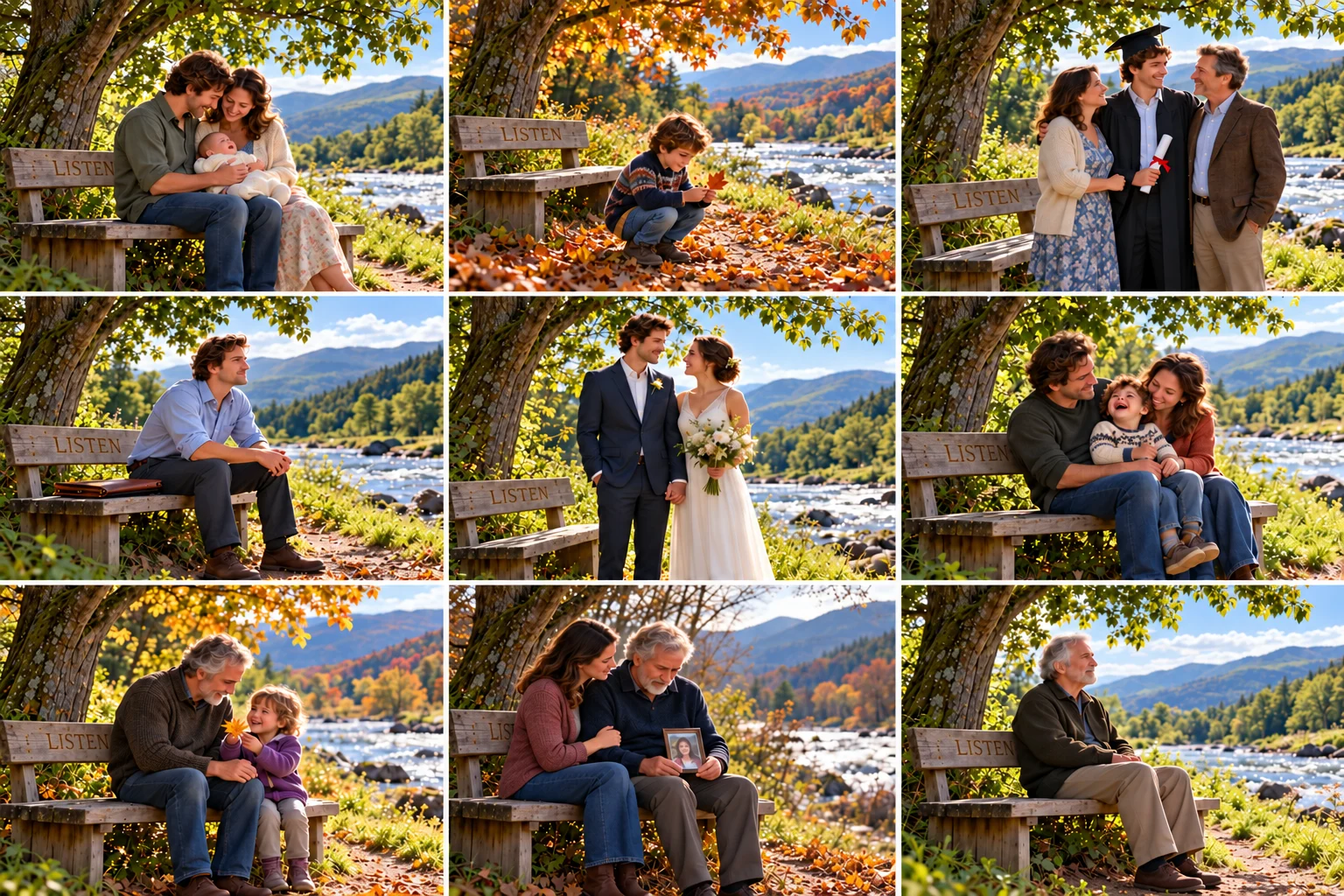
Imagine returning to the same place throughout a life. A river flows beside a path. Beneath a tree stands a wooden bench. Carved into its backrest is a simple invitation: LISTEN.
The scene becomes familiar. The people who enter it change. An infant rests in a parent’s arms. A child plays. A young adult returns with news. Lovers sit together. Years later, someone brings a grandchild. Another visit carries the sorrow of absence.
The river is a companion to these encounters. Each visit invites a fresh meeting with life.
Open to the Unknown
An infant encounters life before having much of a story about it. There is seeing, hearing, feeling and responding. The account of “me and my world” has yet to acquire its familiar shape.
We cannot return to infancy, nor do we need to discard what experience has taught us. Returning to innocence means meeting life openly, with understanding—without requiring the unknown to become familiar before we can welcome it.
Beside the river, a child discovers a fallen leaf. Years later, that child, now a grandparent, receives a leaf from another small hand. A lifetime lies between the encounters, yet the openness of wonder feels familiar.
Birth, Celebration and What Cannot Be Bought
Meeting a newborn can leave us without words. We may have prepared for the arrival, yet the living encounter exceeds our preparations. A small hand closes around a finger. For a moment, there is simply this.
A graduation, a promotion, a wedding—each has its place in the story of a life. Yet what makes the moment precious? The embrace. The shared joy. Being seen and understood. The presence of someone we love.
Money may help arrange the occasion. It cannot purchase the love, wonder or intimacy that gives it meaning. An achievement can mark the occasion; the priceless quality is lived in the encounter.
Health and the Simple Gift of Living
Vibrant Health belongs at the top of our Gratitude List. To walk beside the river, breathe the fresh air, play with a child or simply feel at ease in the body can be quietly extraordinary. We often notice the value of these ordinary freedoms most clearly when they have been interrupted.
Money can pay for treatment and support, yet health is never simply a possession we can purchase and keep. Caring for the body is one way of honouring the life being lived through it.
During illness, recovery or ageing, a Timeless Time may be as simple as a comfortable breath, a moment of relief or the presence of someone who cares. The priceless quality of life is also here, in the tenderness with which we meet ourselves and one another.
Freedom and Being “In the Zone”
A child at play does not always pause to ask how well the playing is going. A musician, craftsperson or athlete may know something similar: action flows while continual self-commentary falls quiet. We call this being “in the zone.”
There can be a taste of freedom in this absorption—freedom from constantly supervising ourselves through an image of who we should be. The activity has its own immediacy.
Such moments come and go. Their value for inquiry lies in what they reveal about the burden of self-preoccupation. What is present when that burden is briefly absent?
Meditation: Accepting the Invitation to Listen
The bench does not demand a particular experience. Its invitation is LISTEN.
Sit comfortably. Feel the support beneath you. Hear the river, or whatever sounds are here. Allow breathing to happen. Notice a thought without needing to complete its story.
Living meditation is listening. Listening-Feeling includes the whole encounter: sound, sensation, movement, thought and silence. There is no requirement to make the mind blank or hold time still.
You can explore this invitation through a simple meditation routine or the yoga of listening.
Love and the Presence of Another
Two people sit beside the river. One speaks; the other listens. For a moment, preparing a reply gives way to hearing what is actually being said.
Love is expressed through such ordinary attention. The felt boundary of “my concerns” can soften enough to include another person. The moment need not be dramatic to be complete.
We give love a name, yet the name cannot contain it. Love is lived through listening, tenderness, honesty and care. It cannot be owned as a thing.
Death, Loss and the Unknown
The death of someone we love can interrupt the familiar account of how life will unfold. A place once shared is encountered differently. The bench remains; the person who sat beside us is absent.
Grief has many expressions. There may be sorrow, numbness, anger, tenderness or silence. Nothing here asks us to turn loss into a spiritual achievement or hurry toward acceptance.
Sometimes, amid grief, there is an extraordinary immediacy: holding a hand, remembering a voice, receiving the quiet company of someone who does not try to explain the pain away. Such presence is also priceless.
Who Am I Through All This?
Infant, child, graduate, partner, parent, grandparent: the names describe appearances and relationships across a life. They matter. Yet do they exhaust the meaning of what you are?
In self-inquiry, this question becomes immediate. The body changes. Memories and roles change. Each is known. What is the Awareness because of which these changing experiences are evident?
A timeless experience is still an experience that passes. In Advaita Vedanta, self-knowledge concerns the timeless Reality of what you are, rather than the preservation of a special moment. Brahman is beyond time and space; recognition does not bring it into existence.
The openness of a Timeless Time can invite this inquiry. Understanding flowers when the error of misidentification is seen and released. What you truly are and how you appear are not-two.
Timeless Times
The river flows. People enter the scene and leave it. A child offers a leaf. Someone listens. A hand is held.
Time gives us a way to describe the changing encounters. Their deepest value cannot be reduced to their duration, their cost or their place in a personal story.
The most valuable things in life are Priceless—and they are not “things.”
For the approach behind this inquiry, read My Teaching: Being Yoga, Listening-Feeling and Self-Knowledge.
Leave a Reply