5 Ways Flow Shapes Your Reality
1. Introduction: The Illusion of the Static
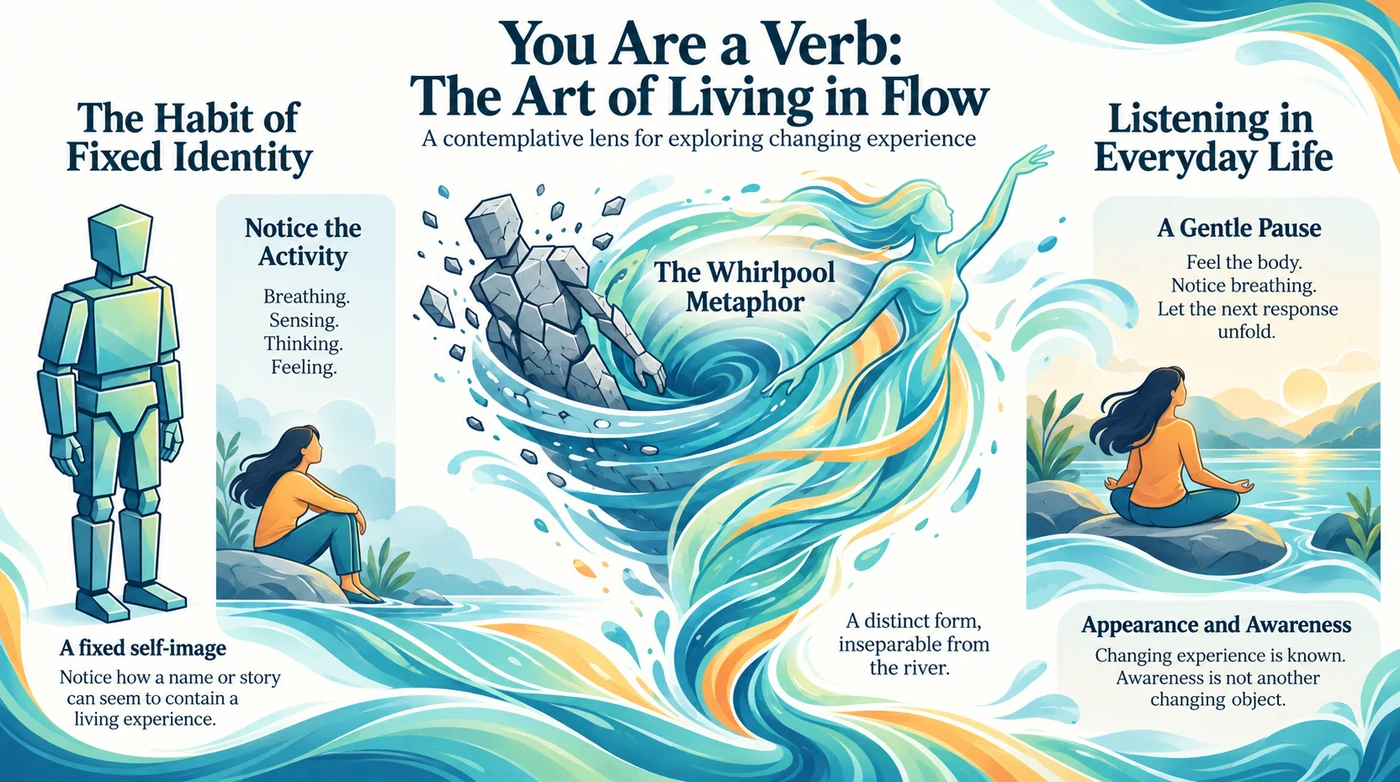
We have been conditioned to view ourselves as fixed entities—solid “nouns” moving through the containers of space and time.
Feel breathing, warmth, movement and sensation. Before “body” becomes an idea about a thing, its actuality is living activity.
You are not a static object; you are a rhythmic event.
In this view, “Form” is not a permanent state but an emergent property of “Flow.”
Just as a whirlpool maintains a consistent shape even as the water passing through it is ever-changing, your body is a temporary manifestation of an underlying, continuous movement.
The heart and the Oṃ symbol offer two lenses for this inquiry: the activity of a living form, and the teaching of experience and Awareness. Their relationship invites contemplation, rather than making anatomy a proof of the Upanishadic teaching.
2. The Living Heart: A Verb Spoken of as a Noun
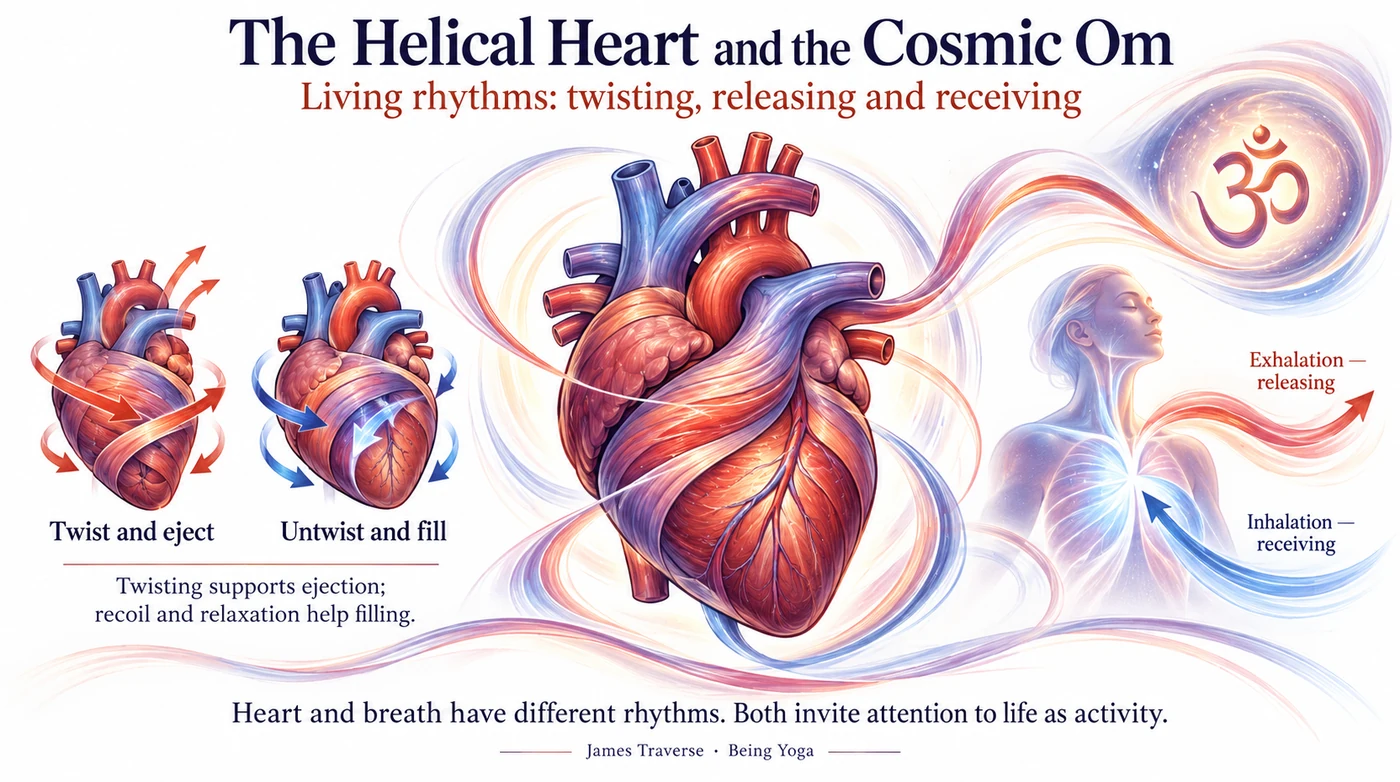
The heart is a muscular pump, and its pumping is a rich, three-dimensional activity. Its muscle fibres have a complex arrangement that includes helical orientations. The name “heart” is useful, yet it does not contain the living movement.
Francisco Torrent-Guasp’s myocardial ventricular band is an influential model of this architecture. The proposal that the ventricular muscle is one discrete, continuous band remains debated. Research on myocardial architecture describes the evidence and controversies.
I speak of a “helical space-time event” to invite attention to form as activity. Regarding the heart, we often treat a verb as a noun. The whirlpool image helps us feel this movement without making it a separate substance.
3. Twisting, Receiving and Releasing
As the heart contracts, twisting contributes to ejection. Relaxation and elastic recoil help it untwist and fill. Filling depends on several interacting factors; it cannot be reduced to a fixed claim that 90% of the blood is “sucked in.”
“Twist-and-suck” is a felt image for this relationship of expressing and receiving. It does not require one universal fibre angle or a division of hearts into spiritually superior and inferior shapes.
The rhythm invites a connection with breathing: releasing and receiving belong to living activity. Feel the correspondence without needing the two rhythms to be mechanically identical. For anatomy, research references and the fuller teaching, see The Helical Heart and the Cosmic Om.
4. Development: Form Taking Shape
The developing heart begins with an early tubular organization, then loops and develops its chambers and other structures through interacting processes. The developmental account describes these changes. It is not a literal replay of adult worms, fish and amphibians within a fixed fifty-day sequence.
The wonder remains: form takes shape through activity. The lesson drawn here is an invitation to look at living development, rather than a claim that embryology proves a spiritual model.
5. The Grammar of Existence: Space and Time as Verbs
Prāṇa is vital life-force energy. Like energy, we understand it through what it does—through its activity and expression. Prāṇa is Flow: breathing, sensing, moving, and the constant change of everyday life. The name points to this living activity; it does not contain or replace it. Prāṇa is the breath within the breath. Prāṇa is Flow.
In my teaching, Oṃ (AUM) provides a contemplative map. Time and space are emergent properties of appearance; Brahman is beyond time and space. The following correspondences invite Listening-Feeling:
- A (Space/Feeling): The waking state. Space is the first “outward thrust” of flow. We experience this biologically during Inhalation, as internal space arises.
- U (Time/Thought): The dreaming state. Here, flow narrates itself, creating the “sequence” of duration. This is mirrored in the Pause between breaths, where presence gathers.
- M (Dissolution): The deep sleep state. The “whirlpool” of identity returns to the river. This is the Exhalation.
- The Crescent (Maya): The illusion that space and time are containers rather than movements of the Flow.
- Silence and the dot: Symbolic pointers to Turīya, the Awareness in which sound, silence and the changing states are known.
Turīya is called “the fourth” from the standpoint of waking, dream and deep sleep. It is not a separate fourth state or object. The Oṃ symbol is itself known by Awareness; the difference between Ātman and Brahman is a teaching standpoint, not a division in Awareness. A natural pause may invite listening, without requiring breath retention.
6. Whirlpools, Spirals and Helices
Whirlpools, spirals and helices are related images in my teaching. They invite attention to movement within form. A spiral, a three-dimensional helix and a fluid vortex describe different things; the resemblance does not make every example one physical mechanism.
A whirlpool makes “Energy-In-Formation” immediately visible: a recognizable form, inseparable from the water flowing through it. The body-mind can be contemplated in this way without defining Awareness as another temporary pattern.
Mathematics offers ways to explore particular natural arrangements. The Fibonacci sequence appears in descriptions of some plant patterns; Douady and Couder studied phyllotaxis as a self-organizing process. This does not assign every shell, galaxy or heart a single Fibonacci blueprint.
Likewise, research comparing neuronal tissue and the cosmic web examines particular structural measures. Such comparisons can invite wonder and investigation without becoming an anatomical explanation of the heart.
The contemplative point is simple: what appears as a thing can be encountered as activity. Feel breathing, listen and notice how quickly a name becomes a conclusion. Knowing via Being allows that conclusion to be examined.
7. Conclusion: Return to the River
Knowing that you are a continuous, dynamic flow rather than a fragile entity experiencing it, how might you live differently? When you realize you are the river, the fear of the whirlpool’s end begins to dissolve into the silence of the flow.
Leave a Reply