1. Introduction: The Yoga You Never Knew
In the modern landscape, “Yoga” has become synonymous with the aesthetic of the athletic—colourful leggings, gravity-defying postures, and a relentless pursuit of physical flexibility.
Yet, through the lens of Vedantic philosophy, this is merely the outermost husk of a profound internal science.
The word Yoga derives from the Sanskrit root yuj, meaning “to unite” or “to combine.”
However, the Vedantic tradition offers a startling twist: the ultimate Yoga is not the act of becoming one with the Divine, but the realization that you were never actually separate from it.
It is the sacred connective tissue between the seeker (sādhaka) and the sought (sādhya).
In this light, Yoga is less about a journey toward a distant destination and more about the removal of the pervasive ignorance that veils the treasure you already possess.
2. Yoga is a Marriage Broker (and You’re Already the Treasure)
To understand the relationship between the practitioner and the goal, one must look to the Rāmāyaṇa.
In this epic, Hanumān serves as the ultimate “marriage broker,” the divine intermediary whose sole purpose is to unite Rāma and Sītā.
Yoga functions in precisely this manner. It does not create a union where none existed; rather, it facilitates the recognition of a pre-existing reality.
Consider the metaphor of a treasure hunter.
The hunter employs various instruments to clear away dirt, rock, and debris. These tools do not “create” the treasure; they simply expose it.
Similarly, the myriad practices of Yoga are the instruments used to remove the mental and egoic obstacles covering your true nature.
“The ultimate yoga is the knowledge that you never were separate. You don’t need to become what you already are.”
3. Success is Not Victory—It’s Balance (Samatvam)
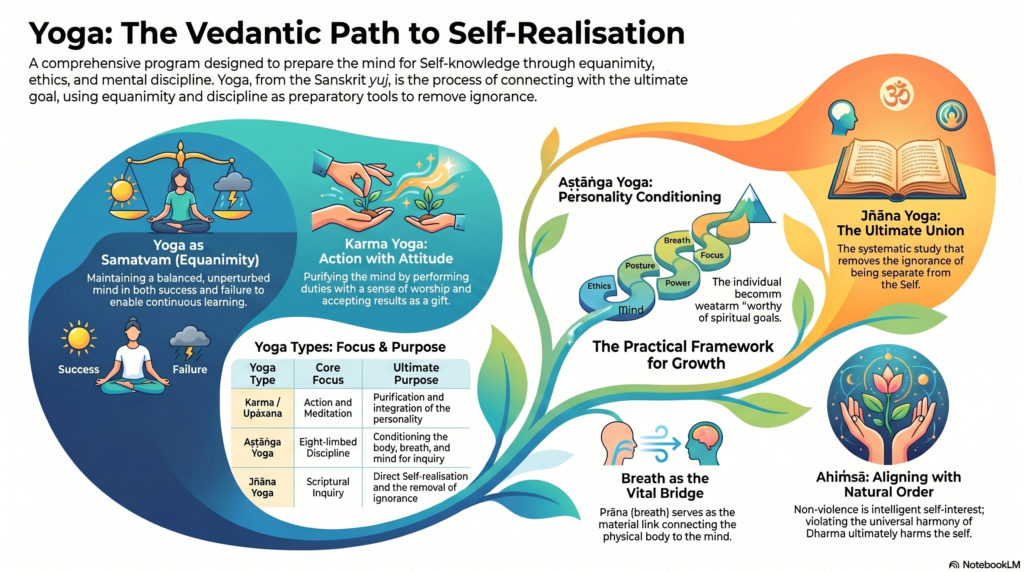
In the Bhagavad Gītā, Lord Kṛṣṇa provides a definition of Yoga that is often overlooked in its simplicity: samatvam.
This is the state of equanimity—an unperturbed mental condition that remains “the same” amidst the fluctuating tides of life.
Samatvam is not a synonym for passivity or cold indifference; it is the spaciousness of a master who remains centered in success and failure, fame and shame, gain and loss.
This inner poise is the prerequisite for being truly effective in the world.
Life is a “university,” and one can only learn from its lessons if the mind is not being tossed around by the results of one’s actions.
The Surgeon’s Poise Think of a surgeon performing a life-critical operation.
If the doctor becomes emotionally unraveled by the sight of blood or the high stakes of the procedure, the surgery is likely to fail.
It is only through samatvam—remaining calm, focused, and detached from the outcome while staying fully engaged in the action—that the surgeon can succeed.
This is Yoga in action: the mental stability required to turn instinctive activity into masterful performance.
4. Your Breath is a Material Mirror, Not the Spirit Itself
There is a common misconception that the breath is the Spirit.
While the word “spirit” etymologically relates to breathing, Vedānta makes a sharp distinction.
The ultimate Spirit (Ātman) is pure, attribute-less Consciousness.
The breath (Prāṇa), however, is material—specifically, it is matter in its subtle form.
The Prāṇamaya-kośa (the vital energy sheath) is “sandwiched” between the gross physical body (Annamaya-kośa) and the psychological mind (Manōmaya-kośa).
Because of this unique positioning, the breath acts as a bridge; by disciplining the Prāṇa, one immediately exerts influence over both the physical and the mental layers.
| Sheath (Kośa) | Nature | Role & Functions as per Source |
| Annamaya | Gross matter | The physical frame: bones, skin, and organs. |
| Prāṇamaya | Subtle matter | The energetic bridge: breathing, circulation, and digestion. |
| Manōmaya | Subtle matter | The psychological layer: emotions, memories, and thoughts. |
The Borrowed Light of the Kena Upaniṣad
The Kena Upaniṣad asks: “What is that spiritual principle which enlivens the material body?”
The answer is not the breath itself, but the Consciousness that enlivens the breath.
Consider a lamp’s filament.
The filament glows with a luminous intensity, but it has no light of its own; it is the electricity flowing through it that makes it glow.
Similarly, the breath is a “mirror” reflecting the light of the Ātman.
As the Taittirīya Upaniṣad notes, we do not live by Prāṇa alone, but by the Consciousness that makes the breath possible.
5. Yoga Builds the Dam; Vedanta Provides the Water
Patañjali’s Yoga Sūtra defines the practice as Chitta Vṛtti Nirodhaḥ—the arresting of the mind’s thought-waves.
While this stilling of the mind is a high achievement, the great philosopher Ādi Śaṅkarācārya clarified that Yoga is apramāṇam—not a valid means of knowledge—for achieving liberation (jñāna).
Yoga can tune the instrument, but it cannot “play the music” of Self-realization.
It is a preparation (sādhana), not a substitute for the inquiry into the Self.
The Dam Metaphor Imagine a river where the water flows wastefully into the ocean.
Yoga builds the dam.
It stops the leaks of mental energy spent on restless thoughts and physical fidgeting.
Once that power is conserved by the “dam” of a disciplined mind, it can be redirected toward the constructive inquiry of śravaṇaṃ (listening to scriptures) and mananaṃ (reflection).
“Yoga is not to substitute Vedanta but yoga is a preparation for Vedanta śravaṇam.”
6. Non-Violence is Intelligent Self-Interest
The concept of Ahiṁsā (non-violence) is often misconstrued as a sentimental moral “should.”
In reality, it is a recognition of the Natural Order (Dharma).
To violate this order is to commit a form of “hiṁsā” that eventually harms the perpetrator.
Swami Dayananda Saraswati famously compared Dharma to a rough tamarind tree.
If you rub your bare skin against its rugged trunk, the tree remains unaffected—it is you who gets hurt.
The world is a mirror: if you deposit violence in the “world bank,” it inevitably returns to you.
Thus, Ahiṁsā is a form of intelligent self-interest rooted in the understanding that the universe is an interconnected whole.
The Three Built-in Weapons of Harm:
- Kāyika (Physical): Harming through the body (e.g., hitting or stealing).
- Vācika (Verbal): Harming through speech (e.g., abuse, harsh criticism, or blame).
- Mānasa (Mental): Harming through the intent (e.g., harboring anger, jealousy, or ill-will).
While Ahiṁsā is the general rule, it is not absolute.
In the context of the Bhagavad Gītā, limited force is sometimes a duty to restore a fractured Dharma.
Just as a doctor must cause temporary pain to perform a life-saving surgery, the use of force may be a “necessary evil” to protect the greater harmony of the world.
7. Conclusion: The Inquiry is the Ultimate Yoga
Yoga is a discipline designed to make the personality puruṣārtha-worthy—fit to achieve the fundamental human goals of security, pleasure, ethics, and liberation.
Practices like āsanas and breath-work are essential for conditioning the mind, but they are not the finish line.
To spend a lifetime perfecting postures without moving toward Self-inquiry is like “polishing a car but never driving it.”
The transition from doing Yoga to being in an inquiry of “Who am I?” marks the shift from the preparatory to the ultimate.
Techniques, cakras, and petals belong to the “not-Self” (anātmā); they cannot provide the knowledge of the Ātman.
True Yoga is the bridge that leads you from the movement of the body to the stillness of the Spirit.

Leave a Reply to james@jamestraverse.com Cancel reply