The Path to Presence – From Questioning to Presence [Audio]
Beyond the Noise of “Doing”
In our modern era, we are obsessed with the architecture of “doing.”
We measure the value of a life by the volume of its noise—the strategies we deploy, the words we broadcast, and the frantic speed at which we react to the “slings and arrows” of our daily existence.
We believe that if we just think harder or move faster, we can finally solve the riddle of our own dissatisfaction.
Yet, we often stumble over a paradox: the more we do, the less we are.
We find ourselves caught in the same intellectual trap that famously paralyzed Prince Hamlet—a cycle of relentless questioning that leads not to clarity, but to a “pale cast of thought” where peace is nowhere to be found.
What if the answers to our most profound dilemmas are not found in the noise of action, but in the stillness of being?
This truth asks us to unlearn everything we know about achievement.
It suggests that the resolution to life’s weightiest questions is found in Presence—a silent, centered readiness that exists beneath the turbulence of the mind.
Insight 1: Silence is Not Empty; It is Your True Nature
We have been conditioned to fear silence, viewing it as a void or a failure of communication.
In reality, silence is the ground of our existence.
To enter into silence is not to enter into nothingness, but to return to your True Nature.
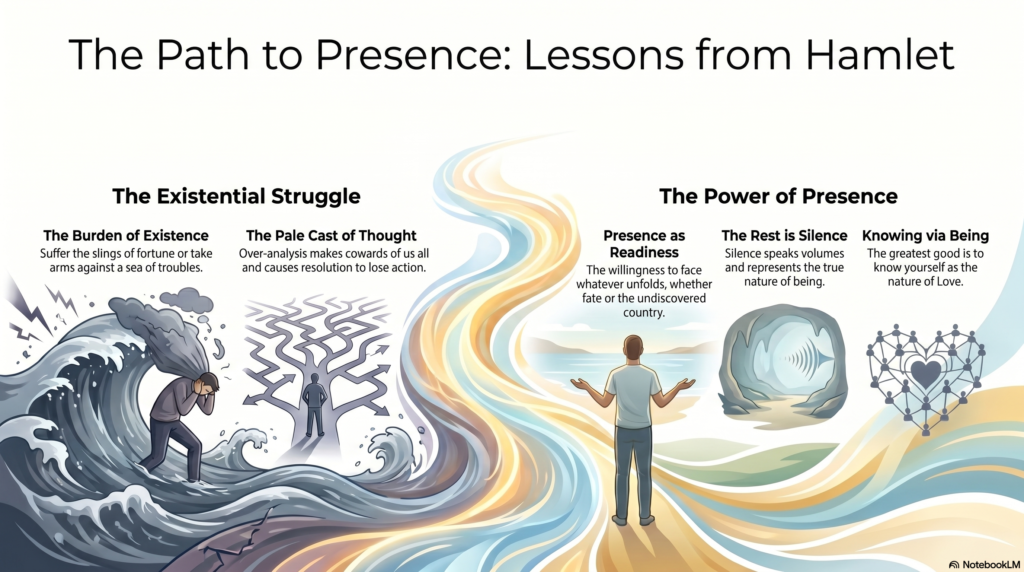
silence speaks volumes – without uttering a word – nothing is unsaid
This truth is deeply counter-intuitive.
We are taught that to be understood, we must speak.
However, when we reside in our true nature, communication happens at a level far deeper than vocabulary.
Silence is more communicative than speech because it does not merely describe the truth—it is the truth.
In this state, nothing is left unsaid because there is no gap between the self and the moment.
Even Hamlet, after a lifetime of tragic eloquence and agonizing soliloquies, eventually found his way back to this source.
His final words—“The rest is silence”—were not a surrender to the void, but an arrival at the only destination that is ever truly real.
Insight 2: The Greatest Gift to Others is Internal
The most beneficial impact you can have on the world does not come from what you do, but from what you are.
“The greatest good that you can do for another is to Know Thyself.”
This is not a call to narcissism. It is “Knowing via Being.”
When you go inward, you discover that your fundamental nature is Love.
Because it is the inherent nature of Love to love, inhabiting this truth allows you to change the world simply by standing in it.
Self-knowledge is the ultimate act of service.
When you understand the true nature of your being, you stop reacting to the world with fear.
You become a centered presence. This internal clarity radiates outward, offering a stability to others that no amount of external “doing” can ever provide.
Insight 3: The Answer to “To Be or Not To Be” is Not a Thought
Hamlet’s journey is the quintessential map of the human struggle between the intellect and the soul.
For much of his story, he is a prisoner of the “pale cast of thought,” trying to think his way out of suffering.
He stands at the edge of the abyss, weighed down by the “mortal coil” of his own logic:
To be, or not to be, that is the question: Whether ’tis nobler in the mind to suffer the slings and arrows of outrageous fortune, Or to take arms against a sea of troubles And by opposing end them… Thus conscience doth make cowards of us all, And thus the native hue of resolution Is sickl’d o’er with the pale cast of thought.
This is the agony of the “Question.”
We treat life as a problem to be solved, debating whether to endure our “heart-ache” or to fight against a “sea of troubles.”
But the more we debate, the more we “lose the name of action.”
Thought creates a buffer between us and reality, making “calamity of so long life” and turning us into cowards before the unknown.
Insight 4: Presence is the Willingness to Face the Unknown
The liberation from Hamlet’s struggle comes not through a smarter argument, but through the shift from questioning to Presence.
Near the end of his journey, Hamlet undergoes a profound transformation.
He stops fighting fate and starts inhabiting the moment.
He realizes that “the readiness is all.”
This “readiness” is the very definition of Presence.
It is the willingness to face whatever unfolds, whether it is a “twist of fate” or the “undiscovered country” of the future.
To reach this state, one must “defy augury”—the anxious attempt to predict and control the future.
We find an unshakeable center when we recognize a “special providence in the fall of a sparrow.”
This imagery suggests that the timing of life is out of our hands, yet perfectly held.
As the source tells us: “If it be now, ’tis not to come; if it be not to come, it will be now; if it be not now, yet it will come.”
Presence is the quiet strength that allows a person to finally “Let be.”
It is the understanding that we do not need to solve the future; we only need to be ready for it.
Conclusion: The Power of Letting Be
Adopting the perspective of “Knowing via Being” fundamentally transforms our relationship with existence.
It moves us away from the exhaustion of constant reaction and toward the peace, the Silence, of constant readiness.
When we understand that our true nature is Silence and that our essence is Love, we no longer need to fear the “thousand natural shocks” of life.
We simply need to be here, now, fully present for the unfolding.
Consider your own life: What would change if you stopped trying to answer every question with more “doing” and instead viewed “readiness” as your primary goal?
What would happen if you trusted that your own silent presence was the most powerful response to any crisis?
If you can trust that being is enough, you will find that the struggles of the mind fall away, leaving only the truth of the moment.
The readiness is all.

Leave a Reply to james@jamestraverse.com Cancel reply