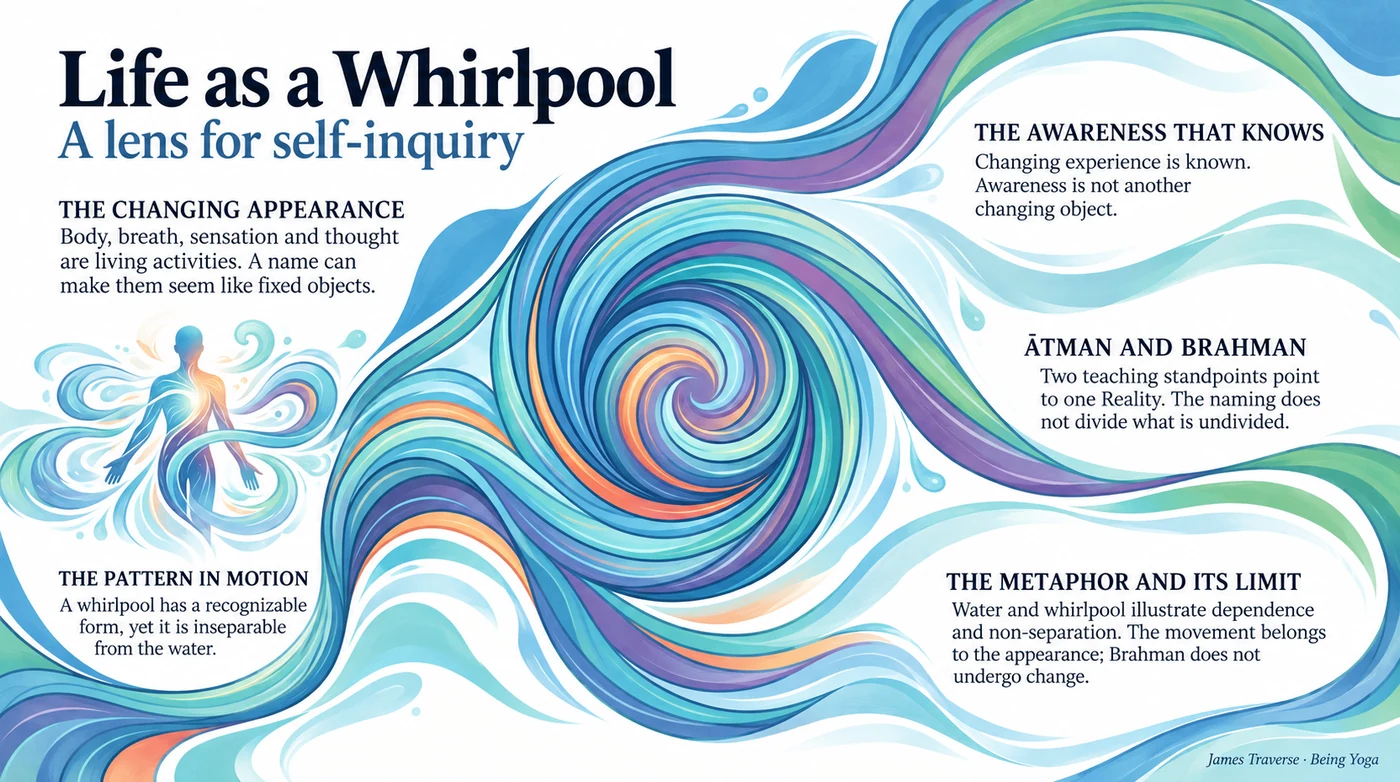
1. The Hook: Transitioning from Static to Flow
We often fall into the trap of viewing our bodies as static “things”—solid, unchanging statues placed within a vast, empty room.
Yet, when we look closer through the lens of ancient wisdom and modern biophysics, we discover that the universe is not a noun, but a verb.
It is a process, a constant and shimmering flow, much like a river that never sits still.
In this grand motion, you are not a fixed entity stuck in the current.
You are a whirlpool: a temporary, localized stabilization of energy that maintains its form only as long as the river continues to move.
2. Takeaway 1: You are a Process, Not a Noun
Your physical form is less like a solid object and more like a beautifully organized pattern of energy within a “Universal River.”
While a whirlpool appears to be a distinct thing, every drop of water passing through it is in a state of perpetual transition.
Similarly, you are a continuous exchange of atoms, literally breathing in the sky, eating the earth, and radiating heat into the silent void.
“If the river stops flowing, the whirlpool vanishes.”
When we view ourselves as a pattern of energy rather than a solid entity, the weight of aging and change begins to lift.
We realize that we are not a collection of parts slowly wearing out, but a “localized expression” of life that is being recreated in every magnificent, flowing second.
3. Takeaway 2: Patterns of Growth
Spirals offer a compelling image for growth. The Fibonacci sequence (0, 1, 1, 2, 3, 5, 8, 13…) and the golden ratio, approximately 1.618, give us one mathematical way to explore particular patterns.
The attraction of these forms can invite us to look more closely at nature. A spiral in one setting, however, does not establish that every spiral follows the golden ratio, or that bodies and galaxies share a single blueprint.
In my teaching, the spiral is a lens for contemplating movement within form. Its value is in the attention it invites: look, feel and discover the activity that a fixed name can conceal.
4. Takeaway 3: The Living Movement in Your Chest
The heart is a muscular pump with a rich, three-dimensional arrangement of muscle fibres. Its contraction includes twisting, while relaxation and recoil help it untwist and fill. “Wrings like a towel” is an image for this movement, rather than a complete account of its mechanics.
Torrent-Guasp’s myocardial band is one influential model of the ventricular muscle; the idea of a single discrete band remains debated. The heart still has distinct chambers. For the fuller account and research references, see The Helical Heart and the Cosmic Om.
Feel the meeting of heart and breath: expressing and receiving, activity and release. Breathing happens without continuous deliberate effort, and you can also attend to it consciously. This makes it an immediate invitation into Listening-Feeling.
There is no need to synchronize yourself with a cosmic frequency. Begin with the movement already present. In this sense, the body is a living whirlpool, sustained through relationship.
5. Takeaway 4: Feeling Is Known Throughout the Body
Candace Pert’s work on receptors and her writing about the “molecules of emotion” opened a conversation about communication within the body. Her receptor research with Solomon Snyder concerns biological signalling; it does not establish that consciousness is a chemical fluid.
For this inquiry, feel how a thought or emotion is encountered: perhaps as warmth, tightening, movement or a change in breathing. Listening includes this whole-body encounter, rather than restricting attention to an idea in the head.
Sensations and feelings change. Ātman names the Awareness in which they are known. A biological account of signalling and a contemplative inquiry into Awareness address different questions, and can be explored without confusing them.
6. Takeaway 5: Participation Without Total Control
Epigenetics studies changes in gene activity that do not require a change in the underlying DNA sequence. Chemical marks help regulate how genetic information is used. The National Human Genome Research Institute explains this distinction.
This is more precise than saying that thoughts rewrite the genetic code. Health is shaped by many interacting conditions; intention alone does not ensure that genes express health rather than disease.
You can still participate in how you live: how you rest, move, eat, relate and seek care when needed. The invitation is attention and responsibility, rather than the burden of believing that you must control every biological outcome.
Listening-Feeling brings the inquiry back to what is here. A changing body is cared for; Awareness need not be manufactured or improved.
7. Conclusion: Flowing Well
The illusion of separation between the self and the world dissolves when we recognize that the “stuff” of our bodies is the same “stuff” of the stars, currently dancing in a specific, beautiful pattern.
We are not observers of the universe; we are the universe in motion, shifting our perspective from seeing static “things” to seeing “actions” and “flows.”
Align yourself with this true nature of reality, and embrace the grace of your own movement.
You are the river, experiencing itself as a whirlpool for a brief, magnificent moment. Flow well.
Leave a Reply