In our contemporary landscape, yoga has been largely reduced to a high-performance fitness regime, a curated aesthetic of the pose designed for external validation.
We have transformed a sacred technology of the soul into another arena for the ego to conquer, judging our “progress” by the geometry of our limbs rather than the depth of our presence.
It has become a metric to track, a chore on a to-do list, and a subtle form of violence against the self where we treat our bodies as projects to be optimized.
This “performance-first” paradigm obscures the true essence of the practice: Awareness in Action.
Traditional yoga was never a quest for physical perfection; it was an invitation to a spiritual awakening.
When we treat yoga as a performance, we remain trapped in the exhausting cycle of “doing,” constantly striving to become a better, more flexible version of ourselves.
We are essentially trying to polish an image rather than inhabit a reality.
The invitation of Being Yoga, this site, is to pivot from the effort of becoming to the grace of remembering.
What if the goal wasn’t to acquire a new skill, but to peel back the layers of performance to reveal the stillness that has always been there?
This is the transition from the friction of striving to the clarity of Being—a homecoming to our essential nature.
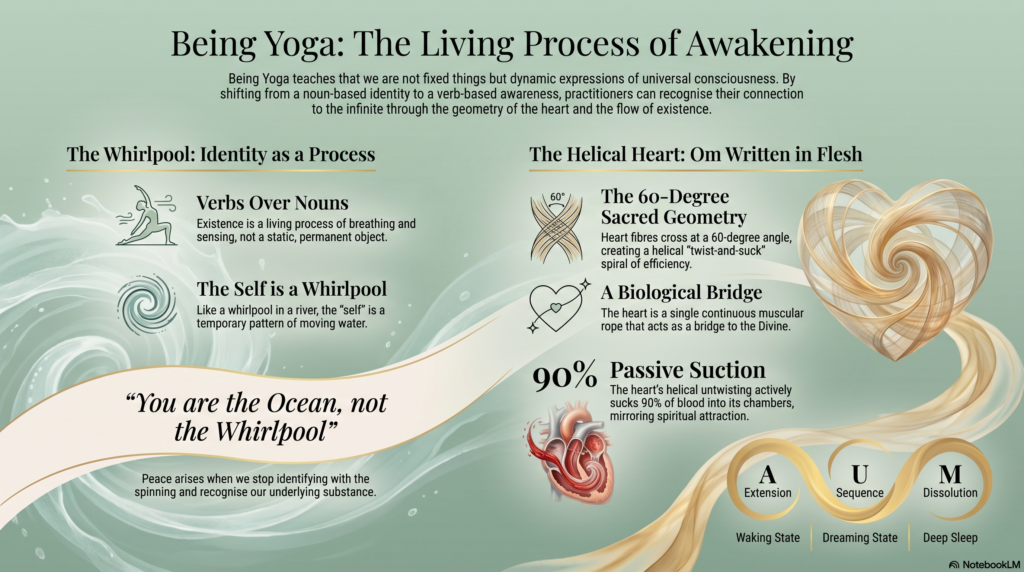
You Are a Process, Not a Product (The Whirlpool Metaphor)
To grasp this shift, we must engage with the non-dual realization that the “self” is not a solid, independent object, but a dynamic pattern of activity.
The most profound metaphor for this is the whirlpool.
To the casual observer, a whirlpool appears to be a distinct entity with a fixed shape and location.
In reality, it has no separate substance; it is simply the ocean in motion.
It exists only because a specific movement is occurring.
In yogic philosophy, our individual identity—the ego, the personality, the body—is exactly like that whirlpool.
We are a collection of vrittis, or mental fluctuations.
These are the “mental loops” of anxiety, repetitive thinking, and identity narratives that create the illusion of a solid “me.”
When these fluctuations spin with enough velocity, we mistake the pattern for a permanent thing.
We spend our lives defending a “self” that is actually a temporary expression of universal consciousness.
“The whirlpool believes it is separate from the ocean, yet it has never been anything but water.”
This insight into non-duality is liberating.
When we recognize that we are a process rather than a product, we can stop the frantic maintenance of our “whirlpool” identity.
We realize that even when the specific movement of our thoughts and circumstances changes, the “water” of our Being remains untouched and eternal.
The Grammar of Awakening (Verbs vs. Nouns)
Our suffering is often reinforced by our language.
We live in a world of nouns—Self, Body, Mind—which trick us into believing in a static, permanent reality.
This linguistic habit freezes the flow of existence into a collection of separate objects, creating a sense of isolation and stagnation.
True reality, however, is fundamentally “verb-like.”
Existence is not a collection of things; it is a continuous unfolding of activity.
To practice “Being Yoga” is to shift our internal grammar from the static to the fluid.
Instead of identifying with the noun “Self,” we observe that “selfing” is a process currently happening.
We move from being a “body” to the act of “breathing,” “sensing,” and “becoming.”
| The Noun Illusion (Static) | The Verb Reality (Process) |
| The Self: A solid, independent entity to be defended. | Selfing: A dynamic process arising within awareness. |
| The Body: A fixed object to be sculpted and controlled. | Breathing & Sensing: The flow of energy and sensation. |
| The Mind: A container for fixed thoughts and beliefs. | Thinking & Perceiving: The movement of the vrittis. |
| The Whirlpool: A separate, independent thing. | Water Flowing: The ocean expressing itself as motion. |
Presence Over Performance
In the philosophy of Being Yoga, transformation does not occur through the sheer force of will or the pursuit of an idealized future version of oneself.
It occurs through radical presence.
When we prioritize performance, we are always living in the “not yet,” reinforcing the ego’s belief that we are currently insufficient.
When we prioritize presence, we are “remembering” the wholeness that is our birthright.
By removing the “need to achieve” from our practice, we dissolve the stress of spiritual competition.
We move away from the pressure of becoming and settle into the ease of Being.
It is here, in the stillness between efforts, that the mind quiets and a deeper intelligence—beyond the noise of constant thought—is allowed to emerge.
The Four Pillars of Integrated Being
This transition requires a grounded framework that addresses the totality of the human experience.
Being Yoga integrates these four dimensions to align the “whirlpool” with the “ocean”:
- Body: Using gentle movement to create a profound sense of balance and ease.
- Breath: Regulating energy and calming the nervous system through conscious breathwork.
- Mind: Cultivating a stable, deep awareness through the practice of meditation and Yoga Nidra.
- Spirit: Awakening to a state of inner peace and authentic living.
Yoga as a “Coming Home”
The ultimate fruit of this path is not a more flexible “noun-self,” but a state of emotional balance and spiritual clarity.
Through Spiritual Self-Inquiry, we begin to see through the mental loops that sustain our psychological whirlpools.
We use practices like Yoga Nidra to access the deep relaxation where the spinning of the mind finally slows.
Yoga is not a destination we reach by mastering a sequence of difficult poses; it is the process of stripping away the illusions of separation and achievement.
It is about returning to the stillness that exists before the movement begins—the realization that we have never actually left the ocean.
“We are not things in existence; we are existence happening.”
Conclusion: The Ocean Remains
The shift from “doing” yoga to “being” yoga is a shift in identification.
It is the moment we stop seeing ourselves as the spinning movement of the whirlpool and start recognizing ourselves as the water itself.
In your daily life, you are invited to look past the “noun” of your roles, your titles, and your achievements to notice the “verb” of your unfolding existence.
When the movement of your current circumstances eventually changes, and the spinning of the mind finally settles into silence, what remains?
If you are not the temporary pattern of your thoughts and actions, who are you in the stillness that follows?

Leave feedback about this