5 Surprising Lessons from the Journey of Water
1. Introduction: The Art of the Mental Vacation
In the relentless rhythm of the modern world, we often find ourselves carrying a profound mental fatigue—a weight that doesn’t always lift simply by closing our eyes.
True restoration requires more than sleep; it requires a conscious shift in how we inhabit our internal landscape. This is the essence of Yoga Nidra, a “practice of awareness” that serves as a profound “mental vacation.”
In this state, you are invited to reside in a unique physiological duality: completely relaxed in the foreground, yet quietly alert in the background. It is an opportunity to set aside the day’s demands and settle into the spaciousness of your heart centre.
Here, you plant the seed of your intention, allowing it to take root in the fertile ground of your awareness before drifting into a deeper exploration of your own being.
2. The Shape of Stillness: Becoming the Mountain
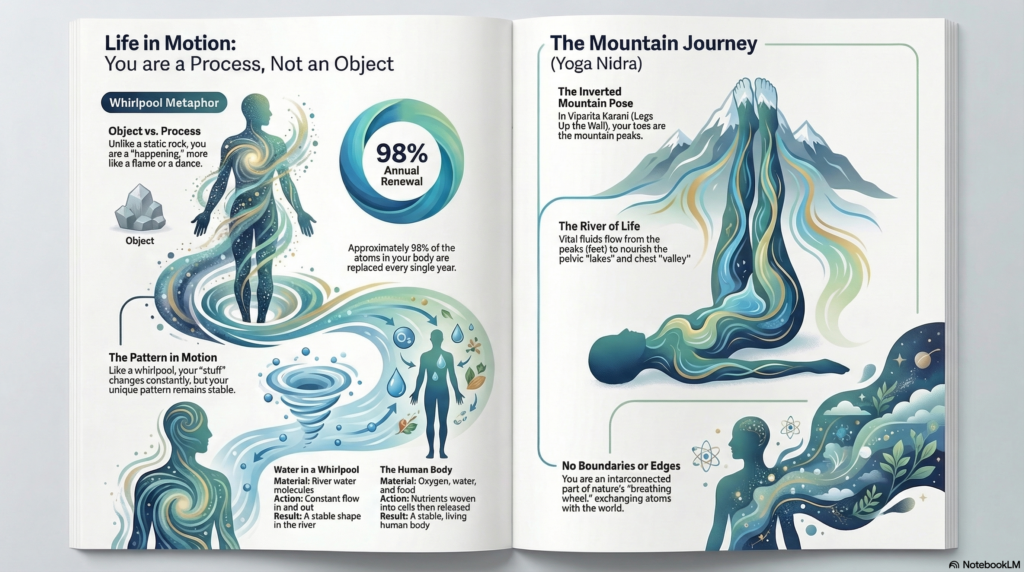
To begin this journey, we place the body in the geometry of Viparita Karani, or Legs-Up-the-Wall pose.
Resting your upper body on the earth—perhaps supported by the gentle elevation of a bolster—you extend your legs vertically against a wall. In this stillness, your body becomes a living mountain: the tips of your toes form the distant, sky-reaching peaks, while your upper body creates the broad, stable, and ancient base.
As you settle into this shape, allow your body to “spread outward like water.” Notice how reversing the pull of gravity shifts your perspective, stimulating a natural flow from the extremities toward the core. By becoming the mountain, you create the necessary topography for the journey of water to begin within you.
3. The Breath as a Tide: Finding Wisdom in the “Emptiness”
Within the stillness of the mountain, we observe the “tide of breathing”—the intimate intercourse between the waves of your respiration and the wheel of your circulation. While we often prioritize the act of breathing, the true wisdom of this practice resides in the “four-fold flow,” specifically the silent spaces that punctuate the movement.
As you relax, you may find that watching your breath is like standing on a quiet beach. There is a profound impact in identifying the transitions where the movement stops.
“See how the completion of your inspiration is punctuated with a natural space, a feeling of ‘pregnant emptiness’ that marks the transition between your inspiration and your expiration… See how the completion of your expiration is also punctuated with a natural space… a feeling of ‘full solid emptiness.’”
These moments of emptiness are not “nothingness”; they are the spaces where the life-force is gathered and renewed. The “full solid emptiness” at the end of the breath ensures the container of your body is open and available to receive the next incoming wave of life-giving energy.
4. Internal Geography: The River of Life Within
As the body relaxes, the dominant element of water takes over. Imagine the water that has been “asleep in the form of snow and ice” at the peaks of your mountain—your feet—awakening from its cold slumber. As it melts, it begins a downward journey through your internal geography.
- The Pelvic Basin: The water first gathers in the bowl-shaped pelvic basin. These are your “high mountain lakes,” the purest and clearest reservoirs on the planet. As the fluids pool here, they bathe and cleanse the organs of reproduction and elimination, streaming into the abdominal cavity to nourish the liver, the pancreas, and the spleen.
- The Rib Cage: When the lakes overflow, the movement becomes a significant “river of life,” flowing into the “tree-lined valley” of your rib cage. Just as the great civilizations of history thrived on the banks of the Nile, the Yangtze, the Rhine, the Seine, the Thames, the Amazon, the Mississippi, the Colorado, and the Ganges, your own vital organs—the heart and lungs—are nourished by this internal river.
- The Brain: Finally, the river reaches its “river delta,” represented by the head and brain. This is a rich, fertile area where vital energies collect to recharge, restore, and renew your central nervous system.
5. The Mirror of Nature: The Interconnectedness of All Things
This internal rhythm is a perfect mirror of the macrocosm. The four-fold flow of your breath—the movement and the pauses—is reflected in the global cycles of our world:
- The Day: In the transitions of dawn and dusk.
- The Year: In the shifting seasons of spring and fall.
- The Lifetime: In the flow from childhood to adulthood, punctuated by the transition spaces of adolescence and old age.
Consider the great mountain ranges: the Alps, the Andes, the Rocky Mountains, and the Himalayas, with peaks like K2, Nangaparbat, Annapurna, and Everest. The water cycle of the planet is a global breath: the ocean “inhales” water up into the clouds, where it pauses before being “exhaled” as snow onto these distant summits. In this state of awareness, you realize there are “no boundaries or edges” defining where you end and the world begins. The drop of water that was once at the top of Nangaparbat is the same life-force moving through your own circulation.
6. Conclusion: Returning to the Source
The practice of Yoga Nidra is a homecoming. Like a drop of water returning to the ocean, you return to a state of fundamental spaciousness. You are simultaneously the localized center in your heart and the vast openness that has no edges. You are part of the “breathing wheel of life,” where every breath released is an invitation for the world to be welcomed back in.
As you conclude this “mental vacation” and transition back into the movement of your day, hold onto this sense of fluidity. How can you carry the quiet strength of the mountain and the effortless interconnectedness of the river into your daily interactions? By remembering that you are not separate from the flow, you can navigate the world with the grace of the turning tide.

Leave a Reply