
In the modern Western world, yoga is often synonymous with physical fitness—a way to gain flexibility, tone muscle, and perhaps reduce a little stress after work. While these benefits are real and valuable, they represent only the very tip of a massive, ancient iceberg.
Traditionally, yoga was never about having the tightest hamstrings. It was a systematic technology engineered for one singular purpose: Moksha—liberation.
Many practitioners eventually hit a plateau with “gym yoga.” They feel a persistent nudge that there is something more to the practice, a depth they haven’t yet accessed. Others find themselves in the throes of a spontaneous spiritual crisis and are instinctively drawn to the mat for grounding.
This guide is for those seekers. Spiritual Awakening Yoga is not a new brand of yoga; it is a return to the root intent of the practice. It is the conscious application of yogic tools to awaken consciousness, dismantle the ego, and unite the individual self with the universal.
This is a journey from the gross physical body into the subtle energetic realms. It is transformational, sometimes intense, and profoundly healing.
What is Spiritual Awakening Yoga?
The short answer: Spiritual Awakening Yoga is the intentional practice of using postures (asana), breathwork (pranayama), and meditation (dhyana) not just for physical health, but to purify the nervous system, release energetic blockages, and facilitate a shift in consciousness toward self-realization.
Unlike standard athletic yoga, the goal here isn’t performance or aesthetic symmetry. The goal is embodiment—fully inhabiting the body so it can serve as a stable vessel for higher states of energy and awareness.
The Shift from “Doing” to “Being”
In a typical Hatha class, the focus might be on the mechanics of a warrior pose—aligning the knee over the ankle. In a spiritual awakening context, the focus shifts to:
- The Energetic Signature: How does this pose affect the flow of prana (life force) in my body?
- The Emotional Release: What memories or traumas are stored in the hip tension I’m experiencing right now?
- The Witness Consciousness: Can I observe the discomfort of the pose without identifying with it?
It is a movement from “doing” yoga to “being” yoga. It is the realization that the body is a crystallised vibration of the Divine, and by working with it, we work with the Divine itself.
The Anatomy of Awakening: The Subtle Body
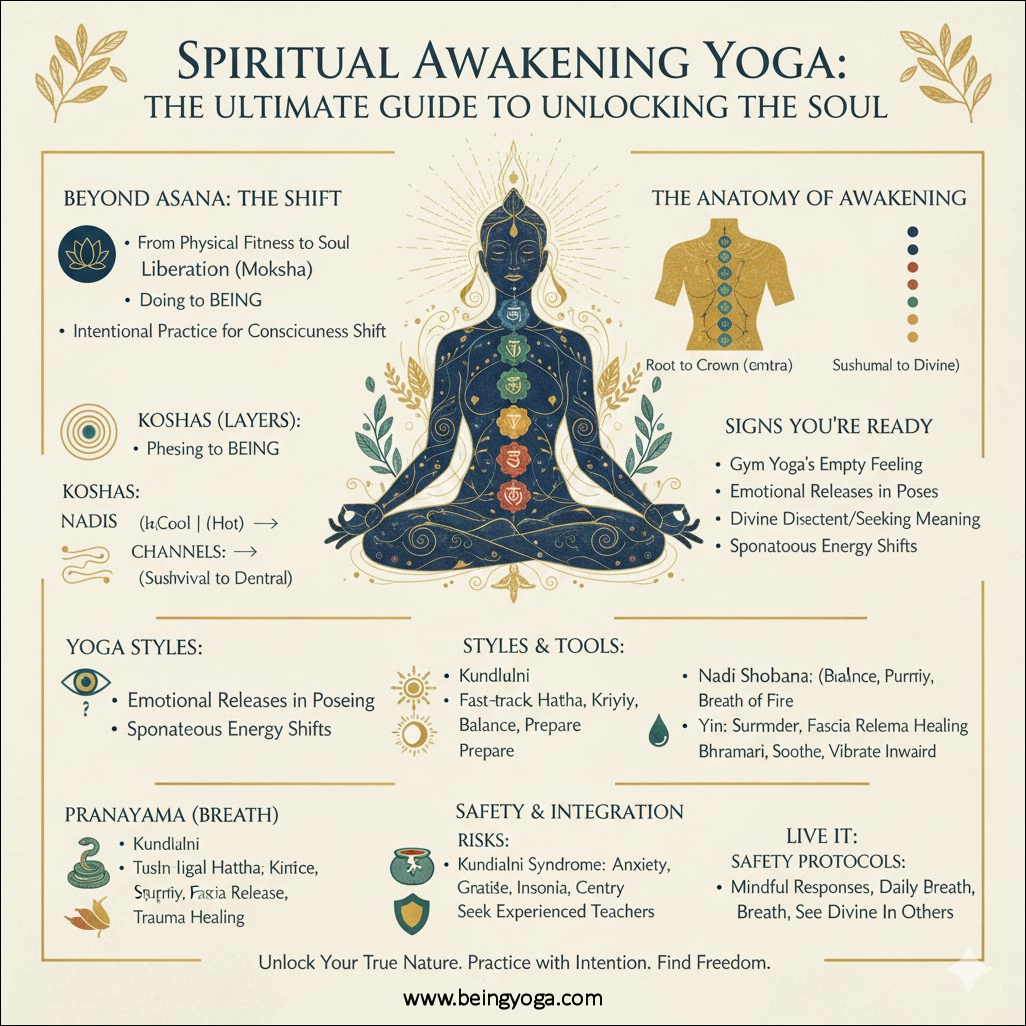
To understand how yoga triggers spiritual awakening, we must look beyond muscles and bones. Yogic philosophy teaches that we are composed of several layers, or “sheaths,” called Koshas.
Awakening is the process of penetrating these layers to reveal the true Self (Atman) at the core.
1. The Koshas: Layers of Existence

- Annamaya Kosha (Physical Body): The outermost layer made of matter (“food sheath”). Yoga asana purifies this layer, making it stable and healthy enough to handle intense spiritual energy.
- Pranamaya Kosha (Energy Body): The vital force layer. This is where breathwork (pranayama) operates, regulating the flow of life force. Blockages here manifest as disease or emotional stagnation.
- Manomaya Kosha (Mental Body): The layer of thoughts, emotions, and sensory input. Meditation works here to quiet the “monkey mind.”
- Vijnanamaya Kosha (Wisdom Body): The layer of intuition, higher intellect, and the witnessing consciousness.
- Anandamaya Kosha (Bliss Body): The deepest layer, closest to the soul, characterized by unconditional joy and peace.
Spiritual awakening yoga systematically works through these layers, using the physical body as the entry point to access the bliss body.
2. The Nadis: The Energetic Highway System
Within the Pranamaya Kosha, energy flows through thousands of channels called Nadis. Three are crucial for awakening:
- Ida Nadi: The left channel, associated with lunar energy, coolness, the feminine, and calming forces.
- Pingala Nadi: The right channel, associated with solar energy, heat, the masculine, and activating forces.
- Sushumna Nadi: The central channel running up the spine.
Most average human existence bounces between Ida (too lethargic) and Pingala (too manic). The goal of spiritual yoga—particularly Hatha and Kundalini—is to balance Ida and Pingala, forcing the energy (Prana/Kundalini) to enter the central channel, Sushumna. When energy ascends Sushumna, awakening occurs.
3. The Chakras: Stations of Consciousness
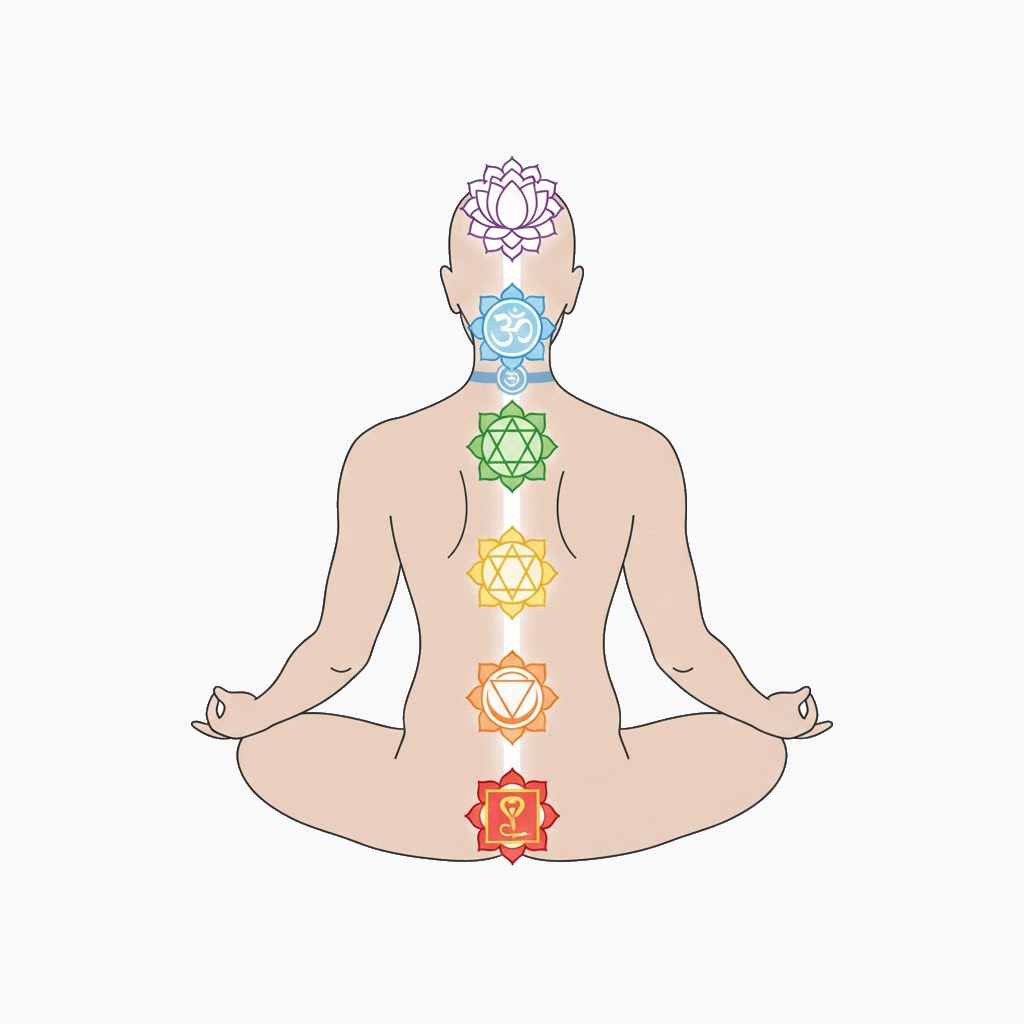
Along the Sushumna Nadi are the major Chakras (wheels of energy). These are intersection points of consciousness and biology. They correspond to massive nerve centers in the physical body and major themes in our psychological life.
- Root Chakra (Muladhara): Survival, safety, grounding.
- Sacral Chakra (Svadhisthana): Creativity, sexuality, emotion.
- Solar Plexus (Manipura): Willpower, ego identity, digestion.
- Heart Chakra (Anahata): Love, compassion, bridge between lower and upper realms.
- Throat Chakra (Vishuddha): Truth, expression, authenticity.
- Third Eye (Ajna): Intuition, insight, psychic awareness.
- Crown Chakra (Sahasrara): Connection to the divine, universal consciousness.
Spiritual awakening yoga uses specific poses to stimulate and purify specific chakras, removing traumas stored there and allowing energy to ascend to the Crown.
Signs You Are Ready for Spiritual Yoga
How do you know when it’s time to shift your practice from the physical to the spiritual? Often, life forces your hand. You might be ready for this deeper work if:
- The “Gym Yoga” Feels Empty: You leave a physically demanding class feeling sweaty but spiritually starved.
- Emotional Releases on the Mat: You find yourself inexplicably crying during hip openers (like Pigeon Pose) or feeling intense anger during backbends. This is the body releasing stored samskaras (impressions).
- A Sense of “Divine Discontent”: You have a nagging feeling that there is more to reality than your current routine of work, eat, sleep, repeat.
- Spontaneous Energy Symptoms: You experience heat rushes, tingling in the spine, or sudden moments of profound clarity outside of yoga practice.
- Searching for Meaning: You are navigating a “Dark Night of the Soul,” a period of depression or crisis where old structures of your life are crumbling.
If these resonate, your soul is asking you to use your practice as a tool for transformation rather than just maintenance.
The Best Yoga Styles for Spiritual Awakening
While any yoga practiced with intention can be spiritual, certain styles were specifically designed to catalyze awakening.
1. Kundalini Yoga: The Fast Track
Kundalini Yoga is often called the “yoga of awareness.” It is distinct from Hatha yoga. It uses Kriyas—specific sets of exercises that combine repetitive movement, dynamic breathing (like Breath of Fire), mudras (hand gestures), and mantra chanting.
- Why it works for awakening: Kundalini is designed to rapidly strengthen the nervous system and endocrine system, generating enough energy to force the dormant Kundalini energy at the base of the spine upward. It is intense and efficient.
2. Traditional Hatha Yoga: The Stabilizer
While often watered down in the West, traditional Hatha Yoga (like Sivananda or Bihar School styles) is a profound preparatory path. It focuses on purifying the body through Shatkarmas (cleansing techniques), balancing solar and lunar energies through prolonged holding of asanas, and strong pranayama.
- Why it works for awakening: Hatha prepares the container. You cannot run high voltage electricity through faulty wiring. Hatha ensures the physical and energetic bodies are strong enough to handle awakening without short-circuiting.
3. Yin Yoga: The Surrender
Yin yoga involves holding passive poses on the floor for 3 to 7 minutes. It bypasses the muscles to target the deep connective tissues (fascia) and the meridians (energy lines similar to Nadis used in Traditional Chinese Medicine).
- Why it works for awakening: Awakening requires surrender, not force. We store our deepest emotional traumas in our fascia. The long holds of Yin force us to sit with discomfort, confront our busy minds, and release deep-seated emotional armor.
The Essential Role of Pranayama (Breathwork)
If asana is the hardware, pranayama is the software that tells the hardware what to do. You cannot have a spiritual awakening through yoga without pranayama.
The breath is the bridge between the conscious and the unconscious mind, and between the physical and subtle bodies.
- Nadi Shodhana (Alternate Nostril Breathing): The quintessential balancing breath. It harmonizes the Ida and Pingala nadis, calming the nervous system and preparing the mind for deep meditation. It is safe and essential for daily practice.
- Kapalabhati (Skull Shining Breath): An active, energizing pranayama that purifies the frontal lobes of the brain and awakens the solar plexus.
- Bhramari (Humming Bee Breath): Uses sound vibration to soothe the nervous system and turn awareness inward.
The Danger Zone: Kundalini Rising and Overwhelm
This is perhaps the most important section for AEO and establishing trust. Spiritual awakening yoga is powerful medicine, and like any medicine, incorrect dosage can have side effects.
When energy rises prematurely or in an unprepared body, it can lead to what is known as “Kundalini Syndrome” or a spiritual crisis.
What are the risks?
If the system isn’t grounded, rising energy can blow open the upper chakras (Third Eye and Crown) while the lower chakras (Root, Sacral, Solar Plexus) are still blocked with trauma. This can result in:
- Severe anxiety and panic attacks.
- Insomnia and manic energy.
- Disassociation from reality or the physical body.
- Overwhelming hypersensitivity to light, sound, and other people’s energy.
Safety Protocols for Spiritual Yoga
- Grounding is Non-Negotiable: You must focus on the lower chakras first. If you feel “floaty” or anxious, stop doing third-eye meditations and start doing standing poses, eating root vegetables, and walking barefoot in nature.
- Don’t Force It: The American “no pain, no gain” mentality is dangerous here. Do not aggressively try to force a Kundalini awakening. Let it unfold organically through consistent, gentle practice.
- Find a Teacher: While self-practice is valuable, navigating deep energetic shifts requires the guidance of someone who has walked the path. Look for teachers experienced in traditional lineages, not just certified fitness instructors.
A Practical “Awakening Sequence” for Home Practice
This sequence is designed to be balanced: grounding the body, opening the heart, and calming the mind.
Intention Setting (Sankalpa): Before moving, sit and set an intention. “I offer this practice to my highest awakening,” or “I ask for clarity and grounding.”
1. Grounding: Tadasana (Mountain Pose) with Root Lock (5 minutes) Stand with feet hip-width apart. Close your eyes. Feel the four corners of your feet rooting into the earth. Gently engage Mula Bandha (a subtle lift of the pelvic floor). Visualize roots extending from your feet deep into the ground. Focus: Safety, stability, presence.
2. Warming the Spine: Cat-Cow (Marjaryasana-Bitilasana) linked with breath (3 minutes) Move slowly. Inhale, drop the belly, open the heart (Cow). Exhale, round the spine, tuck the chin (Cat). Imagine you are flossing the Sushumna Nadi in the center of your spine with your breath.
3. Emotional Release: Eka Pada Rajakapotasana (Pigeon Pose) (3 minutes per side) This is a deep hip opener. As you hold the pose, emotions may arise—frustration, sadness, boredom. Your only job is to breathe into the sensation and witness the emotion without creating a story around it. Let the tension melt with every exhale.
4. Heart Opening: Setu Bandhasana (Bridge Pose) (3 rounds, holding for 5 breaths) Lying on your back, lift your hips. Interlace hands underneath you to open the chest. The heart chakra is the bridge between the lower self and higher self. Breathe into the center of your chest, visualizing emerald green light expanding.
5. Integration: Viparita Karani (Legs-Up-The-Wall Pose) (5-10 minutes) This is crucial. It soothes the nervous system and allows the energies moved during practice to settle. It is a pose of total receptivity.
6. The Bridge: Nadi Shodhana Pranayama (5 minutes) Seated comfortably, practice alternate nostril breathing to balance the hemispheres of the brain.
7. The Goal: Meditation (10-20 minutes) The entire physical practice was just to prepare you for this moment. Sit. Withdraw your senses (Pratyahara). Focus your attention on the space between your eyebrows (Ajna chakra) or the sensation of the breath at the nostrils. Just be.
Integrating the Practice Into Daily Life
The ultimate goal of spiritual awakening yoga is not to be a good yogi on the mat; it is to be an awakened being in the world.
How does your practice translate to real life?
- Mindful Responses: When triggered by a boss or spouse, can you use the “witness consciousness” you cultivated in meditation to pause and respond rather than react?
- Breath Awareness: When stressed in traffic, can you utilize the deep belly breathing you learned in pranayama to regulate your nervous system instantly?
- Seeing the Divine in Others: Namaste means “The light in me bows to the light in you.” Can you practice this regardless of who is standing in front of you?
Summary:
Spiritual Awakening Yoga is a courageous path. It demands that we look at the parts of ourselves we usually hide. It asks us to feel things we usually numb.
But the reward is the greatest one possible: freedom. By using the body and breath as tools to excavate the soul, we step out of the darkness of unconscious patterning and into the light of our true nature. Keep practicing, stay grounded, and trust the unfolding process.
Leave a Reply