1. Introduction: The Primordial Sound
To the student of comparative metaphysics, the universe is not a collection of static objects, but a singular, dynamic event. Ancient wisdom traditions converge on a foundational premise: that the transition from the Unmanifest to the Manifest is facilitated by a primordial vibration. This movement from absolute Silence into the “Divine Word” constitutes the very mechanism of universal projection. In this framework, Silence is not merely the absence of sound, but the pregnant ground of all possibility.
“Silence, God, Love, Energy, Prana, or whatever name you prefer, is both Source and Substance. Like the primordial sound AUM, all ‘things’ emerge out of Silence, are perpetually surrounded by Silence, and inevitably return to Silence.”
Comparative analysis reveals a startling ontological symmetry between the foundational cosmogonies of the West and the East, suggesting that this vibration is the essential fabric of reality itself.
2. Comparative Origins: The Biblical ‘Logos’ and the Vedic ‘Vak’
The investigation into the origins of existence—cosmogony—finds its most profound expression in the parallel concepts of the “Word.” In the Christian tradition, the Johannine Logos represents the divine reason and creative order. Simultaneously, the Vedic tradition speaks of Vac (Speech) as the primary vehicle of Brahman’s manifestation.
The Rig Veda and Krishna Yajurveda provide a precise Sanskrit parallel to the opening of the Gospel of John:
“Prajapati vai idam agra asit. Tasya vak dvitiya asit. Vag vai parama Brahman.” (In the beginning was Prajapati, the Creator; with him was the Word, and the Word was verily the Supreme Brahman.)
The etymology of these terms is vital. Logos (Greek) implies not just speech, but the underlying principle or “reason” of the cosmos. Vak (Sanskrit) denotes the power of sound to give form to thought. Both signify a primordial sound that is simultaneously “with” the Source and “is” the Source.
Comparison of Ontological Foundations
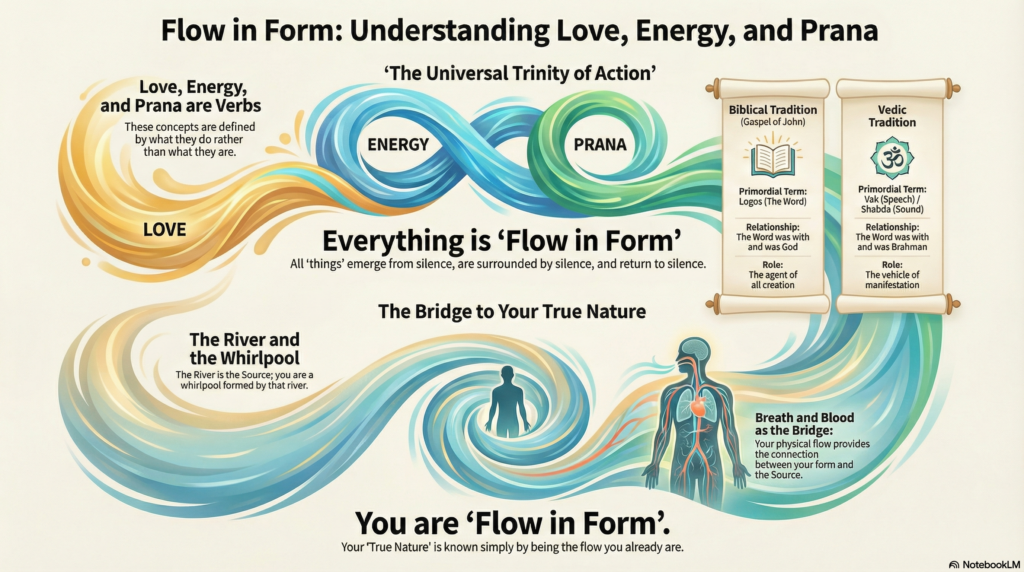
| Feature | Gospel of John (Logos) | Vedic Tradition (Vak/Shabda) |
| Primordial Term | Logos (The Word) | Vak (Speech) / Shabda (Sound) |
| Relationship | The Word was with God and was God. | The Word was with Prajapati and was Brahman. |
| Role | The Agent of creation (“All things were made through Him”). | The Vehicle of manifestation (Creation as a projection of sound). |
These linguistic parallels illuminate a shared understanding of Vac-as-Brahman cosmogony: the universe is a divine speech spoken into the void, where the “Substance” of the word is the Silence from which it was uttered.
3. The Cosmic Vibration: AUM and the Cycle of Silence
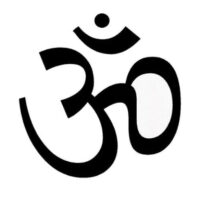
In the Vedic and Upanishadic traditions, this creative “Word” is identified as the mantra AUM (Om). AUM is the primordial vibration—the sonic representation of the totality of existence. This vibration follows a precise, three-stage lifecycle that reflects the rhythm of all manifest forms:
- Arising from Silence: The vibration emerges from the absolute stillness of the Unmanifest Source.
- Surrounded by Silence: Throughout its duration, the sound is held and supported by the field of Silence.
- Returning to Silence: The vibration eventually fades, resolving back into the original Silence.
This cycle demonstrates that while vibration creates the appearance of form, the enduring reality—the “Substance” of the sound—remains the Silence. This transition from abstract cosmic sound leads us to the practical, energetic forces that sustain our immediate life.
4. Existence as a Verb: Love, Energy, and Prana
A rigorous philosophical inquiry requires us to re-evaluate our linguistic categories. We often treat the fundamental forces of life as nouns—static things to be possessed. However, the Source Context argues that these forces are essentially “Flow.” They are not things; they are Verbs.
- Love: Love is what it does. Its nature is the continuous act of loving. It is Love Manifest.
- Energy: Energy is understood exclusively through its activity; it is defined as the ability to do work. It is “Energy-In-Formation.”
- Prana: Derived from the roots Pra (forth/constant) and Ana (to breathe, move, live), Prana is the “Life Force” or “Animating Principle.” It is the “Breath within the Breath” and is synonymous with the concept of Flow.
When we view Love, Energy, and Prana as verbs, we realize that the universe is not a finished product but a continuous “Energy-In-Formation”—a flow that takes temporary shape in our physical world.
5. The Metaphor of the River: Flow in Form
To clarify the relationship between the individual and the Infinite, we utilize the analogy of the Whirlpool and the River. This metaphor reconciles the appearance of a distinct “Form” with the reality of a single “Source.”
Definition: Flow in Form
It is the nature of a river to flow. When the river’s flow enters a specific configuration, a Whirlpool appears. Though the whirlpool has a distinct shape and location, it is composed entirely of the river’s water.
- The River is the Source (Silence, God, or Energy).
- The Whirlpool is the Individual Form (The Body-Mind).
- The Substance of both is identical; form does not imply separation.
This “Flow in Form” illustrates that you are not a separate entity attempting to reach the Source; you are the Source in motion.
6. Conclusion: The Bridge of Breath and Blood
This primer moves beyond mere philosophy into the realm of empirical fact. The student does not need to rely on blind belief to realize their true nature. One needs only to observe the “Bridge” that connects the individual “Whirlpool” to the universal “River.”
The most fundamental connection between your form and the Source is the constant movement within: your Breath Flow and your Blood Flow. Just as the sound AUM arises from and returns to Silence, your breath arises from and returns to the Source. Your human form is quite literally “breath and blood in motion.”
How is this truth known? It is not known through external study, but through “Knowing via Being.” You do not have to “become” the Flow; you simply recognize that you already are That.
——————————————————————————–
WHO AM I?
You are Flow in Form.
Leave a Reply