It is the nature of an error to cease once it is clearly seen.
The fundamental error I want to explore is subtle: we treat verbs as nouns.
You Are Not a Thing: Rivers, Whirlpools, and the Flow of Self
There’s a simple error that quietly shapes how we see everything:
It sounds harmless, but it affects how we experience ourselves, other people, and life itself. Once you see this error clearly, it starts to fall apart on its own.
You don’t have to change your language. You just stop being tricked by it.
1. When Naming Becomes Freezing
Rivers Whirlpools and the Fundamental Error of Naming – Language is full of nouns: river, tree, body, mind, self.
As children, we learn that once something has a name, we “know” what it is. But naming is not the same as knowing. Often, naming is how we stop really looking.
Take a river.
We point and say “river” as if that captures what’s there. But what’s actually happening?
- Water endlessly flowing
- Sediment eroding and depositing
- Banks collapsing and reforming
- Temperatures shifting
- Plants, fish, and microbes living and dying
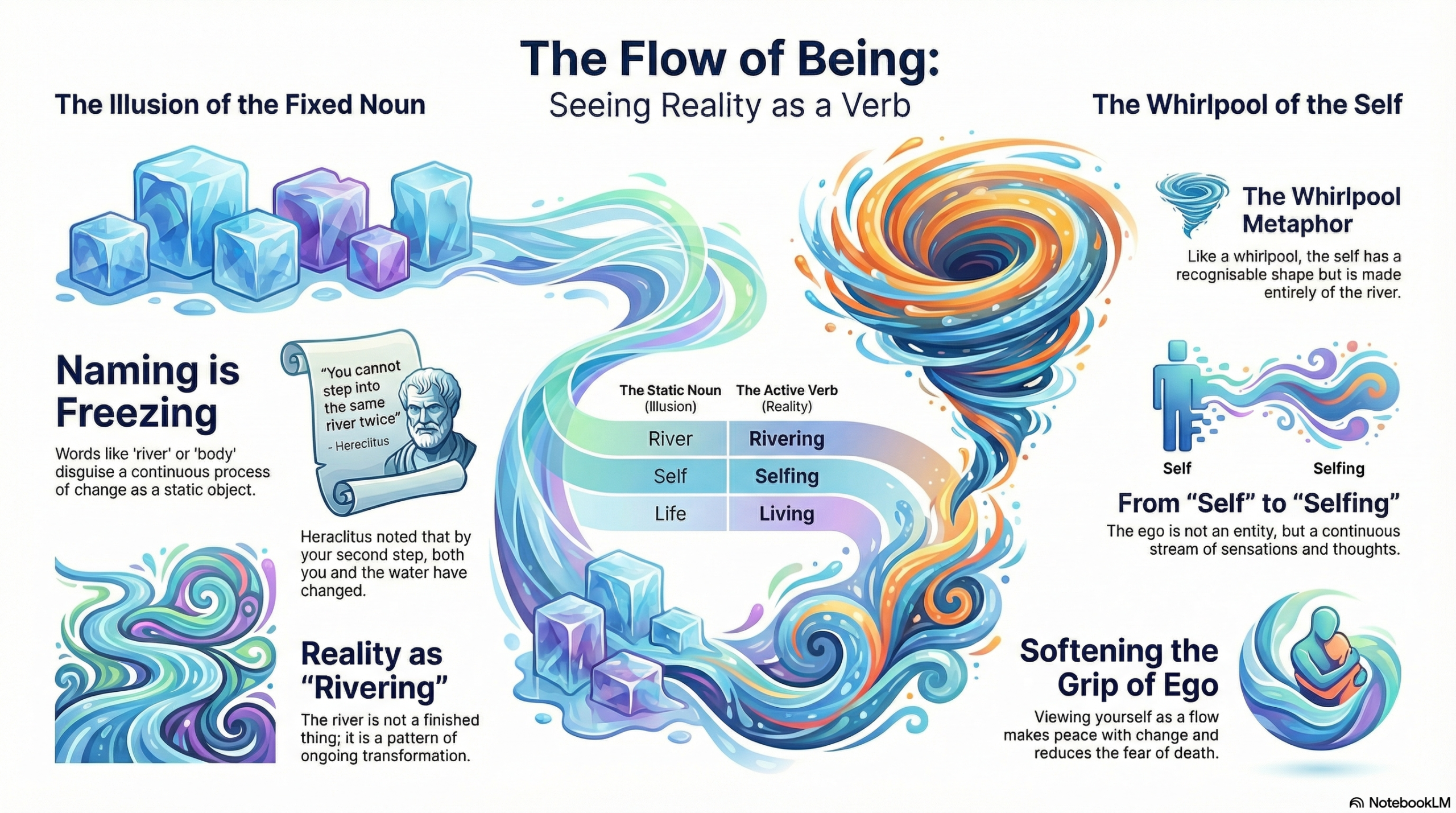
There is no static “thing” there. There is only rivering – a continuous, changing process. “River” is just a convenient handle for that flow.
The mistake is not using the word. The mistake is forgetting that the word freezes what is actually in motion.
We do this with almost everything.
2. Heraclitus and the Pattern of Change
Heraclitus said, “You can’t step into the same river twice.”
By the time you step in again, both you and the river have changed. The “sameness” of the river isn’t a fixed substance; it’s a recognizable pattern of change.
There’s no moment where the river is done. Its being is its doing.
In this sense, reality is more like a verb than a collection of solid nouns.
3. Self as Whirlpool, Not Object
This becomes personal when we turn it toward ourselves.
We speak as if we are solid things:
- “My body”
- “My mind”
- “My life”
But look closely:
- The body is constant exchange
- Air in and out
- Food becoming “me,” waste leaving “me”
- Cells dying, dividing, renewing
- The mind is constant movement
- Sensations arising and passing
- Thoughts appearing, changing, vanishing
- Emotions swelling and dissolving
There is no finished “you” at any point. There is only you-ing.
A helpful image is a whirlpool in a river:
- The river is Life, Source, reality as a whole
- The whirlpool is the pattern we call “me”
The whirlpool looks like a thing, but:
- It has no hard edge where “whirlpool” ends and “river” begins
- It’s made of nothing but the river
- Its identity is a form of motion, not a lump of stuff
So too with us: we are distinct patterns, but not separate substances. We are ways the river is swirling.
4. From “Self” to “Selfing”
When we say “self,” we usually imagine an inner owner:
- A someone who has experiences
- A stable “me” beneath the changes
But if you examine experience directly, what you find is:
- Sensations
- Thoughts (“my story,” “my problems”)
- Feelings
- Images, memories, expectations
These are all moving. The sense of “I” is woven out of this ongoing activity.
In other words, what we call “self” is selfing – a process, not a thing.
Like the whirlpool, the self is real as a pattern, but not as an independently existing object.
5. Breath and Blood: The River Inside You
This isn’t just poetic. The “rivering” is happening right now as your breathing and blood flow.
Breathing
We talk about “a breath” as if it were an object:
- “Take a breath.”
- “I lost my breath.”
But in reality:
- Air is constantly moving in and out
- Oxygen passes from air to blood
- Carbon dioxide passes from blood to air
- Muscles and nerves are coordinating without your conscious control
There is no static “breath.” There is only breathing – a continuous exchange between “you” and “world.”
The air that was “not-me” becomes “me,” then returns to “not-me.” The boundary is blurrier than it feels.
Blood
We talk as if blood were something we have:
- “My blood pressure.”
- “My blood is circulating.”
But blood is also a process:
- Cells and plasma constantly moving
- Oxygen and nutrients arriving, wastes leaving
- Signals and immune cells flowing everywhere
It’s a hidden river connecting every part of the body, constantly fed by what comes from outside: air, food, water.
What we call “my blood” is really blooding – circulation within the larger circulation of Earth and atmosphere.
The Vanishing Boundary
Breathing and blood flow show, in real time, that:
- The body is not a sealed container
- “Inside” and “outside” are in constant conversation
The “I” that says “my breath, my blood, my body” is arising together with these processes. There is no separate owner apart from what is happening.
Life is simply:
- Breathing
- Beating
- Circulating
- Sensing
- Thinking
The “me” who claims ownership is itself part of that movement.
6. Why This Matters
This way of seeing is not just interesting; it changes how we live.
Softer Ego
If you believe you are a fixed, separate someone, life becomes a project of:
- Defending an image
- Resisting change
- Fearing loss and death as total annihilation
When you see yourself as a whirlpool in the river:
- You still care for your life, your responsibilities, your relationships
- But you no longer confuse the pattern with a permanent object
The sense of “I” becomes lighter, less brittle, less desperate to control everything.
Peace with Change
If everything is flow:
- Aging is the river continuing
- Loss is the river rearranging its patterns
- Death is a whirlpool relaxing back into the water
This doesn’t erase grief. But it places it in a bigger context: what truly is, is the water, not the temporary shape.
Language as Tool, Not Trap
You don’t need to stop saying “river,” “self,” or “life.” You don’t need to talk in strange new jargon.
The shift is internal:
- When you say “river,” you know it’s rivering
- When you say “self,” you know it’s selfing
- When you say “my breath,” you know it’s breathing happening here
Nouns become gentle pointers to processes, not prisons that pretend to hold reality still.
7. One River, Many Whirlpools
If each of us is a whirlpool in the same river, then:
- We are genuinely different in pattern
- But not different in the water we’re made of
The same “stuff” flows as you, as me, as trees, oceans, animals, clouds.
From here:
- Compassion is simply recognition: the “other” is not fundamentally other
- Humility is natural: no whirlpool makes its own water
- Gratitude arises: this particular life is a temporary, unearned expression of something larger
To live as if we were isolated nouns is to live in a kind of illusion. To see ourselves as verbs in one vast flowing sentence of existence is to align more closely with how things actually are.
8. Letting Yourself Be a Verb
The core error is treating verbs as nouns and then trying to make those nouns safe and permanent.
We do it with rivers, with bodies, with breath and blood, with minds, with selves.
Seeing through this doesn’t require you to change your vocabulary. You can still say “I,” “you,” “world,” “river,” “life.”
What changes is the quiet understanding underneath:
- River is rivering
- Breath is breathing
- Blood is flowing
- Life is living
- Self is selfing
Everything is whirlpooling in one unfathomable river.
You can’t step into the same river twice, and you can’t be the same “you” twice either. There is only this moment’s pattern of flow, ever changing.
To recognize this is a kind of liberation:
- The burden of being a fixed someone softens
- Trust in the deeper current grows
- You can live more as an expression of the river than as a frightened noun trying to resist its own verb-like nature
We keep the words. We keep saying “river” and “self” and “life.”
But now, quietly, we know:
All of it is water.
All of it is flow.
Leave a Reply