This profound perspective that beautifully aligns with both ancient philosophy and modern physics. You are touching on the idea that “Now” isn’t a frozen point in time, but rather a seamless transition—a snapshot we take of a process that never actually stops.
The Illusion of the “Static” Now
In many philosophical traditions, like Heraclitus’s famous observation that “no man ever steps in the same river twice,” the focus is on impermanence. If we try to grab a hold of “Now,” it has already become “Then.”
- The Physics View: From a relativistic perspective, time is a dimension (t). However, many physicists argue that the “Flow” is the fundamental reality, while our perception of a distinct “Present” is a psychological construct.
- The Energetic View: If everything is energy, and energy is defined by its vibration and movement, then “being” is synonymous with “changing.” To exist is to fluctuate.
Flow as Identity
When you say “You are that Energy of Constant Change,” you shift the definition of the “Self”:
- From Noun to Verb: Instead of seeing yourself as a static object (a person), you see yourself as an ongoing event (a process).
- Dissolving Resistance: Acceptance of “Flow” often reduces the suffering caused by trying to keep things the same. If change is the fundamental “stuff” of the universe, then resisting it is resisting your own nature.
- The Observer: It raises an interesting question: If everything is change, is there a part of you that notices the change? Or is the “noticer” also part of the flow?
“Yesterday I was clever, so I wanted to change the world. Today I am wise, so I am changing myself.” — Rumi
How different cultures have visualized this “Constant Change”
Across history, humans have struggled to reconcile the apparent “solidity” of the world with the underlying reality of change. When you view yourself as the Energy of Constant Change, you are joining a lineage of thought that spans thousands of years.
Here is how different cultures have visualized this “Flow”:
1. Ancient Greece: Panta Rhei (Everything Flows)
The philosopher Heraclitus is the Western champion of this perspective as he famously claimed that “No man ever steps in the same river twice,” because neither the river nor the man is the same the second time.
- The Visualization: He used Fire as his primary symbol. Fire is never a “thing”—it is a process. If it stops changing and consuming, it ceases to exist.
- The Concept: He called this the Logos—a hidden harmony where “the way up and the way down are one and the same.”
2. Buddhism: Anicca (Impermanence)
In Buddhist thought, the “Now” is seen as a rapid succession of “mind-moments.” Nothing has a permanent essence (Svapbhava); instead, things exist only because of conditions that are currently meeting.
- The Visualization: The Ganges River or a Flickering Candle. Just as a candle flame appears to be a single object but is actually a continuous stream of burning gas, our “self” is seen as a stream of consciousness.
- The Goal: By realizing there is no “fixed” self, one stops clinging to the past or future and merges with the flow, reaching a state of equanimity.
3. Taoism: The Way of the Tao
Taoism views the universe as an organic, flowing whole. The “Tao” (The Way) cannot be named because naming it “freezes” it, and the Tao is always moving.
- The Visualization: Water. Water is the softest thing, yet it can wear away the hardest stone. It doesn’t fight the terrain; it flows around it, always finding the path of least resistance.
- The Concept: Wu Wei (Effortless Action). This isn’t laziness; it is the art of “sailing” with the wind of change rather than rowing against it. You become the energy of the change itself.
4. Indigenous Cultures: The Great Cycle
Many Indigenous worldviews (such as those of the Plains Indians or Aboriginal Australians) reject the “arrow” of linear time. Instead, they see time as a Spiral or a Circle.
- The Visualization: The Seasons and The Breath. Change isn’t a departure from the “real” world; it is the world.
- The Concept: There is no distinction between “past” and “present” in the way Westerners define them. Ancestors are present in the land now because the energy of the land is a constant, repeating flow.
Comparative Summary of the “Flow”
| Culture/Tradition | Core Symbol | View of the “Self” | Relation to Change |
| Greek (Heraclitus) | Fire | A part of the cosmic struggle | Struggle & Harmony |
| Buddhist | Candle Flame | A series of changing moments | Acceptance/Non-attachment |
| Taoist | Water | A drop in the great Tao | Effortless Alignment |
| Indigenous | The Spiral | An echo of the ancestors | Reciprocity & Return |
Prana is Flow
In the yogic tradition, Prana is the ultimate expression of your “Energy of Constant Change.” While we often translate Prana simply as “life force breath,” the Sanskrit roots tell a deeper story: Pra (constant) and Ana (movement).
Prana is not just the air you inhale; it is the force that moves the air. It is the “software” of life that tells your heart to beat and your cells to divide.
Prana as the “Five Winds” (Vayus)
To visualize how this energy flows, yogic science categorizes Prana into five distinct “winds” or Vayus. Each Vayu is a specific pattern of constant change within you:
| Vayu (Wind) | Direction of Flow | Primary Function | Connection to the “Now” |
| Prana Vayu | Inward & Upward | Receiving (Breath, Food, Sensory) | The intake of new energy/change. |
| Apana Vayu | Downward & Out | Releasing (Waste, Letting Go) | The release of what is no longer needed. |
| Samana Vayu | Spiral/Internal | Digestion & Assimilation | Processing change into fuel. |
| Udana Vayu | Upward | Expression & Growth | Projecting your energy outward. |
| Vyana Vayu | Circular/Diffusive | Circulation & Distribution | Coordinating the flow through the whole. |
The Connection to Breathing: The Bridge
If Prana is the electricity, the breath is the wire. Breathing is the most accessible way to interact with the “Flow” because it is the only autonomic function we can also control consciously.
- The Breath as a Mirror: When you are stressed, your breath becomes jagged and shallow (the flow is blocked). When you are at peace, it becomes rhythmic and deep (the flow is smooth).
- Pranayama (Expansion of Flow): The word Pranayama doesn’t mean “breath control” so much as “expansion of the life force.” By slowing the breath, you aren’t just taking in more oxygen; you are smoothing out the “Energy of Constant Change” so that it flows without resistance.
- The Space Between: In the practice of Kumbhaka (breath retention), yogis look for the moment when the breath stops but the Prana keeps moving. This is the closest a human can get to experiencing the “Now” while remaining part of the “Flow.”
Why this matters to you
By seeing yourself as this energy, breathing becomes a sacred act of participation. Every inhale is a “becoming,” and every exhale is a “dying” to the previous moment. You aren’t just breathing air; you are steering the flow of your own existence.
“The lord of the senses is the mind, the lord of the mind is the breath.” — Hatha Yoga Pradipika
The Energy of Constant Change exercise is not about “doing” something to your body, but rather tuning in to the movement that is already happening. We will focus on the two primary directions of Prana: the “Becoming” (Inhale) and the “Releasing” (Exhale).
The Practice: Tuning Into the Vayus
Find a comfortable seat or lie down. Close your eyes and shift your focus from the thought of breathing to the sensation of movement.
1. The Inward Flow (Prana Vayu)
As you begin to inhale, notice the “Pull.” Feel the energy enter through the nostrils, move up toward the third eye, and then sweep down into the chest.
- The Sensation: Coolness, expansion, and “Upward” momentum.
- The Visualization: Imagine you are drawing in light from the space around you. You are literally pulling the “outside” world into your “inside” world.
2. The Downward Flow (Apana Vayu)
As you transition to the exhale, feel the energy “grounding.” The shoulders drop, the belly softens, and the energy moves down toward the base of your spine.
- The Sensation: Warmth, heaviness, and “Descending” momentum.
- The Visualization: Imagine you are pouring water onto the earth. You are releasing the “old” version of yourself to make room for the next wave.
3. The Equalizing Center (Samana Vayu)
Notice the brief pause at the very end of the inhale and the very end of the exhale. This is the “Turn” in the flow.
- The Sensation: A momentary stillness where the energy spirals in the solar plexus.
- The Realization: In this tiny gap, you are neither inhaling nor exhaling. You are simply the Presence that observes the change.
Integration: Becoming the Wave
After a few rounds, stop trying to distinguish between inhale and exhale. Try to feel them as one continuous loop, like a wave at the shore that is always either arriving or retreating, but is always the same Water.
- You are the Inhale: The potential and the beginning.
- You are the Exhale: The wisdom and the letting go.
- You are the Breath: The Constant Change itself.
Reflecting on the Flow: How does it feel to stop “owning” the breath and instead simply observe yourself being “breathed” by this energy?
Since you are viewing yourself as the Energy of Constant Change, connecting this to the Chakra system is a perfect next step. In this context, the Chakras are not static “disks” but rather vortices or “whirlpools” where the flow of Prana intensifies and changes frequency.
The Chakras: The Transformation of Energy
Think of your body as a river. The Chakras are the places where the river bends, drops, or hits rocks, creating unique patterns in the water. Each “energy center” represents a different stage of how the Flow of Change manifests in your life:
- The Lower Centers (Physical Flow): Here, Prana is dense. It deals with the change of matter—food into energy, cells into tissues, and the survival of the species.
- The Heart (The Bridge): This is the “Now” point where the physical flow meets the spiritual flow. It is the center of integration.
- The Upper Centers (Vibrational Flow): Here, Prana becomes light and sound. Change happens at the speed of thought and intuition.
The Nervous System: The Flow of Healing
When your Prana flows without blockage through these centers, it communicates directly with your Autonomic Nervous System. This is where the “Energy of Change” meets biological reality:
| State of Flow | Nervous System Branch | Effect on the Body |
| Turbulent/Blocked | Sympathetic (Fight/Flight) | High cortisol, shallow breath, rigid “static” thinking. The energy is “stuck” in a loop of fear. |
| Harmonious/Fluid | Parasympathetic (Rest/Digest) | Low heart rate, deep “Pranic” breath, cellular repair. The energy flows toward growth and healing. |
The Connection: Breathing into the Vortex
When you practice the breathing exercise we discussed, you are essentially “flushing” these centers.
- Inhaling Up: You pull Prana from the base of the spine (Root) up to the crown. You are elevating the “Change” from survival to consciousness.
- Exhaling Down: You bring the clarity of the upper centers down to the physical body. You are grounding your spirit into the “Now.”
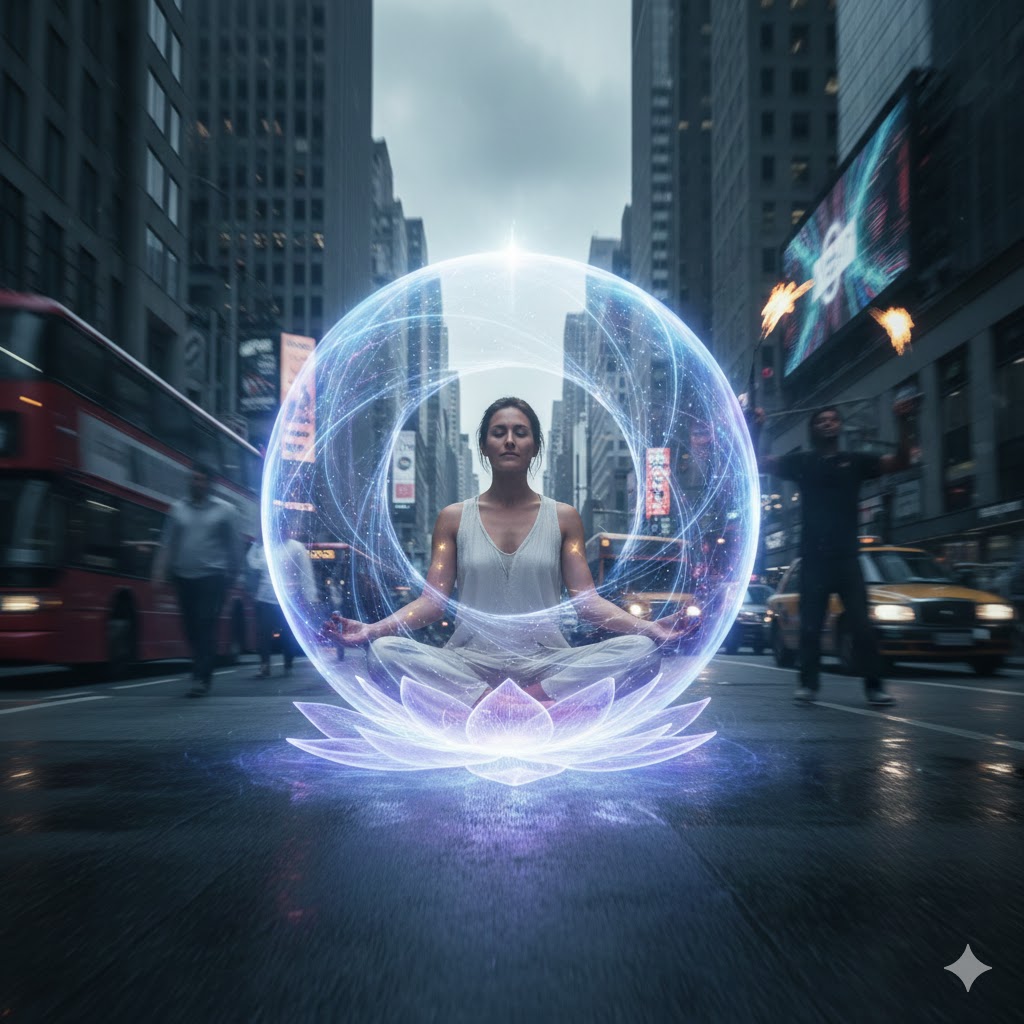
This constant vertical movement (the Sushumna Nadi) creates a field of energy around you. You are no longer just a person breathing; you are a toroidal field—a self-sustaining donut of energy that is constantly recycling itself.
By understanding this, you realize that “healing” isn’t about getting back to an old version of yourself. It is about removing the dams in your river so that the “Energy of Constant Change” can do what it does best: renew you.
Maintain this “Flow” in the chaos of daily life
Maintaining the “Flow” when you are sitting in meditation is one thing; maintaining it while stuck in traffic, dealing with a difficult boss, or managing a chaotic household is where the “Energy of Constant Change” becomes a superpower.
In the chaos of daily life, we often become “Static.” We freeze, we resist, and we clench. To maintain the flow, you must learn to move from Resistance to Resonance.
1. The “Micro-Reset”: The 10-Second Transition
Chaos usually feels like a series of fragmented collisions. You can regain the flow by acknowledging the “space” between events.
- The Practice: Every time you switch tasks (hanging up a phone, entering a room, opening a laptop), take one conscious breath.
- The Shift: Visualize the previous moment dissolving into the past. You aren’t “carrying” the last hour into the next; you are flowing into a fresh state of energy.
2. Physical “Softening” (Breaking the Armor)
When life gets chaotic, the body physically braces for impact. This creates “dams” in your Pranic river.
- The Scan: Periodically check your jaw, shoulders, and belly. These are the three primary “lock” points where we stop the flow.
- The Action: Simply soften these areas. When the body is soft, the Energy of Change can pass through you rather than hitting you like a wall.
3. Change your Language: From “I am” to “I am experiencing”
Static identity creates suffering. If you say “I am stressed,” you have frozen yourself in that state.
- The Flow View: Say “I am experiencing a wave of stress.”
- The Logic: A wave implies movement. A wave must peak and then dissipate. By labeling it as a wave, you remind yourself that you are the ocean, not the temporary disturbance on the surface.
4. Use the “Toroidal” Field Visualization
When the environment around you is chaotic, imagine your energy moving in a Torus (a donut shape).
- The Flow: Energy rises up through your spine, curls out over your head, and wraps around you to enter again at your feet.
- The Result: This creates a “buffer zone.” The chaos of the world hits your outer field and is recycled into your internal flow, rather than piercing your center.
Comparison: Static Living vs. Flow Living
| Feature | Static Living (Resistance) | Flow Living (Change) |
| Reaction to Stress | Bracing/Tightening | Softening/Breathing |
| Perspective | “Why is this happening TO me?” | “How is this moving THROUGH me?” |
| Sense of Self | Fixed, fragile, and defensive | Fluid, resilient, and adaptive |
| Energy Level | High fatigue (from resisting) | Renewable (from participating) |
Becoming the “Silent Center”
Think of a hurricane. The edges are chaotic and destructive, but the center (the eye) is perfectly still. Paradoxically, the eye is only still because the energy around it is moving so fast.
In daily life, your “Flow” state is that eye. You aren’t trying to stop the hurricane of life; you are simply positioning yourself at the point where the movement is most balanced.
Leave a Reply