5 Surprising Truths About Your Biological Reality
1. Introduction: The Illusion of Solidity
Most of us perceive ourselves as static, physical objects—solid entities navigating a world of other solid things.
However, this perception is a biological illusion, a trick of the senses that masks a far more radiant reality.
Rather than being a fixed “thing,” the human body is more accurately described as a “Living Vortex.”
Consider the whirlpool.
As you watch it churn in a river, it appears to be a distinct object with a definite shape.
But look closer: the water is rushing through it at incredible speeds, never staying for more than a second.
The whirlpool is not the water itself; it is the specific, momentary pattern through which the water flows.
We are that pattern.
We are a process in motion, a “Source in motion,” rather than a static collection of matter.
By exploring the intersections of geometry, quantum biology, and consciousness, we can begin to redefine what it means to be human—moving beyond the “bag of skin” to recognize ourselves as an ever-evolving expression of flow.
2. Takeaway 1: You Are a “Constant Happening” (The 98% Rule)
Scientific data regarding “Total Atomic Renewal” reveals that our physical bodies are in a state of perpetual flux.
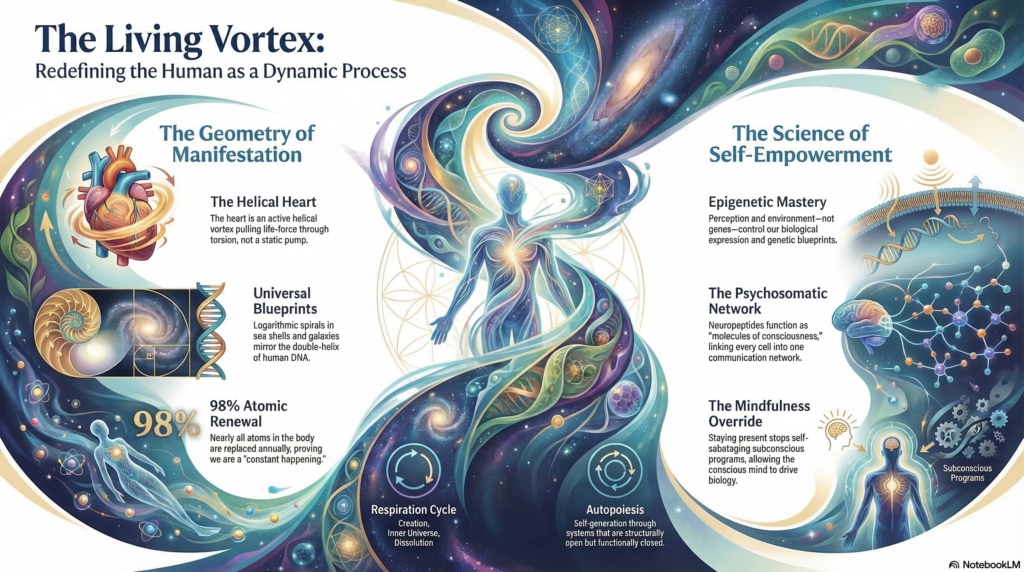
Research confirms that a staggering 98% of the atoms currently in your body are replaced every single year.
You are an “open system,” a biological transit point constantly exchanging matter with the environment.
If your material components are almost entirely different from year to year, your identity cannot be anchored in physical parts. Instead, your true nature is a “dynamic process.”
The Verb of Being We are not nouns; we are verbs.
Our existence is a “constant happening” rather than a finished product.
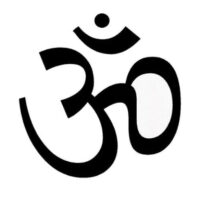
This reality is proven in every breath we take through the AUM physiological model.
Respiration is the physical evidence that we are not separate entities, but part of a cosmic cycle of manifestation.
Inhalation represents Creation, the intake of energy and matter;
the Pause represents the Inner Universe, the moment of integration;
and Exhalation represents Dissolution, the release back into the environment.
In this cycle, the “Source in motion” becomes a lived, biological fact.
3. Takeaway 2: Your Heart is a Vortex, Not a Pump
Conventional medicine often describes the heart as a mechanical, static pump—a heavy-duty piston forcing blood through tubes.
However, cutting-edge models suggest the heart is actually an “active helical vortex.”
Rather than simply pushing, the heart utilizes torsion to pull life-force into the body, acting as a rhythmic engine of flow.
This helical structure is a “biological signature” found throughout the known universe.
There are profound geometric parallels between the double-helix of our DNA, the logarithmic spirals of sea shells, and the rotating arms of spiral galaxies.
These forms are the physical manifestation of Spanda, or primordial vibration.
The heart’s helical geometry is the visual equivalent of the cosmic sound AUM, serving as a bridge between universal blueprints and biological life.
Your heart doesn’t just sustain life; it mirrors the geometry of the stars.
4. Takeaway 3: Your Mind Has No Edges (The Psychosomatic Network)
The traditional view that the mind is a prisoner of the skull is rapidly dissolving.
Research by Candace Pert identifies neuropeptides as “molecules of consciousness” that link every cell into a single, unified communication network.
This means consciousness is not a centralized executive in the brain, but a distributed intelligence woven into the very fabric of our tissues.
Because of this “Psychosomatic Network,” we must view the mind through the lens of 4E cognition: it is Embodied in our cells, Embedded in our environment, Enacted through our social interactions, and Extended through tools and language.
Our cognitive architecture does not stop at the skin; it is a coupled system that merges with the world around it.
When you use a tool or speak a language, your mind is literally expanding into the environment.
The “self” has no hard edges; it is a porous, extended network of experience.
5. Takeaway 4: Perception Is Your Biological Master
The field of epigenetics has shattered the myth of genetic determinism.
We are not victims of our DNA; instead, our perception and environment control how our genes are expressed.
While our genetic blueprints provide the possibilities, the “reading” of those blueprints is determined by our response to the world.
A vital component of this control system is the “Somatic Marker”—the emotional and physical signals our bodies send to the brain.
These markers act as a biological shorthand, influencing our reasoning and decision-making before we even have a conscious thought.
This science offers a profound path to empowerment.
Through a “Mindfulness Override,” we can stay present and observe these somatic signals rather than reacting to them blindly.
By changing our internal state, we alter the “input” to our genes, effectively rewriting our biological expression and interrupting self-sabotaging subconscious programs.
6. Takeaway 5: The Uroboros of Self-Generation
To understand how we can be both a distinct entity and a part of the environment, we look to Francisco Varela’s concept of “Autopoiesis.”
The human body is an autonomous system that is “structurally open but functionally closed.”
We are a system that generates itself, maintaining a stable identity even as the water of the world rushes through us.
The ancient symbol of the Uroboros—the snake eating its own tail—perfectly illustrates this self-generation.
Just as the AUM cycle of breathing integrates creation and dissolution, our biology is a closed loop of self-maintenance that relies on an open exchange with the cosmos.
We are self-organizing processes that create our own boundaries, existing as a localized expression of the universal flow.
Conclusion: Becoming the Aperture
When we look past the “bag of skin,” we find a reality that is far more expansive and interconnected than we ever imagined.
We are helical vortexes of energy, distributed minds that extend far into our surroundings, and masters of our own genetic destiny.
The human being is not a static object adrift in a cold universe; we are an “aperture through which the cosmos experiences itself.”
We are the “Source in motion,” a living process that is simultaneously the creator and the creation.
If you are the flow and not the vessel, what direction will you command your current to take?
Leave a Reply