Why You’re a Process, Not a Person: 5 Radical Shifts in Reality
When you look into a mirror, you likely see a solid, permanent object—a monument of flesh with a fixed identity, much like a brick or a piece of furniture.
This is the mirror’s great deception. Biology and physics suggest a radical transience: we are less a static “thing” and more a high-velocity exchange of atoms.
We are not nouns; we are verbs.
To understand this shift, we must distinguish between an object and a process.
A rock is a static object; its atoms are locked in place, remaining relatively unchanged for decades.
A flame or a dance, however, is a process.
A flame appears to have a steady shape, but it is actually a continuous interaction of fuel and oxygen.
It exists only as long as there is movement and flow.
By synthesizing the ancient insights of Advaita Vedanta with modern physics, we discover that the “self” is not a finished product, but a “you-shaped pattern” in the constant river of life.
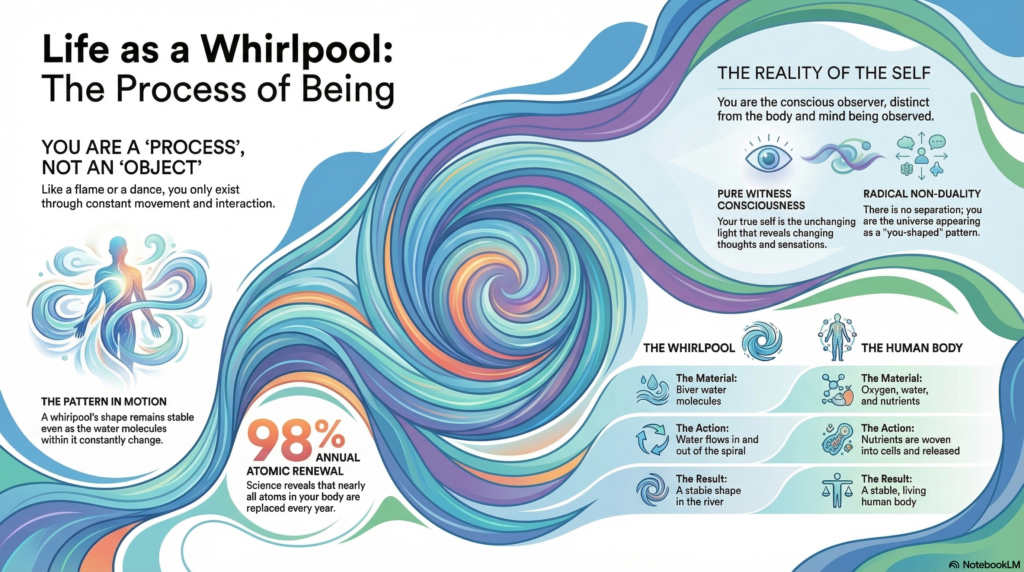
1. You Are the Whirlpool, Not the Water
Consider a whirlpool in a fast-flowing river.
It possesses a distinct, recognizable shape, yet it is composed of water that is constantly rushing in one side and out the other.
The specific molecules that constituted the whirlpool a second ago are already gone, replaced by new ones.
The whirlpool is a pattern, not a thing. As James Traverse noted, the shape remains stable only because the flow is steady.
The human body functions precisely like this.
While we perceive our bones and muscles as permanent fixtures, science reveals that 98% of the atoms in the human body are replaced every single year.
We are a biological process in a state of total renewal.
This flow is not merely internal; it is an open-loop system with the environment.
Through the simple act of breathing, we trade pieces of ourselves with the atmosphere.
We inhale oxygen “exhaled” by trees, and we exhale carbon dioxide that becomes the very wood of those same trees.
We are not separate from the world; we are a localized swirl in the continuous stream of nature, maintaining stability through movement rather than stagnation.
2. Solving the “10th Man” Problem with Swami Sarvapriyananda
Swami Sarvapriyananda tells an ancient Indian parable recounts ten friends who cross a treacherous river.
Fearing one has drowned, each man counts the others, reaching only nine.
They wail in grief until a passerby catches the counter’s hand and points it back at the counter himself: “You are the tenth.”
The error was looking for an “object” to count while overlooking the subject doing the counting.
We often feel “missing” from our own lives because we treat the self as a thing to be found rather than the awareness that finds it.
This leads to the “Deconstruction of Self.” Using the logic of the “Seer and the Seen,” we can observe that the body is a biological machine and the mind is psychological machinery.
Because I can observe my body, my breath, and my thoughts, I cannot literally be them.
The object seen is always distinct from the subject who sees.
We are the Witness—the “tenth man” who is never lost, but simply forgotten in the frantic search for external objects.
3. The “Hard Problem” is Upside Down
Modern science is haunted by the “Hard Problem of Consciousness”: the mystery of how physical brain matter produces the “feels-like” quality of experience.
Materialism assumes the brain produces consciousness, yet despite a landscape of over 325 competing theories, science has failed to explain how neurochemical activity translates into the smell of a rose or the melody of a song.
The Vedantic view suggests the materialist approach is upside down.
Consciousness is not a byproduct of the brain; it is fundamental.
A key nuance is the simplicity of consciousness versus the complexity of experience.
Consciousness itself is “simple”—it only does one thing, which is provide the quality of awareness.
The complexity belongs entirely to the objects of experience: the neurochemistry, the sunsets, and the music.
This is the metaphor of the Bare Light. Just as bare light reveals a landscape without being altered by the objects it illuminates, consciousness reveals a “depressed” or “joyful” mind without itself becoming depressed or joyful. It is the steady, unstained background upon which the drama of life is projected.
4. Renunciation is an Internal Upgrade, Not a Forest Retreat
In the popular imagination, renunciation is a grim withdrawal from the world. However, Swami Sarvapriyananda redefines it as an internal shift in orientation.
It is not about giving up possessions, but about ensuring you are not possessed by them.
It is the realization that you can have things, but the things don’t “have” you.
The tradition illustrates this through the story of the monk Shukadeva and Emperor Janaka.
Shukadeva was a wandering monk who owned nothing but a loincloth, yet he was deeply anxious when it was threatened by a small fire.
Conversely, Emperor Janaka sat on a throne, ruling a kingdom, yet remained serene and unattached even when told his capital city might burn.
This is the shift from the “Unripe Ego”—the “begging bowl” that seeks fulfillment by grabbing things from the world—to the “Ripe Ego,” which realizes it is already the “fullness” (Ananda).
Renunciation is the upgrade from seeking light to realizing you are the source of it.
5. The Two Arrows of Suffering
The Buddhist “Two Arrows” story provides a precise anatomy of human misery.
The “First Arrow” is the unavoidable physical pain or circumstance of life—sickness, aging, and loss.
The “Second Arrow” is our mental reaction: the anxiety, resentment, and resistance we layer on top of the initial wound.
While enlightenment does not stop the first arrow, it provides “Stabilized Wisdom” (Sthitaprajna) that insulates us from the second.
This is the “So What?” shift.
It is the move from being upset by the setup of life to being serene within it.
As the Swami explains, the world is like a movie screen.
The drama of the film—the fires, the storms, the tragedies—appears to happen on the screen, but when the movie ends, the screen is found to be completely unstained and dry.
Stabilized wisdom allows us to participate in the “movie” of life while remaining grounded in the reality of the “screen.”
Conclusion: The One and the Zeros
To understand the ultimate value of this shift, consider Sri Ramakrishna’s parable of the ones and zeros.
Worldly achievements—wealth, fame, and power—are like zeros.
Alone, they represent nothing.
You can line up an infinite string of zeros, and the sum remains zero.
However, when you place the “One” (Spirituality/Self-Knowledge) in front of them, every zero suddenly gains immense value, transforming the sequence into tens, hundreds, and millions.
The worldly “zeros” are not valueless, but their value is derived entirely from the “One.”
When you realize you are a process and the witness rather than a static, lacking object, life ceases to be a transactional struggle.
It becomes a manifestation of the fullness you already possess.
If you were to step back from the “person” you think you are for just one moment, what is the light that remains?

Leave a Reply to The Vibrational Blueprint of Being – Cancel reply