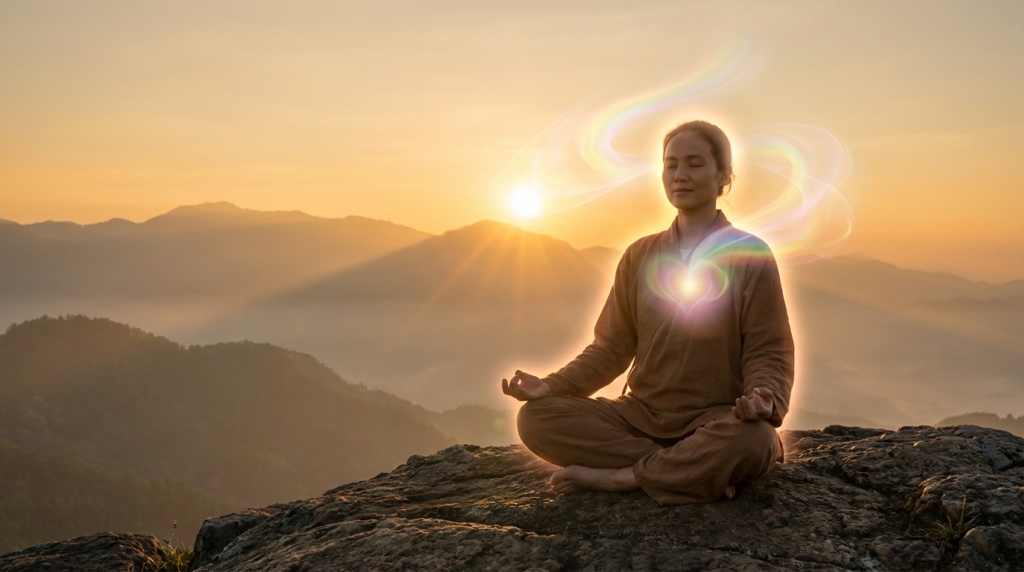
Introduction to Yoga and Spiritual Awakening
Yoga is far more than a physical exercise routine—it is a profound spiritual practice that has guided seekers toward enlightenment for over 5,000 years. Spiritual awakening through yoga represents a transformative journey where practitioners move beyond the physical realm to discover their true nature and connect with universal consciousness.
The ancient science of yoga provides a systematic approach to self-realization, combining physical postures (asanas), breath control (pranayama), meditation (dhyana), and ethical principles (yamas and niyamas) to create a comprehensive path toward spiritual growth.
Understand Spiritual Awakening
What is Spiritual Awakening?
Spiritual awakening is a shift in consciousness where an individual transcends their ego-based identity and experiences a deeper connection to their authentic self and the universe. This awakening involves:
- Expanded Awareness: Moving beyond limited self-perception
- Inner Peace: Finding tranquility independent of external circumstances
- Universal Connection: Recognizing the interconnectedness of all existence
- Authentic Living: Aligning actions with deeper truth and purpose
- Transcendence: Rising above material attachments and ego-driven desires
Signs of Spiritual Awakening
- Heightened intuition and inner guidance
- Increased compassion and empathy for all beings
- Desire for solitude and introspection
- Questioning previous beliefs and life patterns
- Experiencing synchronicities and meaningful coincidences
- Feeling a deep sense of purpose and meaning
- Greater appreciation for present-moment awareness
The Eight Limbs of Yoga: A Pathway to Enlightenment
Patanjali’s Yoga Sutras outline the Eight Limbs of Yoga (Ashtanga Yoga), which form a comprehensive framework for spiritual development:
1. Yama (Ethical Restraints)
- Ahimsa: Non-violence in thought, word, and action
- Satya: Truthfulness and honesty
- Asteya: Non-stealing and respecting others’ possessions
- Brahmacharya: Energy conservation and moderation
- Aparigraha: Non-attachment and freedom from greed
2. Niyama (Personal Observances)
- Saucha: Purity of body and mind
- Santosha: Contentment and acceptance
- Tapas: Self-discipline and inner fire
- Svadhyaya: Self-study and introspection
- Ishvara Pranidhana: Surrender to the divine
3. Asana (Physical Postures)
Physical poses prepare the body for meditation by:
- Releasing physical tensions and blockages
- Strengthening the nervous system
- Creating flexibility and balance
- Cultivating body awareness
4. Pranayama (Breath Control)
Breathing techniques that:
- Regulate life force energy (prana)
- Calm the mind and nervous system
- Purify energy channels (nadis)
- Prepare consciousness for meditation
5. Pratyahara (Sense Withdrawal)
- Turning attention inward
- Reducing external distractions
- Developing inner focus
- Bridging outer and inner worlds
6. Dharana (Concentration)
- Single-pointed focus
- Training the wandering mind
- Developing mental discipline
- Preparing for meditation
7. Dhyana (Meditation)
- Sustained, uninterrupted awareness
- Witnessing thoughts without attachment
- Experiencing stillness between thoughts
- Deepening self-awareness
8. Samadhi (Absorption/Union/Enlightenment)
- Complete absorption in consciousness
- Dissolution of individual ego
- Experience of oneness with all
- Ultimate spiritual awakening
How Yoga Facilitates Spiritual Awakening
1. Activating and Balancing the Chakras
Yoga practices work directly with the body’s energy centers (chakras), facilitating spiritual growth:
| Chakra | Location | Spiritual Function | Yoga Practices |
|---|---|---|---|
| Muladhara (Root) | Base of spine | Grounding, security, survival instinct | Standing poses, grounding meditation |
| Svadhisthana (Sacral) | Lower abdomen | Creativity, emotions, sensuality | Hip openers, flowing movements |
| Manipura (Solar Plexus) | Upper abdomen | Personal power, confidence, will | Core strengthening, breathwork |
| Anahata (Heart) | Center of chest | Love, compassion, connection | Heart-opening poses, loving-kindness meditation |
| Vishuddha (Throat) | Throat | Expression, truth, communication | Shoulder stands, chanting, mantras |
| Ajna (Third Eye) | Between eyebrows | Intuition, insight, wisdom | Meditation, visualization, forward folds |
| Sahasrara (Crown) | Top of head | Divine connection, enlightenment | Headstands, silent meditation, prayer |
2. Awaken Kundalini Energy
Kundalini is the dormant spiritual energy residing at the base of the spine. Through dedicated yoga practice:
- Energy Rises: Kundalini awakens and travels upward through the chakras
- Consciousness Expands: Each chakra activation brings new levels of awareness
- Transformation Occurs: Physical, emotional, and spiritual purification takes place
- Union Achieved: Energy reaches the crown chakra, facilitating enlightenment
3. Quiet the Mental Chatter (Chitta Vritti)
The primary obstacle to spiritual awakening is the constant fluctuation of thoughts. Yoga addresses this through:
- Mindful Movement: Asanas require present-moment focus
- Breath Awareness: Pranayama anchors attention to the now
- Meditation Practice: Systematic training to observe and transcend thoughts
- Witness Consciousness: Developing the ability to watch the mind without identification
4. Cultivate Present-Moment Awareness
Spiritual awakening happens in the eternal now. Yoga develops this awareness through:
- Body Scanning: Noticing subtle sensations during practice
- Breath Following: Tracking each inhalation and exhalation
- Mindful Transitions: Moving consciously between poses
- Savasana Integration: Deep relaxation and presence
5. Dissolve the Ego
The ego, or false sense of separate self, is the primary barrier to awakening. Yoga dissolves ego through:
- Humility Practice: Accepting limitations without judgment
- Service (Seva): Acting selflessly for others
- Surrender: Letting go of control and outcomes
- Self-Inquiry: Questioning “Who am I?” beyond roles and identities
Types of Yoga for Spiritual Awakening
Kundalini Yoga
- Focus: Awakening dormant spiritual energy
- Practices: Dynamic movements, breath of fire, mantra chanting
- Benefits: Rapid spiritual transformation, energy activation
- Best For: Those seeking intense spiritual experiences
Raja Yoga
- Focus: Meditation and mental mastery
- Practices: Eight Limbs of Yoga, contemplation
- Benefits: Deep self-awareness, mental clarity
- Best For: Philosophical seekers and meditators
Bhakti Yoga
- Focus: Devotion and divine love
- Practices: Chanting, prayer, devotional service
- Benefits: Opening the heart, transcending ego through love
- Best For: Those with devotional temperament
Jnana Yoga
- Focus: Knowledge and wisdom
- Practices: Self-inquiry, scriptural study, contemplation
- Benefits: Intellectual understanding of truth
- Best For: Analytical, philosophical minds
Karma Yoga
- Focus: Selfless action and service
- Practices: Working without attachment to results
- Benefits: Purification of heart, ego dissolution
- Best For: Action-oriented individuals
Hatha Yoga
- Focus: Physical and energetic purification
- Practices: Asanas, pranayama, cleansing techniques
- Benefits: Preparing body and mind for meditation
- Best For: Beginners and those needing physical foundation
Scientific Evidence: Yoga and Consciousness
Modern neuroscience confirms what ancient yogis knew:
Brain Changes from Yoga Practice
- Increased Gray Matter: Regular meditation increases brain density in areas associated with awareness
- Enhanced Neural Plasticity: Yoga rewires the brain for positive states
- Reduced Amygdala Activity: Decreased fear and stress responses
- Strengthened Prefrontal Cortex: Improved decision-making and self-regulation
- Elevated GABA Levels: Natural anxiety reduction and mood enhancement
Measurable Benefits
- 30% reduction in stress hormones (cortisol)
- 65% improvement in emotional regulation
- Significant increases in alpha and theta brain waves (associated with relaxation and meditation)
- Enhanced heart rate variability (marker of resilience)
- Improved immune function and cellular health
Practical Steps to Begin Your Spiritual Awakening Journey
For Beginners
- Start with Simple Asanas
- Sun Salutations (Surya Namaskar)
- Child’s Pose (Balasana)
- Mountain Pose (Tadasana)
- Corpse Pose (Savasana)
- Introduce Basic Pranayama
- Deep belly breathing
- Alternate nostril breathing (Nadi Shodhana)
- Three-part breath (Dirga Pranayama)
- Begin a Meditation Practice
- Start with 5 minutes daily
- Focus on breath or a simple mantra
- Gradually increase duration
- Study Yoga Philosophy
- Read the Yoga Sutras of Patanjali
- Explore the Bhagavad Gita
- Learn about chakras and energy anatomy
Intermediate Practices
- Extend meditation sessions to 20-30 minutes
- Practice more advanced pranayama techniques
- Incorporate mantra chanting (Om, So Hum)
- Explore specific chakra meditation
- Attend retreats or workshops
Advanced Practices
- Extended meditation retreats (Vipassana, silent retreats)
- Kundalini awakening practices under guidance
- Advanced pranayama (Kapalabhati, Bhastrika)
- Self-inquiry and contemplation
- Teaching and serving others
Common Obstacles and How to Overcome Them
Physical Discomfort
- Solution: Modify poses, use props, practice ahimsa (non-violence) toward your body
- Mindset: Discomfort teaches presence and acceptance
Restless Mind
- Solution: Return focus to breath repeatedly, practice loving acceptance of thoughts
- Mindset: The wandering mind is normal; training happens through patient return
Doubt and Skepticism
- Solution: Approach with beginner’s mind, direct personal experience over beliefs
- Mindset: Question everything, including your doubts
Impatience with Progress
- Solution: Release attachment to outcomes, find joy in the practice itself
- Mindset: The journey is the destination; awakening is happening now
Spiritual Bypassing
- Solution: Address emotional wounds, integrate shadow work, seek therapy if needed
- Mindset: True awakening includes all aspects of being, not escape from pain
Key Takeaways
✓ Yoga is a holistic spiritual practice that integrates physical, mental, and energetic dimensions for complete transformation
✓ The Eight Limbs provide a systematic path from ethical living to ultimate enlightenment
✓ Chakra activation and kundalini awakening are powerful mechanisms of spiritual transformation in yoga
✓ Meditation and mindfulness quiet mental chatter, revealing the true nature of consciousness
✓ Different yoga paths suit different temperaments—devotional, intellectual, action-oriented, or meditative
✓ Scientific research validates the consciousness-expanding effects of yoga on brain structure and function
✓ Consistent practice is essential—spiritual awakening unfolds gradually through dedicated effort
✓ Integration matters—awakening isn’t escape but full embodiment of truth in daily life
✓ Guidance helps—teachers, communities, and retreats accelerate spiritual growth
✓ The journey is individual—each person’s awakening unfolds uniquely according to their nature
People Also Ask Regarding: How Does Yoga Help with Spiritual Awakening?
Q1: How long does it take to experience spiritual awakening through yoga?
A: There is no fixed timeline for spiritual awakening. Some practitioners experience profound shifts within months, while others practice for years before major breakthroughs. Awakening often happens in layers—small insights accumulate over time, leading to deeper realizations. The key is consistent, sincere practice without attachment to specific outcomes. Mini-awakenings or glimpses of expanded consciousness may occur early, while full stabilization of awakened awareness typically requires years of dedicated practice.
Q2: Do I need to be flexible or physically fit to use yoga for spiritual awakening?
A: Absolutely not. While physical yoga (asanas) is one component, spiritual awakening is accessible regardless of physical ability. Meditation, pranayama, mantra practice, and ethical living (yamas and niyamas) are equally powerful pathways that require no physical flexibility. Many enlightened yogis have achieved realization primarily through meditation and devotion. The body is a vehicle, not the destination. Modify practices to suit your abilities, or focus on non-physical aspects of yoga.
Q3: Can yoga spiritual practices conflict with my religion?
A: Yoga is fundamentally a spiritual science rather than a religion. While it originated in Hindu culture, its practices and principles are universal and compatible with most religious traditions. Many Christians, Muslims, Jews, and Buddhists integrate yoga while maintaining their faith. You can view yoga as a set of techniques for self-awareness and inner peace rather than a belief system. If certain elements feel uncomfortable (like chanting Hindu deities), you can substitute prayers or mantras from your own tradition while retaining the beneficial practices.
Q4: What is kundalini awakening, and is it dangerous?
A: Kundalini awakening refers to the activation of dormant spiritual energy at the base of the spine, which rises through the chakras, bringing expanded consciousness. When guided properly, it’s a natural part of spiritual evolution. However, forced or premature awakening without adequate preparation can cause physical discomfort, emotional upheaval, or psychological distress. Practice under experienced guidance, build a strong foundation through gentle practices, and allow the process to unfold naturally. Most traditional yoga practices work with kundalini safely and gradually.
Q5: How do I know if I’m experiencing spiritual awakening or just feeling good from exercise?
A: Spiritual awakening involves qualitative shifts in consciousness that go beyond physical well-being:
- Perspective Changes: Fundamental shifts in how you view yourself and reality
- Increased Awareness: Heightened presence and witnessing consciousness
- Compassion Expansion: Genuine care for all beings, not just self-improvement
- Detachment from Ego: Less identification with roles, possessions, and mental narratives
- Meaning and Purpose: Deep sense of connection to something greater
- Spontaneous Wisdom: Insights arising without intellectual effort
Exercise endorphins feel pleasant but don’t fundamentally change your relationship to existence. If you’re questioning and seeking deeper meaning, you’re likely experiencing the early stages of awakening.
Q6: Should I practice yoga alone or join a class for spiritual development?
A: Both have value. Classes provide:
- Expert guidance and correction
- Community support and energy
- Structured learning progression
- Motivation and accountability
Solo practice offers:
- Deep introspection without distraction
- Personalized timing and pacing
- Direct experience without external influence
- Development of inner guidance
Ideal approach: Combine both. Learn from qualified teachers, attend classes or workshops regularly, but also develop a personal home practice. This balances external wisdom with inner discovery.
Q7: Can I experience spiritual awakening without a guru or teacher?
A: While a qualified teacher greatly accelerates the journey and helps navigate challenges, self-directed awakening is possible. The true guru is your own inner wisdom, which external teachers help you access. Many have awakened through books, self-practice, and direct experience. However, teachers provide:
- Navigation of difficult phases
- Clarification of confusing experiences
- Protection from pitfalls
- Transmission of subtle teachings beyond words
If you practice alone, study authentic texts, remain humble, practice discernment, and be willing to seek guidance when needed.
Q8: What’s the difference between spiritual awakening and enlightenment?
A: These terms are often used interchangeably, but some traditions distinguish them:
- Spiritual Awakening: The initial recognition or glimpse of your true nature beyond ego; the beginning of conscious spiritual evolution; can happen in stages or “mini-awakenings”
- Enlightenment: Full, permanent realization and embodiment of truth; complete liberation from suffering and illusion; stable, unchanging awareness regardless of circumstances
Think of awakening as the sunrise beginning (seeing the first light), while enlightenment is full noon (complete illumination). Most practitioners experience awakening, while complete enlightenment is rarer and represents the culmination of the path.
Q9: How can I maintain spiritual growth in a busy modern lifestyle?
A: Integration is key. Spiritual practice isn’t separate from life:
- Micro-practices: 5-minute morning meditation, mindful breathing during commute
- Mindful Activities: Turn routine tasks into meditation (washing dishes, walking)
- Set Boundaries: Protect sacred time for practice like any important appointment
- Simplify: Reduce unnecessary commitments and distractions
- Community: Connect with like-minded practitioners for support
- Remember Purpose: Reconnect with your “why” when motivation wanes
Consistency matters more than duration. Ten minutes daily surpasses occasional hour-long sessions.
Q10: What should I do if I experience difficult emotions or fear during practice?
A: Challenging emotions are normal and often indicate purification:
- Stay Present: Witness emotions without judgment or suppression
- Breathe Consciously: Use breath to create space around difficult feelings
- Practice Self-Compassion: Treat yourself with kindness and patience
- Ground Yourself: Focus on physical sensations, connect with earth
- Seek Support: Talk to teachers, therapists, or experienced practitioners
- Slow Down: Reduce intensity of practice if overwhelmed
- Journal: Write about experiences to process and integrate
If difficulties persist or intensify, consult mental health professionals familiar with spiritual emergence. Some challenging experiences are normal growth pains; others may require professional support.
Summary: How Does Yoga Help with Spiritual Awakening?
Yoga serves as a comprehensive and time-tested pathway to spiritual awakening, offering practitioners a systematic approach to transcending ordinary consciousness and realizing their true nature. Through the integration of physical postures (asanas), breath control (pranayama), meditation (dhyana), and ethical living, yoga addresses the complete human being—body, mind, and spirit.
The Eight Limbs of Yoga provide a roadmap from basic ethical principles to ultimate enlightenment, working progressively to purify the body, calm the mind, and awaken spiritual energy. By activating and balancing the chakra system, quieting mental fluctuations, and dissolving the ego’s grip, yoga creates the conditions for profound shifts in consciousness.
Whether through the devotional path of Bhakti, the intellectual inquiry of Jnana, the meditative focus of Raja, or the energy activation of Kundalini yoga, practitioners find approaches suited to their unique temperament and needs. Scientific research increasingly validates the transformative effects of yoga on brain structure, stress response, and overall well-being, confirming what ancient wisdom has taught for millennia.
The journey of spiritual awakening through yoga is not a destination but an ongoing unfolding—a return to our essential nature that was never truly lost. With patience, dedication, and openness, yoga offers anyone willing to practice a genuine path to inner peace, expanded awareness, and ultimate liberation. The practices are ancient, but their relevance and power remain timeless, offering modern seekers the same profound transformation experienced by yogis throughout the ages.
Begin where you are, use what you have, and trust the process. The awakening you seek is already present within you, waiting to be recognized through the mirror of consistent, heartfelt practice.

Leave a Reply