Start Here → Teaching Library → Body and Breath
Connecting to your inner self can begin with noticing the difference between a description of yourself and what you experience now. Names, roles and memories are useful, but they are not the whole of immediate experience.
What Do We Mean by “Inner Self”?
In everyday language, turning inward means giving attention to feelings, sensations and thoughts that can be overlooked amid activity. This is a useful beginning. Yet “inner” can also suggest that your true nature is a hidden thing somewhere inside the body.
In my teaching, the inquiry goes further. Sensations, thoughts and the sense of being a particular person are all known. What is the Awareness because of which they are known? In Advaita Vedanta, Atman names this Self—what you truly are. Self-knowledge concerns recognizing what is already present as mistaken identification is seen and released.
Begin with Listening-Feeling
Yoga offers an immediate doorway through the living body. Before deciding whether a posture looks right or whether meditation is going well, feel what is actually happening. There may be warmth, pressure, movement, tension or ease. Let the encounter be more important than your description of it.
Living meditation is listening. Listening-Feeling includes bodily sensation, sound, breathing, thought and silence. It is an openness to the whole encounter. You need not shut out the world to explore what you are.
Try a Small Embodied Inquiry
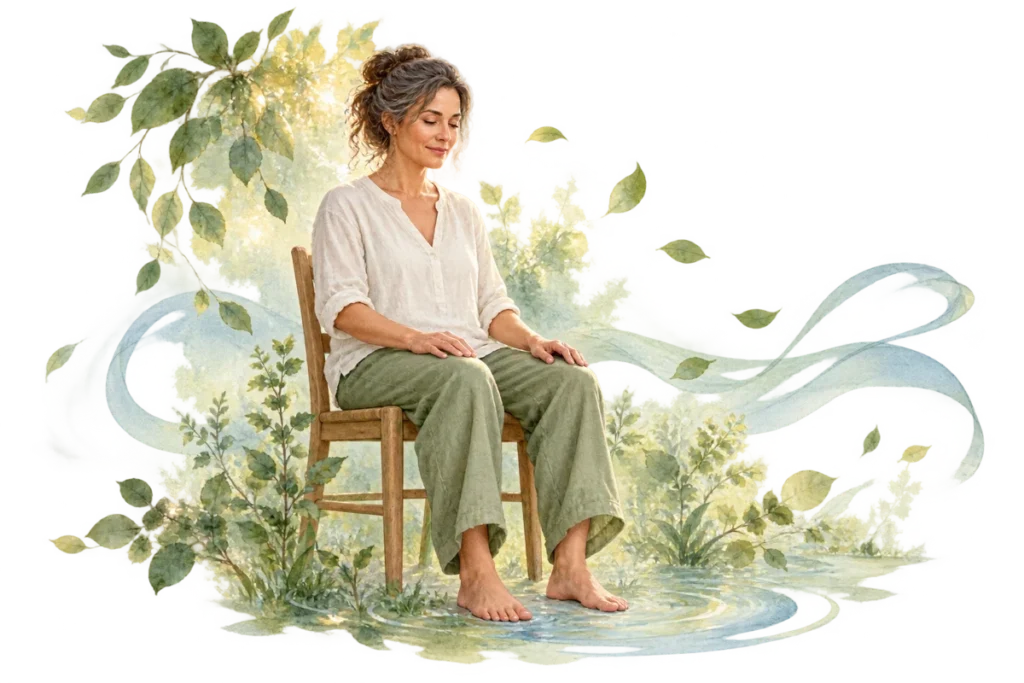
Take a few unhurried minutes. Sit on a chair with your feet supported, or choose another comfortable position.
- Feel one point of contact: feet on the floor, hands resting, or the support beneath you. Notice the sensation before naming it.
- Allow a natural breath. Feel the movement of breathing without requiring it to become slower or deeper.
- Include sounds around you. Let attention open beyond one point of concentration.
- Let a familiar self-description appear: “I am busy,” “I am anxious” or “I am a good meditator.” Notice these words as thoughts.
- Ask gently: What else is present besides this description? Allow the question without rushing to a verbal answer.
A wandering thought is another part of what can be noticed. You can return to contact, breathing and sound without turning the practice into a contest with the mind.
From Performing a Pose to Feeling Your Way
The same inquiry can accompany movement. In a simple standing posture, notice how weight is received through the feet. As an arm rises, feel the changing sensations through the shoulder, ribs and hand. Explore within a comfortable range; there is no need to reach an ideal shape.
“Body” is a useful noun, yet its living actuality is activity: breathing, sensing, balancing and responding. Feeling this activity can loosen the fixed picture of a body that must be continually judged and corrected. The posture becomes an opportunity to listen.
An Ordinary Example
Before a meeting, the thought “I always get this wrong” may appear. Feel your feet and hear the sounds around you. The thought can be noticed without becoming the only account of the moment. You can still prepare, ask a question and act responsibly.
Likewise, during a conversation, notice when listening gives way to rehearsing your reply. Feel the body and return to hearing the other person. Connecting with yourself and being available to another can belong to the same openness.
From Sensation to Self-Inquiry
A moment of ease is welcome, but it changes. So does a difficult feeling. Self-inquiry asks about the Awareness in whose presence both are evident. It does not require a permanently quiet mind or a particular sensation to confirm what you are.
Embodied practice prepares this inquiry by making assumptions easier to notice. Insight concerns seeing the error of misidentification. Yoga is the flowering of Being Understanding: the wholeness already present becomes evident as the error that veils it is seen and released.
Read Self-Inquiry Meditation: Who Am I? for a fuller exploration. For the broader context, begin with the Spiritual Awakening guide. Explore Choosing a Practice for an everyday starting point, or My Teaching for the approach behind Listening-Feeling.
Leave a Reply