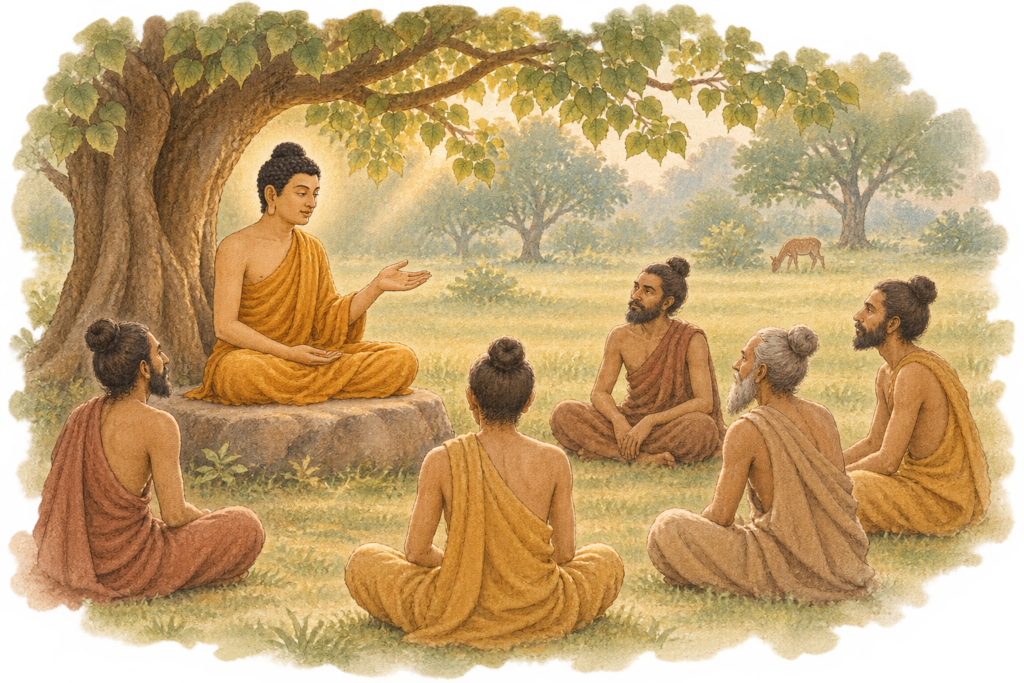
In What Did the Buddha Get?, we followed the story of the Buddha’s awakening. What did he teach when he tried to put that understanding into words? In the discourse traditionally regarded as his first teaching after awakening, he speaks to five ascetics in the Deer Park near Vārāṇasī. He asks them to understand suffering, see what sustains it, realize its ending, and develop a way of living that leads to that ending. Setting the Wheel of Dhamma in Motion, SN 56.11
The Four Noble Truths name these four things. Each comes with a different task. Suffering is to be understood. Craving is to be relinquished. Cessation is to be realized. The path is to be developed. The distinction matters when something hurts. The urge is often to get rid of the hurt before we have understood what is happening.
1. Dukkha — understand suffering
The Pāli word dukkha is often translated as suffering, stress, or unsatisfactoriness. The discourse includes bodily pain, aging and death, separation from those we love, and the frustration of wanting what we cannot have. A pleasant experience can be thoroughly pleasant while it lasts. The difficulty appears when we depend on it to last, or expect it to give us a security that changing conditions cannot provide.
The Buddha sums up this truth in terms of the five aggregates subject to clinging. These are bodily form, feeling, perception, mental formations, and consciousness. They describe familiar aspects of experience. Think of hearing a criticism. There is tension in the body, an unpleasant feeling, recognition of the words, the impulse to defend yourself, and consciousness of what is happening. We can take hold of this whole movement as a verdict on who we are.
In the discourse of the two arrows, the Buddha distinguishes a painful feeling from the further distress that can arise around it. If you made a mistake, there may be embarrassment, consequences, and something to repair. Then comes the thought, “Everyone will always see me this way.” You replay the conversation on the way home and again the next morning. The distinction helps you give the original hurt and its consequences the care they need while seeing what the replay adds. The Arrow, SN 36.6
2. Samudaya — relinquish the craving that sustains suffering
The second truth identifies taṇhā, literally thirst, as the origin of dukkha. The discourse describes thirst for sensual pleasure, thirst for becoming, and thirst for non-becoming. We chase a gratifying experience, try to become somebody who can never be questioned, or wish to escape a state or identity we cannot bear. In the criticism example, the thirst may be the insistence that the other person must think well of you before you can be at ease.
A wish to make amends or to learn from criticism has a practical purpose. The path itself calls for the intention and effort to cultivate what is wholesome. Look for the point where a sensible wish becomes a demand that the outcome settle your worth. What happens to that demand when you hear it clearly?
3. Nirodha — realize cessation
The third truth says that the craving described in the second can cease. In the first discourse, cessation is the complete fading and relinquishment of that thirst. In Buddhist teaching this is the liberation called nibbāna, or nirvāṇa in Sanskrit. The discourse presents it as the ending of craving and of the further becoming that craving sustains.
We can glimpse the distinction in a smaller way. Suppose you still feel the sting of criticism, yet the need to win back the other person’s approval loosens. The conversation becomes available to you again. You can hear what was said, ask what the person meant, or acknowledge what you did. A moment like this illustrates what changes when a particular grip relaxes. The third truth points to the complete release of craving.
4. Magga — develop the Noble Eightfold Path
The Buddha calls this the Middle Way. He introduces it by setting aside two extremes familiar to his listeners, devotion to sensual indulgence and devotion to self-mortification. The path brings together wisdom, ethical conduct, and training of the mind. Its eight factors support one another in meditation and in the choices we make throughout the day.
- Right understanding. See experience in light of suffering, its origin, its cessation, and the path ~ when there is right view the other seven steps unfold naturally.
- Right intention. Cultivate renunciation, goodwill, and harmlessness.
- Right speech. Refrain from lying, divisive or harsh speech, and idle chatter.
- Right action. Act with care for life, respect for what belongs to others, and responsibility in sexual conduct.
- Right livelihood. Make a living in ways consistent with ethical conduct.
- Right effort. Prevent and abandon unwholesome states, and bring forth and sustain wholesome ones.
- Right mindfulness. Attend clearly to body, feelings, mind, and the patterns that shape experience.
- Right concentration. Develop the collectedness of mind described in the early discourses through the four meditative absorptions, or jhānas.
A fuller account of each factor appears in An Analysis of the Path, SN 45.8.
What the Buddha said he had done
In the first discourse, the Buddha describes three ways of knowing each truth. He knew the truth itself, knew the task it called for, and knew that the task had been fulfilled. Four truths seen in these three ways make twelve aspects. He links his claim to awakening to the completion of all four tasks. Read alongside the story beneath the Bodhi tree, the discourse gives substance to the words “I’m awake.” He had understood dukkha, relinquished its origin, realized its cessation, and developed the path.
An invitation to look
The next time a small difficulty stays with you, give it a moment of listening. What hurts? What are you asking the situation to give you, keep for you, or take away? If the demand loosens, even briefly, notice what becomes possible. Perhaps there is a conversation to have, an apology to make, or a feeling that needs room before you speak. The response can begin with the situation you are actually in.
For a companion reading, see Self and No-Self, which explores how the Buddhist inquiry into clinging and identification meets and differs from Advaita Vedānta.
Leave a Reply