Someone questions a decision you made. You feel your jaw tighten. Before you have fully heard the question, you are defending yourself. A moment ago there was a decision to discuss. Now it seems that you are at stake.
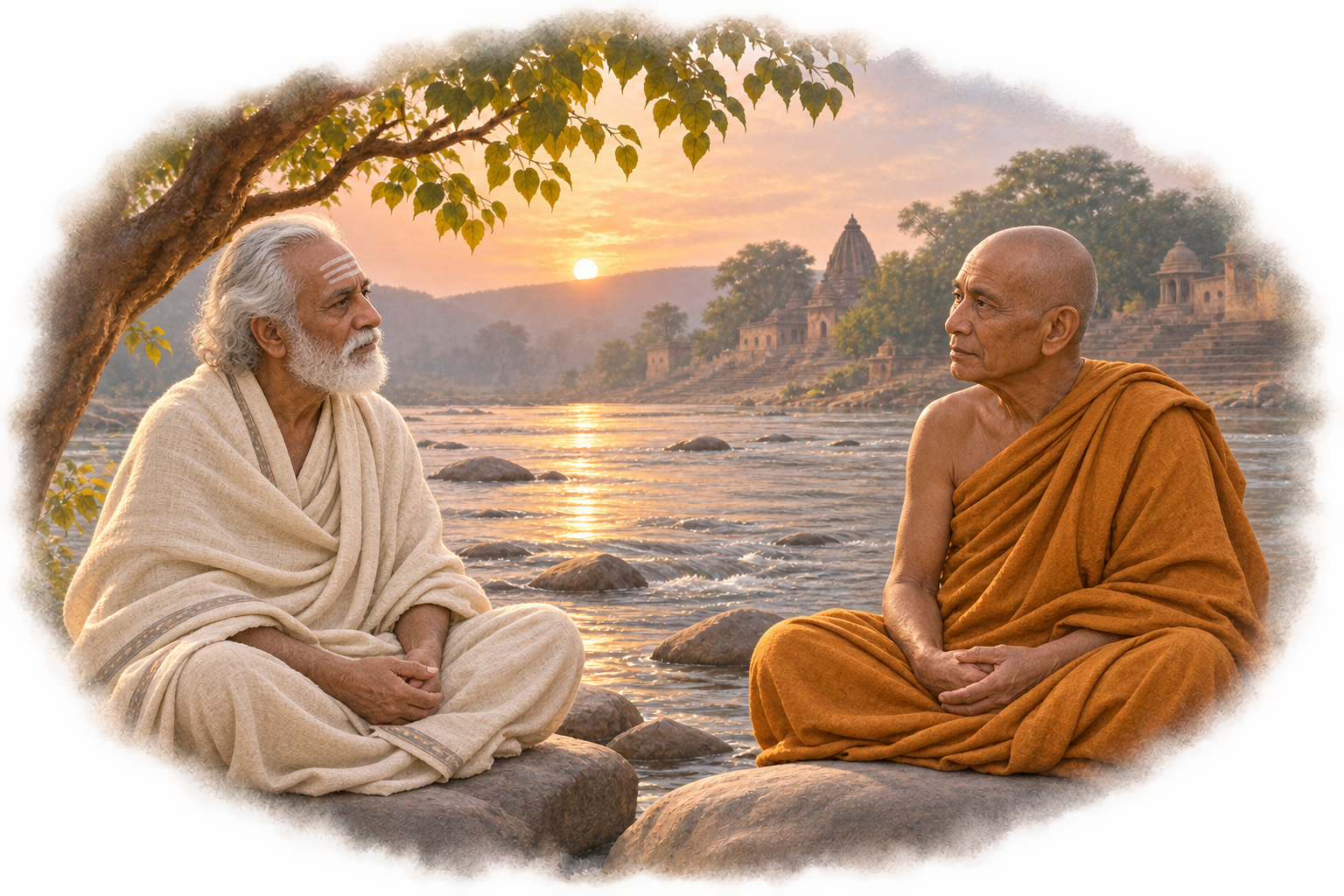
What is this “I” that feels threatened? Advaita Vedānta and Buddhism both invite us to look closely. The two teachings meet in questioning our identification with the body, thoughts and feelings. They part company over what that inquiry reveals. Advaita teaches that the Self is limitless Reality. The early Buddhist teaching of not-self asks us to relinquish identification with every aggregate of experience, including consciousness.
What Advaita means by the Self
In the Chāndogya Upaniṣad, Uddālaka teaches his son Śvetaketu through a series of examples. In one, he asks the boy to dissolve salt in water. The salt can no longer be picked out, yet the water tastes salty wherever he sips it. Uddālaka uses the example to point toward a reality that cannot be singled out by sight. His teaching culminates in Tat Tvam Asi, “You are That.” The example gives the student something he can discover directly. The declaration asks him to reconsider what he means by “you.” Chāndogya Upaniṣad 6.8.7 · The salt and water teaching, 6.13
Advaita reads this as a statement of identity. Ātman names the Self. Brahman names limitless Reality. The two words approach one reality from different directions. We can begin by asking what we truly are or by asking what is ultimately real. In this teaching, the inquiries converge.
The difficulty is that we are accustomed to looking for ourselves among things we can know. We find a body, a memory, a feeling, an inward voice. Even the impression of being a watcher somewhere behind the eyes can be noticed. Yājñavalkya takes the inquiry further in the Bṛhadāraṇyaka Upaniṣad when he asks how the knower could itself be known. Śaṅkara’s commentary brings out the difficulty of trying to make the knower into one more object of knowledge. In Advaita, Self-knowledge concerns what is already present in knowing. This is the direction I mean by Knowing via Being. Bṛhadāraṇyaka Upaniṣad 2.4.14 and Śaṅkara’s commentary · Ātman and Brahman on Being Yoga
What Buddhism means by not-self
Anattā, the Pāli word often rendered “no-self,” can also be translated “not-self.” That wording lets us hear how the teaching proceeds in the early discourse on the subject. The Buddha examines five aggregates: bodily form, feeling, perception, mental formations and consciousness. He asks whether what changes, is liable to distress and cannot be made to conform to our wishes is fitting to regard as mine, as my self or as what I am. The inquiry leads toward release from clinging. It includes consciousness in the examination, a detail that matters when we bring the teaching alongside Advaita. Discourse on the Not-Self Characteristic, SN 22.59
In another discourse, Vacchagotta asks whether there is a self and then whether there is no self. The Buddha remains silent. He later explains to Ānanda how either answer, given to this questioner, would mislead. Vacchagotta might hear a denial as the news that a self he once possessed had disappeared. Elsewhere, the Buddha directs attention away from extremes of existence and nonexistence and toward the conditions under which suffering arises and ceases. That is a different kind of inquiry from trying to secure a final answer about the existence of a thing called “me.” The exchange with Vacchagotta, SN 44.10 · The discourse to Kaccāna, SN 12.15
Buddhist traditions develop this inquiry in different ways. Nāgārjuna, for example, connects emptiness with dependent arising. A person, a feeling or a thought can have real effects in ordinary life while depending on conditions for its existence. Emptiness points to this lack of independent existence. It would be a mistake to read it as a hidden substance behind appearances and then call that substance Brahman. Nāgārjuna, Mūlamadhyamakakārikā 24.18
Where the teachings meet and where they part
Suppose anger arises. You can feel its heat, hear the sentences it puts together and watch it change. You may discover how quickly “anger is here” becomes “I am the person who has been wronged.” Both teachings give us a way to examine that movement. Once it is seen, there may be enough room to hear what the other person actually said.
The next step is where the difference matters. Advaita asks us to recognize the Self through which the changing experience is known. Buddhist not-self practice also examines the consciousness and the sense of knowing that we might be tempted to claim as our own. An Advaitin can reply that the consciousness under examination is conditioned experience, whereas Ātman is the reality by which any experience is known. A Buddhist can ask what warrants taking that distinction as evidence for an unconditioned Self. These are serious questions. A moment in which the usual self-story falls quiet does not settle them on its own. Bṛhadāraṇyaka Upaniṣad 2.4.14 · SN 22.59
An invitation to look
Listen to an ordinary sound. As it changes or fades, notice any sense of being the one who listens. Does that sense have a location, a bodily feeling or a quiet inward phrase? Can those features themselves be noticed?
From the Advaita side, ask what is meant by the knowing in which the sound and the sense of a listener are evident. From the Buddhist side, notice how the sound, the attention and the sense of ownership arise and change. What happens when you let the experience unfold without taking it as a statement about who you are?
Then return to the person who questioned your decision. There may be a mistake to correct, a misunderstanding to clear up or a boundary to state. You will hear more of what the situation calls for when your first task is to listen. That is one place where the two teachings can be tested in living, even as their accounts of liberation remain distinct.
Continue exploring. For a visual telling of the Buddha’s awakening and a brief invitation to look for yourself, see What Did the Buddha Get?
Leave a Reply