All that you encounter is an appearance in awareness.
This is an invitation to explore everyday experience through Listening-Feeling. What appears as a thing is also an activity—a changing form, a movement, a sounding. A voice, a breath, a tree moving in the wind, the living body: each can be encountered before thought gathers experience into separate objects.
In Being Yoga, spiritual awakening concerns seeing through the error of separation. In Advaita Vedānta, this error involves adhyāsa—superimposition: confusing the Self with the body and mind, and attributing their limitations to the Self.
Listening-Feeling opens this inquiry through the immediacy of living.
Living meditation is Listening
Listen to a sound. Notice its arising, its changing and its fading. Feel how the whole body participates.
There is no need to name everything immediately. A name is useful, yet it does not contain the living encounter. “Breath” names something whose actuality is breathing. “Body” names a living activity. What we describe as a thing is continually changing and expressing itself.
Living meditation is Listening.
By Listening, I mean an openness that includes hearing, sensation, movement, thought and silence. Listening-Feeling allows experience to reveal itself without requiring it to confirm what you already believe.
A sound is known. Its change is known. Its fading is known. Silence is also known.
Can you notice that the sound changes, while the awareness in which the sound is known does not become another sound?
This is an invitation to examine the assumed separation between “the listener” and “what is heard.” There is no special experience to manufacture.
The ear of the ear
The Kena Upaniṣad speaks of the “ear of the ear.” Its inquiry turns toward that by which hearing is possible—toward the knowing presence in which sound and silence are evident.
The physical ear receives sound. The mind recognizes and interprets it. Both the ear and the mind are themselves known.
The “ear of the ear” is therefore a pointer to awareness: that because of which the ear, sound, mind and silence are known. Awareness is not an object that can be heard or seen as one particular thing. It is the self-evident reality because of which experience is evident.
This connects with my association of Source with the ear. Listening invites inquiry into the openness of knowing itself.
A sound changes. The knowing of its change does not need to become another sound. Listening can therefore invite recognition beyond the particular experience being heard.
Read the Kena Upaniṣad with commentary, and allow its words to guide the inquiry.
The Word, Vāk and Oṃ
The Gospel of John begins, “In the beginning was the Word.”
In its Christian context, the Word—Logos—has meanings that extend beyond audible speech, including creative expression and wisdom. It offers a fruitful comparison with Indian teachings concerning Vāk, speech, and Oṃ, while each tradition retains its own context.
The Prajāpati–Vāk passage in the Kāṭhaka Saṃhitā presents speech in relation to creation. Bṛhadāraṇyaka Upaniṣad 4.1.2 also considers speech as supreme Brahman, within a dialogue that develops the understanding further. The familiar comparison with John brings these passages together; they are separate textual references.
These teachings invite contemplation of the relationship between Brahman and appearance, between the truth of what is and the forms through which it is expressed.
In Advaita Vedānta, Brahman is not an object or person standing apart from the universe. Īśvara is Brahman understood through Māyā as the creator, sustainer and resolver of the universe. The universe is mithyā, dependent reality, while Brahman is satyam, independent reality.
In my teaching, Source and its expressions are not-two.
Oṃ gives this inquiry a voice—and a symbol.
Read John’s opening verses and explanatory notes.
Oṃ as a map of experience and appearing
The Māṇḍūkya Upaniṣad relates A, U and M to waking, dreaming and deep sleep. Its teaching of Turīya points to the non-dual reality underlying all three states.
Alongside this traditional account, I explore the written symbol of Oṃ through a correspondence developed in my own teaching.
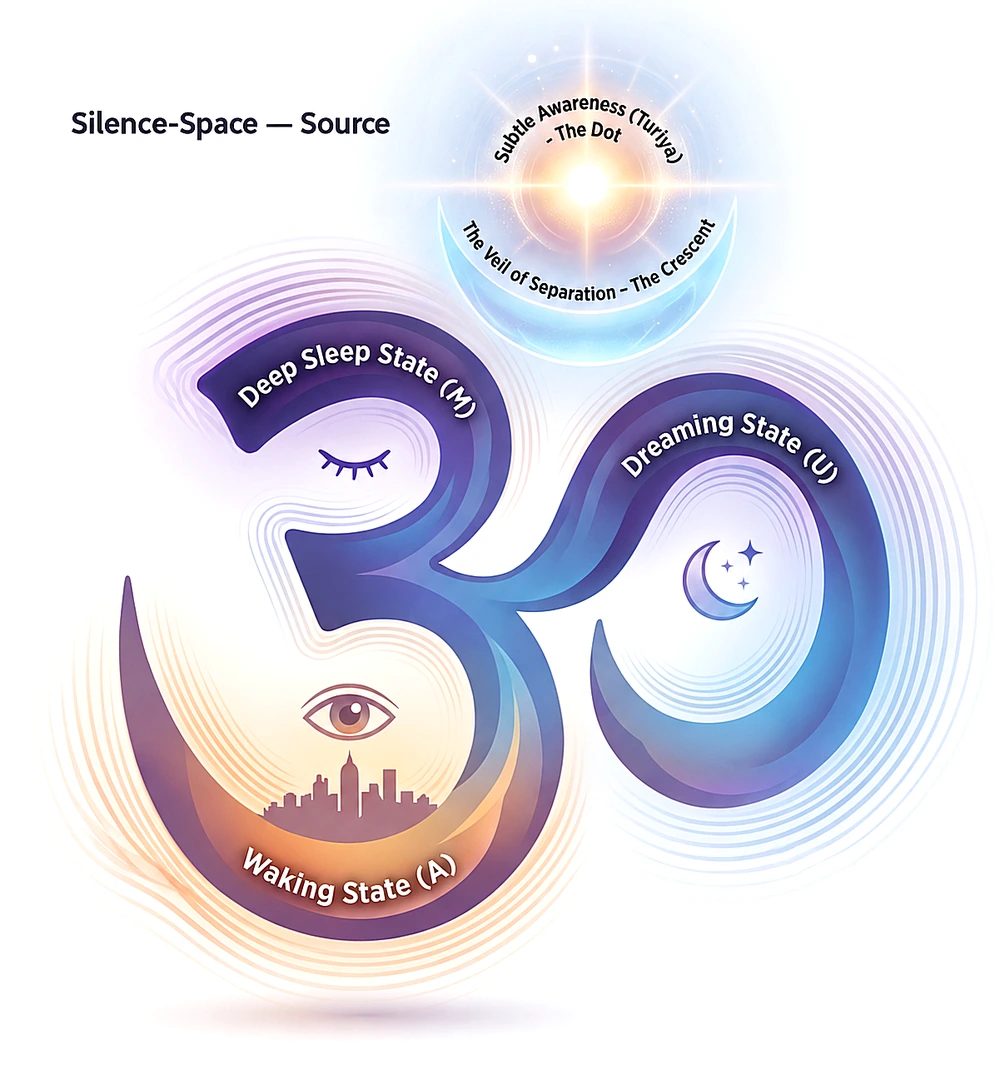
- Silence-Space represents Source, by whatever name. I also use the expression Full Solid Emptiness: fullness in which nothing is lacking, solidity as undivided wholeness rather than physical density, and emptiness of independently existing, separate things.
- The dot represents Turīya as the most subtle appearance of Ātman. A point has location yet no dimension; in this map, it allows the threshold of appearing to be contemplated.
- The crescent represents the veil through which separation appears.
- The three descending curves represent sound coalescing into progressively denser form, expressed as deep sleep, dreaming and waking.
This is my contemplative interpretation of the symbol, rather than a claim that the Māṇḍūkya Upaniṣad defines Turīya as a located point or an appearance.
In this correspondence, Ātman and Turīya are names through which the inquiry can be spoken about. Yet Ātman is Brahman, and Turīya is Brahman. The distinctions in naming do not establish separate realities. Source and its expressions are not-two.
The appearances are mithyā: experienced, yet without independent reality apart from Brahman. The map describes an unfolding of expression, rather than a sequence through which Brahman changes or becomes something else.
“Silence-Space” and “Full Solid Emptiness” are contemplative expressions used here in my teaching. The latter draws on the term śūnyatā, usually translated as “emptiness.” These expressions do not reduce Brahman to physical space or equate the distinct doctrinal meanings of Buddhist śūnyatā and Vedantic Brahman.
The same correspondence can be explored through the elements: one ultimate—Source—and four penultimate expressions. Through this lens, simple and complex forms can be contemplated as degrees of vibration, as shaped sound.
Explore the Māṇḍūkya Upaniṣad through the Vedanta Society of New York.
A sounding in form
All that you encounter is shaped sound.
This expresses a contemplative perspective. It does not mean that Brahman is a physical vibration, or that every form is literally audible sound. It invites you to encounter form as activity: changing, dependent and revealed in awareness.
A conversation offers an ordinary example. Before deciding what someone’s words mean, listen to their rhythm, pauses and tone. Feel your own response. Notice how quickly interpretation becomes conclusion.
Listening allows room for that conclusion to be seen—and, when mistaken, released.
Listening-Feeling can loosen habitual reactions and prepare the mind for inquiry. Freedom, however, does not depend on maintaining a particular state of mind. The inquiry concerns accurate understanding of what you are.
A scientific echo
Pressure waves travelled through the early universe’s dense plasma, leaving patterns that scientists study today. NASA has translated these primordial oscillations into frequencies we can hear.
These were physical acoustic waves. Their existence offers a compelling point of conversation between cosmology and contemplation, while leaving the philosophical meaning of Oṃ to its own inquiry. They are not proof that Brahman is a primordial physical sound.
Hear NASA’s explanation of the sounds of the ancient universe.
Being Understanding
I first heard the expression “Being Understanding” from my teacher, Jean Klein. I use it here to point to understanding inseparable from being—to wisdom lived, rather than knowledge held only in thought.
The universe can be contemplated as one song: countless movements and voices, with silence inseparable from their expression. We participate simply by being.
Listening-Feeling invites you to discover this participation in everyday life. There is no need to manufacture wholeness. The inquiry concerns the error that makes what is whole appear divided.
You are not required to experience awareness as an object. Awareness is already present as the reality in whose presence every sound, silence, thought and feeling is known. Recognizing this, the attempt to grasp a special spiritual experience can fall away.
Yoga is the flowering of Being Understanding: the wholeness already present becomes evident as the error that veils it is seen and released.
Leave a Reply