Why Spiritual Awakening Isn’t What You Think (And Why You’re Already There)
Many of us move through life with a persistent, quiet sense of inadequacy. We feel incomplete, as if a fundamental piece of the puzzle is missing from our existence. This leads to an endless chase—pursuing security, status, relationships, and even temporary “spiritual highs” in the hope that something finite will finally make us feel whole. According to the ancient tradition of Vedānta, this feeling of being limited and separate is the result of avidyā, or self-ignorance. We have mistakenly concluded that we are merely a “limited body-mind-sense complex.”
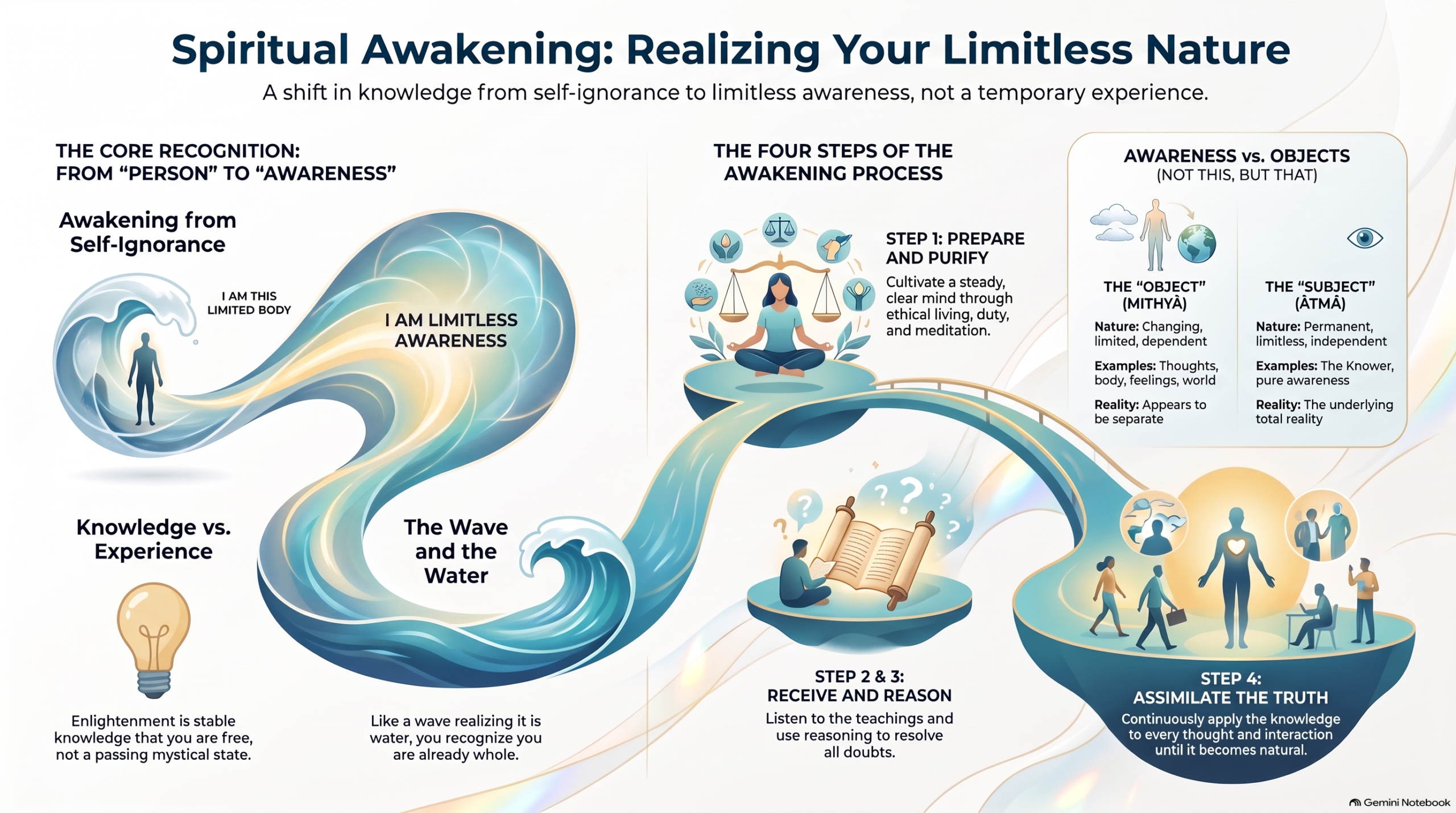
This ignorance functions through two specific mechanisms: Veiling and Projection. Veiling hides your true nature as limitless awareness, while Projection causes you to superimpose the limitations of your body, thoughts, and stories onto yourself. Spiritual awakening is the process of lifting this veil. It is the pursuit of Mokṣa—freedom from this fundamental error. It is not about gaining a new self or reaching a far-off destination; it is the realization that the wholeness you seek is already the ground upon which you stand.
You are the Subject, Not the Object
The most common pitfall in the spiritual search is treating the Self as something to be “experienced” or “perceived,” much like a beautiful sunset or a profound meditative vision. This stems from a fundamental “subject-object error.” Awareness cannot become an object of your perception because it is the subject—the very knower of every object, thought, and sensation.
There is a profound paradox here: the very act of looking for the Self as a special experience is what keeps it hidden. By seeking the Self as an object, you reinforce the dualistic notion that you are separate from it. In reality, you are the presence in which all experiences occur. You are the “knower” who is aware of the mind’s fluctuations without being those fluctuations.
“I am not a limited person who occasionally experiences awareness. I am awareness, in whose presence the person and the world are known.”
The World Doesn’t Disappear, Your Perspective Does
A common misconception is that spiritual awakening will cause the physical world to vanish, similar to how a dream world evaporates when you wake up in the morning. Spiritual awakening is fundamentally different. In this realization, the world does not disappear; you continue to experience your body, your work, your relationships, and the inevitable mix of pleasure and pain.
What changes is your understanding of the world’s status. You begin to see the world as mithyā—a dependent reality. Like a gold ornament that depends on gold for its existence, the world depends on you, the ātmā (the Self). This shift provides immense relief. You can engage fully with life’s dynamic nature without being defined or limited by it. You are no longer a victim of your circumstances because you know your true nature remains untouched by the play of the world.
Bliss is a State, Enlightenment is Knowledge
Many seekers spend years chasing “spiritual highs,” visions, or the movement of kundalinī. While these experiences can be supportive milestones, they are not enlightenment. Because all experiences have a beginning and an end—they “arrive and depart”—they cannot be the permanent reality of the Self.
Enlightenment is not a permanent state of bliss; it is steady, unshakeable knowledge. It is the recognition that you are already free right now, even when the mind is tired, the body is limited, or the emotions are heavy. Freedom is found in the recognition that these limitations belong to the mind-body complex, not to the awareness that observes them. We must distinguish between temporary states of the mind and the permanent fact of our existence.
You Are the Water, Not the Wave
To understand this shift in identity, consider the relationship between a wave and the ocean. Modern culture is obsessed with “self-improvement”—the endless task of making the wave bigger, stronger, or more “spiritual.” We act as if the wave must undergo a massive transformation to eventually become water.
But the wave is already water. It was never anything else. Awakening is not a transformation where a limited person becomes a limitless god; it is a recognition of an existing identity. This is deeply counter-intuitive because it suggests that your “problems” do not need to be solved for you to be free. The “wave” (your individual persona) is simply a form that awareness takes. The focus is not on perfecting the form, but on realizing that the essence of the wave has always been the ocean.
The “Preparation” vs. The “Realization”
If we are already the limitless Self, why is this not our lived reality? A distracted or emotionally reactive mind cannot easily assimilate such subtle knowledge. This is why spiritual inquiry is not a “do-it-yourself” project of internal reflection alone, but a methodology requiring a qualified teacher and the traditional framework of Vedānta to act as a mirror.
Spiritual practices like Dharma (ethical living), Karma-yoga (converting duty into inquiry), and meditation are secondary means. They do not “produce” the Self—which is already present—but they “prepare and purify the mind” for knowledge. Once the mind is ready, the realization unfolds through three deliberate steps:
- Śravaṇa: Listening to the teachings that systematically remove incorrect notions about reality.
- Manana: Using reasoning to resolve doubts. We ask: “If I am the one aware of my thoughts, how can I be my thoughts?” This intellectual rigor ensures the knowledge is not just a belief, but a certainty.
- Nididhyāsana: Assimilating the knowledge through contemplation until it becomes steady and natural.
Here, we must distinguish between self-realization and self-actualization. Recognition (realization) may occur in a flash of clarity, but the “actualization”—allowing that knowledge to become your natural response to every encounter and fear—takes time and assimilation.
The End of the Search
Spiritual awakening is ultimately the recognition, through the mirror of Vedānta and a prepared mind, that you are already the limitless awareness—ātmā/Brahman. It is the steady assimilation of this knowledge until the ups and downs of finite experience no longer have the power to define or bind you.
You do not need to reject your dynamic life or escape to a cave to find reality. Reality is the very fabric of your current experience. The search ends not when you find a new object, but when the seeker realizes they were the destination all along. Instead of waiting for a future event or a mysterious breakthrough, look at the one who is reading these words: Who is the “knower” of your current thoughts right now?



Leave feedback about this