Usually, we box ourselves in with pretty fixed ideas about who we are. We slap labels on, rely on certain roles, and basically just cling to specific traits.
But that whole mindset? It totally misses the fact that life’s just this constant, flowing thing.
When we’re talking about staying healthy or really, getting well, grasping that “You are a Verb” can seriously flip how you approach improving, healing, and even just feeling decent day-to-day.
This kind of shift actually lines up with really old ideas, traditions that have always seen life as this ongoing, ever-changing dance. Think about it: your body’s always making new cells.
Your thoughts just keep on moving, one right after another. Your energy? That bounces around all day long. Leaning into this idea that you’re an active, continuous process — not some rigid, finished product — frees up a surprising amount of personal power when it comes to your own wellness.
It means you start working with how you’re naturally designed instead of constantly fighting it.
The impact of this goes way beyond just, you know, deep philosophical discussions. Seeing yourself as a verb literally changes a whole bunch of things: what you put in your body, how you move, how you breathe, even how you manage stress.
It totally reshapes your view on getting better, on growing, and definitely on the whole experience of aging. So, this article is all about digging into how you can actually grab onto this really useful idea for your everyday health journey.
Life as Flow: The River Metaphor
You Are a Verb in Motion
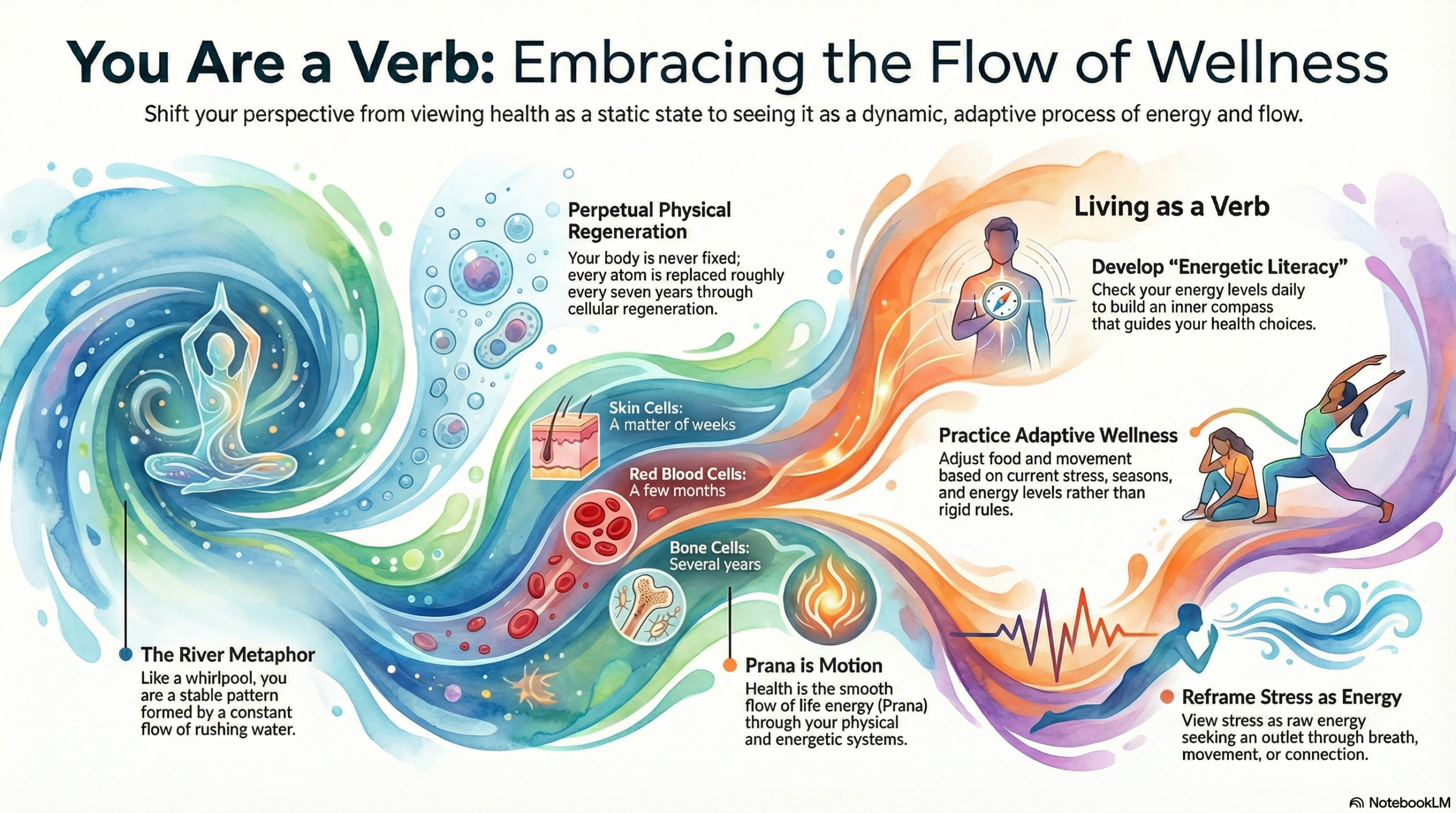
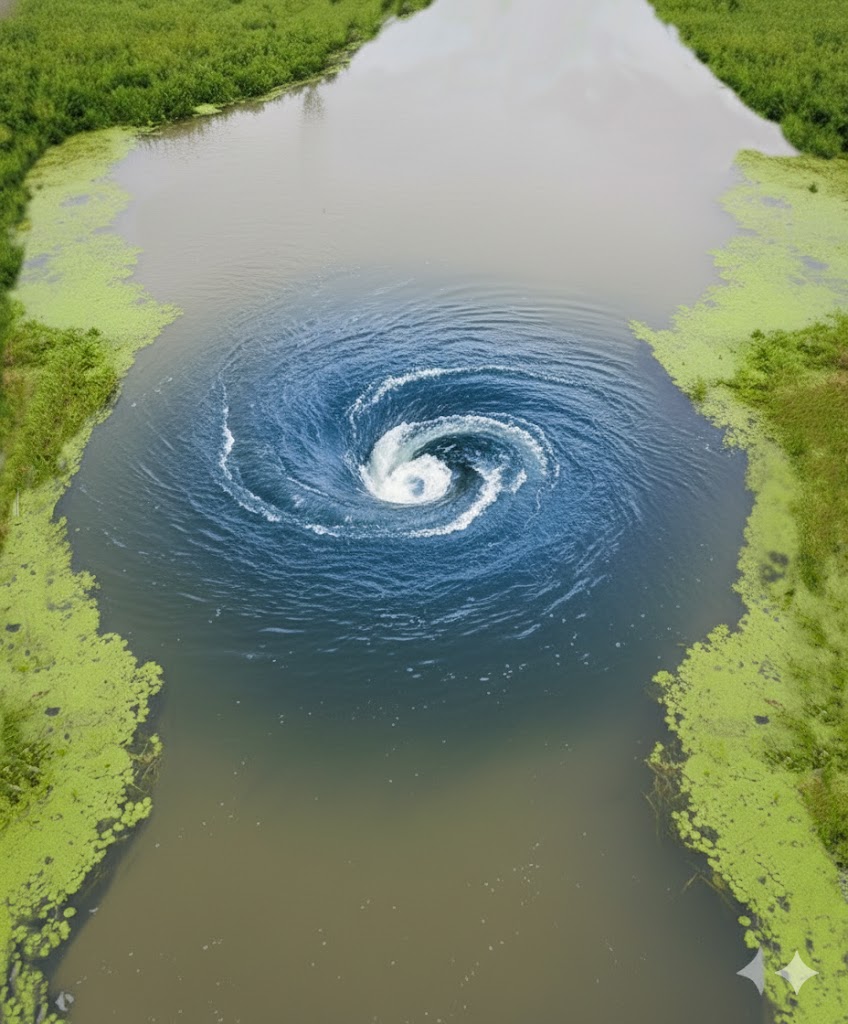
Life really is just like a river; it’s always moving, never holding still. And picture this: you’re kind of like a whirlpool in that river – it keeps its shape, right, even though it’s totally made of rushing water.
That whirlpool isn’t something separate from the main river; it’s just the river’s water organizing itself into a pattern for a bit.
Your body is a perfect example of this principle. Every single atom in you actually gets swapped out, they say, every seven years or so, yet you totally still feel like you.
Your cells are always dying, then regenerating. Skin cells refresh themselves in a matter of weeks, red blood cells take a few months, and bone cells need years. The pattern is what sticks around, while the actual physical stuff just flows right through.
This understanding completely reshapes how you deal with health issues.
Instead of seeing sickness as this fixed thing that just happens to you, you start realizing it’s a temporary pattern in your flow, something that can absolutely shift and change.
Stuff like chronic conditions, for instance, become dynamic processes; they’re things that respond when you take deliberate action, not just permanent states you’re stuck with forever.
You Are a Verb in Healing
Embracing the idea that nothing’s truly permanent when it comes to your health is super important for healing.
This whole river thing? It tells us that going against the current just makes everything choppy. But when you just kinda go with it? Smooth sailing, every time.
For wellness, this means leaning into your body’s natural rhythms instead of trying to force super strict schedules or dive headfirst into extreme routines.
Your energy, it ebbs and flows throughout the day, right? Seasons totally mess with your mood and how your metabolism works. Plus, what your body needs for food shifts big time depending on how active you are, or if you’re stressed, or just, you know, how life’s going.
The best wellness plans get that things are constantly changing. So instead of doing the exact same thing no matter what, you tweak your routine here and there.
That way, you’re actually supporting yourself, gently nudging things in the right direction. Could be eating lighter if you’re super stressed, or doing more restorative, chill things if you’re coming off a sickness, or just going easy on the workouts because you slept like crap or feel emotionally wiped.
The Energy of Being: Prana is Motion
Your Energetic Nature in Action
That flowing something, the thing that gives everything life? It’s called prana.
And honestly, it isn’t just some woo-woo spiritual idea. It’s just that steady beat in your chest, your breath moving, all the activity in your brain, even your cells doing their normal thing — that’s prana in action. Pretty straightforward.
Science is finally catching up to what ancient wisdom has told us forever: we’re basically organized energy, just in a physical form.
This prana isn’t static, either; it moves along specific paths and collects in different spots in your body. When it gets blocked or goes a bit wild, that’s really when you start feeling off. We’re talking anything from having a foggy head and being super moody to gut issues or even chronic pain.
Seeing yourself as this moving prana means realizing that health problems aren’t always just your body mechanically breaking down; often, they’re energetic blockages.
This perspective opens up a ton of healing methods well beyond typical medicine. Things like yoga, tai chi, acupuncture, or even just some really deep breathing can directly impact prana flow.
Even simple stuff like walking outside, singing, or just having a good belly laugh can help bring your energy back. These aren’t just ways to relax, you know, but actually pretty powerful tools for your overall well-being.
Getting in Tune with Your Energy
Learning how to really sense your prana moving helps you actually stay healthy, oftentimes before problems even show up.
You start picking up on those tiny energy shifts way before they turn into actual physical symptoms.
For instance, that heavy feeling after certain meals? It might be a sign those foods aren’t actually great for your energy levels. Or maybe some new kind of exhaustion means you really need some serious movement, not just more.
This kind of self-awareness; It doesn’t just happen overnight. It takes consistent effort, honestly, and just really paying attention.
So, if you make a habit of checking your energy levels every morning, really noticing what impacts you throughout the day, and just observing your body’s natural rhythms, you’ll start to develop what I call “energetic literacy.”
Eventually, you build this incredible inner compass, something far more useful than any generic health advice because it’s totally tuned into your specific energy.
Putting It Into Practice: Living on the Fly
Eating & Moving as a Verb
When you start seeing yourself as something that’s always in flux, always changing, it totally shifts how you think about food and working out.
Instead of blindly following diets or sticking to super rigid workout schedules, you actually begin to use strategies that bend and adapt to whatever’s going on with you at any moment.
Your body’s nutritional needs, I mean, they’re definitely not static. Think about your stress, how much you’ve moved, what time of year it is, and just, well, life.
Sometimes, particularly when you’re slammed with stress or it’s cold outside, all you want is something warm and comforting.
Other times, maybe you’ve been super active or it’s hot, you’ll probably crave lighter, cooling foods instead.
You stop seeing these preferences as some kind of weakness or proof that you’re inconsistent; instead, you recognize them as your body’s smart way of telling you precisely what it needs.
Movement works pretty much the same way. It becomes less about forcing yourself through a strict routine and more about really listening to what your energy is telling you.
Some days, a really intense workout is exactly what you need to kick that sluggish feeling.
But then there are days when gentle stretching or something restorative feels like just the ticket.
Your exercise then becomes an actual exploration of what your prana — that’s your life energy, you know — truly wants, not just some pre-written plan.
Stress as Moving Energy
Stress itself stops being this terrifying enemy you constantly battle.
Instead, it morphs into energy that’s simply looking for release, trying to find a way to resolve itself.
All that physical stuff you feel when you’re stressed — a pounding heart, tight muscles, that feeling of being totally on edge — those are just signals that your prana is gearing up to handle something.
The real trouble starts when that stress energy gets hung up or misdirected. Dealing with stress effectively means actually helping that energy move, not just trying to cram it down.
Things like getting your body moving, really focusing on your breath, channeling it into creative outlets, or just connecting with other people, these are all perfectly natural ways for that intense stress energy to pass through your system.
This keeps tension from just piling up inside you, which, you know, can lead to bigger health issues later, all while you’re still pretty much dealing with whatever life decides to throw your way.
Key Takeaways
- You know, who you are isn’t this fixed thing; it’s a constant journey, always shifting, kind of like a river’s pull, always moving.
- When a health issue pops up, think of it as just a quick pause in your energy flow, something that can totally shift if you pay it the right mind.
- Prana, that essential life stuff we all have inside, it follows particular paths, and it really thrives on anything that keeps your energy in sync.
- Figure out your own energy vibe, and you can totally take charge of your well-being, maybe even stopping problems before they turn into full-on symptoms.
- What you eat and how you move, these just become ongoing chats with your body about what it needs, not some rigid rulebook.
- And stress? That transforms from something “bad” into just raw energy looking for an outlet – maybe through moving your body, taking deep breaths, or just hanging out with folks.
Frequently Asked Questions
What does it even mean to “Live as a Verb”?
Thinking of living as a verb essentially means you understand you’re constantly evolving, always shifting.
In practical terms, this shows up as being flexible with your health choices.
You know, you actually listen to what your body needs right then, instead of just blindly sticking to some super-strict plan.
Maybe your diet changes with the seasons, or you adjust your workouts based on how much energy you’ve got that day.
And those health challenges? They’re more like temporary detours, honestly, not permanent roadblocks.
How can I learn to feel my prana?
Start with pretty simple stuff. When you first wake up, actually check in with your energy levels.
Notice how different foods make you feel — do they give you a nice boost or just totally wipe you out?
Tune into your body’s natural rhythms throughout the day.
While you’re doing your everyday things, really pay attention to those small feelings: which activities actually make you feel alive, and which just leave you flat?
Yoga, tai chi, or just really focusing on your breath are awesome ways to get more in touch with that inner energy.
After a while, you’ll easily tell the difference between being tired from bad sleep, actual hunger, or just carrying a lot of tension.
Is thinking about myself as energy at odds with traditional medical treatment?
Not at all, seriously.
Seeing yourself as this system of organized energy actually works really well with conventional medical care, it doesn’t fight against it.
This whole perspective can even help your treatments work better because you’re actively supporting your body’s healing by making smarter lifestyle choices, managing stress, and using those energy practices.
Tons of hospitals are even bringing in these kinds of complementary approaches now, doing body-energy work right alongside all the usual medical stuff.
How do I decide when to push through discomfort and when to just dial it back?
Figuring that out takes some real practice, honestly. It’s all about learning to tell the difference between feeling uncomfortable in a good way versus a bad way.
There’s the kind of discomfort that helps you grow; it feels a bit hard, yeah, but also kind of invigorating, right?
Then there’s the other kind, the one that leaves you totally wiped out, just empty – that’s pretty much depletion kicking in.
Think about your recent stress, how much sleep you’ve really had, and just how charged up your energy reserves are.
If you’re ever genuinely unsure, always leaning towards rest is usually the smarter move.
Pushing when your battery’s dead just makes it take even longer to recover.
This stuff can actually help with those stubborn, long-term health issues. But it’s definitely something you do alongside your regular medical treatment, you know, not instead of it.
Chronic conditions often involve energy patterns that are either stuck or just completely out of whack, and adding practices that encourage flow and balance can honestly make a huge impact.
Many folks find their symptoms get a lot better when they try energy-focused approaches like acupuncture, yoga, breathwork, and just generally get better at managing stress.
The key is to hit both the physical side and those deeper, energetic imbalances.
And what if it’s just tough to switch up your routine when your body’s needs keep changing?
Just start tiny. Maybe pick one super small thing, like making a minor adjustment to your morning ritual depending on how you actually feel getting out of bed.
Keeping a simple journal helps a ton, seriously. Just jot down your energy levels throughout the day – see if any patterns emerge.
Then, you can figure out what really works for you on different days. It’s important to remember that this whole flexible approach takes some getting used to, especially if you’ve been locked into a really rigid routine.
You genuinely need to be easy on yourself while you slowly get better at sensing what your body needs and responding to it properly.
Conclusion
Once you actually grasp that “You are a Verb,” always in motion, instead of just a rigid “noun,” it completely flips your perspective on staying healthy and feeling good.
This realization means you stop looking at your body like some broken machine that just needs endless repairs. Instead, you get that you’re essentially living energy, just moving through a physical container.
Picture a river; it perfectly illustrates how you’re consistently you, even though you’re constantly shifting, sort of like a whirlpool always looks the same even as the water rushes straight through it.
Buying into this idea really opens up smarter, newer ways to amp up your well-being.
It helps you discover dynamic approaches to eating well, staying active, and dealing with stress.
Once you truly understand that prana (that’s basically life force, just so you know) is at your core, you become better at picking up on those energetic patterns that actually mess with your physical body.
You stop trying to force your body into no rigid schedules here; you just figure out what’s needed right now, kind of gently nudging yourself toward better habits.
When you really live life as a “verb,” it definitely takes both time and effort, but, wow, the payoff is huge.
Seriously, we’re talking about building up way more resilience, getting that true inner drive, and just feeling so much more like yourself.
Your health becomes this incredible, ongoing partnership between what you consciously aim for and your body’s own natural intelligence, all just flowing, like a river does.
Leave a Reply