1. The Fundamental Error: Deconstructing the Noun-Based Self
The primary cognitive pathology in human perception is the persistent linguistic tendency to treat verbs as nouns.
This linguistic nominalization serves as a cognitive freezing agent, ossifying the dynamic phenomenology of reality into manageable but false icons.
We utilize labels such as “river,” “body,” or “self” as convenient handles, yet we fall into the trap of mistaking these semiotic placeholders for static, finished objects.
In truth, a river is not an object but a continuous process—a “rivering” defined by the perpetual movement of water, the erosion of banks, and shifting thermal gradients.
By naming the flow, we conceptually manufacture a boundary where none exists, effectively ceasing to observe the unfolding reality in favor of a fixed mental construct.
“Heraclitus said, ‘You can’t step into the same river twice.’ By the time you step in again, both you and the river have changed. The ‘sameness’ of the river isn’t a fixed substance; it’s a recognizable pattern of change.”
2. The Whirlpool Metaphor: Identity as a Form of Motion
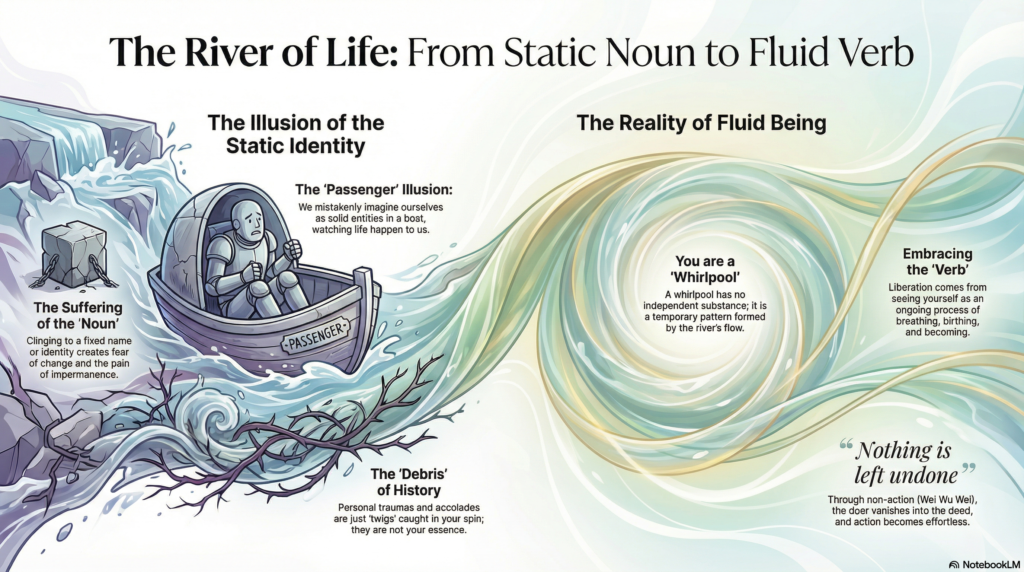
To grasp the nature of the individual “I,” one must synthesize the relationship between the “River” (the Ground of Being or Source) and the “Whirlpool” (the localized self).
The whirlpool appears to be a distinct entity, yet it possesses no independent existence outside of the movement of the river.
Attributes of the Self-as-Whirlpool
• Absence of Hard Edges: There is no distinct demarcation where the whirlpool terminates and the river begins; the boundary is an observational illusion.
• Ontological Unity: The whirlpool is composed of the same substance as the river; it is a temporary configuration of the Source, not a separate essence.
• Identity as Motion: Its “selfhood” is derived strictly from its pattern of rotation rather than from a static “lump of stuff.”
• Continuous Exchange: The whirlpool maintains its form only through the constant influx and efflux of water, just as the self is a perpetual flow of sensations and thoughts rather than a stable “owner” of those experiences.
3. The Seven Main Chakras: Patterns of Energetic Rotation
From the perspective of integrative bio-psychology, chakras are not anatomical structures but dynamic “wheels” or vortexes of spinning, conical energy.
These subtle-body gateways serve as the interface between the physical and the metaphysical, acting as conduits that coordinate the flow of prana (vital life force) throughout the human system.
Technical Breakdown of the Vortex
• Rotational Dynamics: Translating to “wheel” or “disk,” a chakra represents a continuous rotational energy that draws in environmental and universal prana to sustain the biological and psychic form.
• Bi-Directional Conical Extension: While often visualized as two-dimensional disks, these centers are actually three-dimensional, funnel-shaped vortices that extend from both the front and the back of the body, creating a complex field of dynamic equilibrium.
• Subtle-Body Regulation: These centers act as the primary regulators of the human energetic economy. They may exist in states of underactivity (stagnation) or overactivity (excess), with optimal health manifesting as an open, free-spinning state that facilitates harmony between the physical and spiritual dimensions.
4. Analytical Mapping: Elements, Endocrine Links, and Propensities
The following analysis utilizes the framework of Bio-Psychology—the integrative science exploring the relationship between the subtle energy centers (chakras), the nervous plexi, and the endocrine system. Each chakra acts as a controlling point for specific physical elements and psychological propensities.
| Chakra Name | Location | Controlling Element | Endocrine Association | Psychological Propensities |
|---|---|---|---|---|
| Muladhara | Base of spine | Solid factor | Base of spine / Adrenal Medulla (Bio-psychological implication) | Existential fear vs. Sense of safety/security |
| Svadhisthana | Below navel | Liquid factor | Testes and Ovaries | Tendency toward overindulgence vs. Harmonious relationships |
| Manipura | Navel | Luminous factor | Adrenal glands and Pancreas | Power-mongering and worthlessness vs. Empowerment/Enthusiasm |
| Anahata | Centre of chest | Aerial factor | Thymus gland | Possessiveness/Avoidance vs. Expanded love/Connection |
| Vishuddha | Centre of throat | Ethereal factor | Thyroid and Parathyroid | Listlessness/Dullness vs. Truth/Creativity |
| Ajina | Between eyebrows | Mind (Seat of) | Pituitary gland | Slave to habits and impulses vs. Intuition/Willpower |
| Sahasrara | Crown of head | Soul (Seat of) | Pineal gland | Enlightenment and Spiritual connection |
5. The Physiological River: Breathing and Circulation as ‘Verbs’
The process philosophy of “selfing” is most evident when we deconstruct human physiology. By applying a verb-based lens, we dissolve the illusion of the body as a sealed container and reveal it as a continuous conversation with the cosmos.
| Noun Perspective (Static) | Verb Perspective (Process) |
|---|---|
| The Breath: An object or “thing” that one possesses or takes. | Breathing: A continuous exchange where the atmosphere becomes “me” and the “me” returns to the world, blurring the boundary between internal and external. |
| The Blood: A static substance circulating within a closed loop. | Blooding: A hidden river of circulation connecting every cell, directly fed by the larger circulation of the Earth and atmosphere through air, food, and water. |
6. Spiritual Awakening: From ‘Being’ to ‘Selfing’
Spiritual liberation within the Tantric and Yogic traditions is not the attainment of a new state, but the transition from defending a fixed image to embracing the “selfing” process.
This awakening is facilitated through the movement of Kundalini energy as it “pierces” the various chakras, transforming the practitioner’s phenomenological experience.
Benefits of the Process-Oriented Perspective
1. Softer Ego: Recognizing the self as a transient pattern rather than a permanent object alleviates the desperate need to defend a brittle, illusory image.
2. Peace with Change: When the self is understood as “flow,” aging and loss are viewed as the river rearranging its patterns rather than the annihilation of a fixed entity.
3. Language as a Tool: Nouns are utilized as gentle, practical pointers rather than prisons of thought, acknowledging that the label is never the reality.
4. Integrative Mastery: The use of mental practices and mantra serves as the primary technical tool for piercing the centers, allowing the full power of the chakras to blossom as the Kundalini ascends.
7. Synthesis: Living as an Expression of the River
To live as a “verb” is to be liberated from the burden of maintaining the facade of a fixed identity.
While we continue to navigate the world using names and pronouns for practical convenience, the underlying realization remains: we are not separate nouns, but expressions of an unfathomable flow.
Trust is no longer placed in the permanence of the whirlpool’s shape, but in the enduring current of the river itself.
All is water, all is flow.
Leave a Reply