The OM Map of Consciousness
Beyond the Yoga Studio Chant
In the modern world, the OM symbol (Oṅkāra) has become a ubiquitous icon, often relegated to a calming yoga studio chant or a decorative graphic on a t-shirt.
However, to the modern Vedānta scholar, OM is far more than a mantra; it is a pratīka ālambanam—a sophisticated, non-personal symbol used as a support for meditation.
It is, in fact, a “secret map” that outlines the entire structure of the universe and the human psyche.
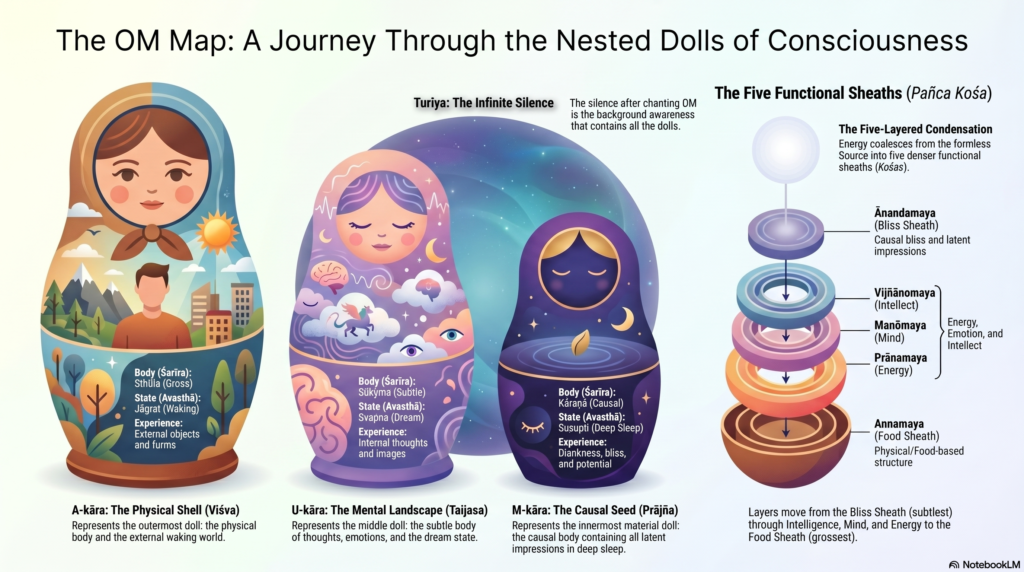
To understand this map, we must look at it through the lens of a set of Russian nesting dolls.
Just as one doll fits precisely inside another, our experience of reality is composed of layers—from the vast, formless silence of consciousness to the rigid, tangible form of the physical body.
By decoding the OM symbol, we can learn to “peel” these dolls and find the source that contains them all.
——————————————————————————–
Takeaway 1: OM is a Structural Diagram, Not Just a Logo
The syllable OM is technically composed of three phonetic units or mātrās: A (A-kāra), U (U-kāra), and M (M-kāra).
As the Māṇḍūkya Upaniṣad explains, these three units are not just sounds; they represent a complete diagnostic map of our individual experience and the cosmic totality.
Crucially, the map mirrors the individual (Vyakti) with the total universe (Samaṣṭi).
When we chant OM, we are acknowledging that the microcosm and macrocosm are one.
| Mātrā | Individual State | Total Aspect | Body & Experience |
| A-kāra | Viśva (The Waker) | Virāṭ (The Total Gross Universe) | The physical body and the world of objects. |
| U-kāra | Taijasa (The Dreamer) | Hiraṇyagarbha (The Total Subtle Mind) | The inner world of thoughts, emotions, and dreams. |
| M-kāra | Prājña (The Sleeper) | Īśvara (The Total Causal Potential) | Deep sleep—the seed state where everything is unmanifest. |
The Katha Upaniṣad highlights the profound power of this symbol:
“ētadālambanaṁ śrēṣṭham, ētadālambanaṁ param – This is the best symbol. This is the symbol for the higher and lower Brahman.”
By utilizing OM as a structural diagram, we stop seeing our lives as a series of random events and start seeing them as a nested hierarchy of consciousness.
——————————————————————————–
Takeaway 2: The “Reverse Doll” Theory – You are Condensed Energy
While many seek the “inner self” by going deeper inside, Vedānta also teaches the pravṛtti mārga, or the outward journey of manifestation.
In this “Reverse Doll” theory, pure consciousness is the outermost doll—the largest and most inclusive.
Through the power of māyā (the creative power of projection and veiling), this infinite consciousness “coalesces” into denser and more limited forms.
Think of it as the states of H₂O:
- Pure Consciousness is the formless source.
- Causal Potential is like steam—invisible, yet containing everything.
- Subtle Mind is like liquid water—fluid and taking the shape of its container.
- Physical Form is like ice—the most rigid, condensed, and limited “innermost doll.”
The Vivekacūḍāmaṇi uses the “Pot and Clay” metaphor to explain this: the clay is the substance (kāraṇam), while the pot is merely a temporary modification (kāryam).
Similarly, our physical form is just a condensed modification of the original Source.
Śaṅkarācārya provides a beautiful scholarly image in the Dakṣiṇāmūrti Stotram: the body is like a clay pot with five apertures (the senses). Inside the pot sits a brilliant light (Ātmā). The light “leaks” through the holes to perceive the world, but the light itself is never limited by the shape of the pot.
——————————————————————————–
Takeaway 3: The 5-Layer Shield (Pañca Kośa)
To navigate the map of OM with precision, we must understand the pañca kośas—the five “sheaths” or functional layers that cover our true nature.
These layers are classified as anātma, a term meaning “non-self” or matter.
In Vedāntic logic, anātma is anything that can be observed; because you are the one observing these layers, they cannot be what you fundamentally are.
Moving from the most manifest to the most subtle, these “dolls” are:
- Annamaya: The physical “food” sheath (Gross Body).
- Prāṇamaya: The energy/vitality sheath (Physiological functions).
- Manōmaya: The mental/emotional sheath (Desires and feelings).
- Vijñānamaya: The intellectual/cognitive sheath (Decision-making and logic).
- Ānandamaya: The bliss sheath (The causal layer of deep sleep and latent impressions).
As the Vivekacūḍāmaṇi notes:
“The pañca kośas are nothing but anātma or the three śarīraṁs themselves further divided into five kośas.”
We often suffer because we mistake one of these “outer wrappers”—like a passing mood (Manōmaya) or a physical ailment (Annamaya)—for our actual identity.
——————————————————————————–
Takeaway 4: Your Daily Routine is a Laboratory for Liberation
You do not need to retreat to a cave to find the Source; your daily cycle of waking, dreaming, and sleeping is a laboratory.
The practice of Pravilāpana Dhyānam involves using the sounds of OM to “resolve” the inner dolls back into the outermost silence.
The Meditation Practice:
- Chant A-kāra: Visualize the physical body and the gross world (Viśva/Virāṭ) resolving into the mind.
- Chant U-kāra: Visualize the world of thoughts and dreams (Taijasa/Hiraṇyagarbha) resolving into the causal seed state.
- Chant M-kāra: Visualize all potentiality (Prājña/Īśvara) resolving into the background of pure awareness.
- Rest in Silence: This is Turīya—the “fourth”—the silence that contains the sound.
To understand Turīya, imagine a lighthouse with three concentric rooms. You may move between the room of the physical world, the room of dreams, and the dark room of deep sleep, but you are the light itself that makes all three rooms visible.
The Naishkarmya Siddhi highlights this discovery:
“In the three states of experience… everything in creation is subject to arrival and departure, while ‘I’ alone continue to be there as the constant factor.”
——————————————————————————–
Takeaway 5: The Three “Defects” That Keep the Dolls Sticky
Why do we struggle to “peel” these dolls?
It is because we are attached to the pleasures they provide.
To break this “stickiness,” we must recognize the Doṣa Trayam—the three defects inherent in all sense-pleasures:
- Mixed with Pain (Duḥkha miśritatvam): Every pleasure requires effort to acquire and stress to preserve.
- Impermanent (Adhruvatvam): Every experience has an “expiry date.” This applies even to the Ānandamaya (bliss) sheath—the peace of deep sleep is defective because it ends the moment you wake up.
- Insatiable (Atṛptihetutvam): Indulgence doesn’t satisfy craving; it fuels it, like pouring oil on a fire.
Understanding these defects is not about “giving up” joy, but about gaining mastery.
When you see that the wrappers (the dolls) are flawed and temporary, you stop clinging to them and naturally reach for the “candy”—the eternal, unmixed bliss of your true nature.
——————————————————————————–
Conclusion: Finding the Silence Between the Sounds
The journey of the OM symbol is a full circle.
It tracks how the formless Source condenses through māyā into the physical “inner doll” of your body, and it provides the map to trace your way back home.
Ultimately, you are not the physical form, the racing mind, or even the bliss of deep sleep.
You are Turīya—the “space” or the silence that allows all these dolls to exist.
You are the witness of the waking, the dreaming, and the sleeping.
If you were to step out of the “waking doll” for just one moment today, who would be left watching?
The Om Map – The Journey of the Nested Dolls of Consciousness [Audio] https://www.youtube.com/watch?v=c-V-svVNtog
The OM Map of Consciousness https://www.youtube.com/watch?v=KRo3KwVeK-o