Have you ever experienced a lingering intuition that there is “more” to reality than what meets the eye?
You move through your day, handling responsibilities and reacting to events, yet a subtle sense of incompleteness persists.
The Upaniṣads don’t suggest you are simply tired; they diagnose you as a somnambulist—a sleepwalker traversing a landscape that has no more substance than a midnight whim.
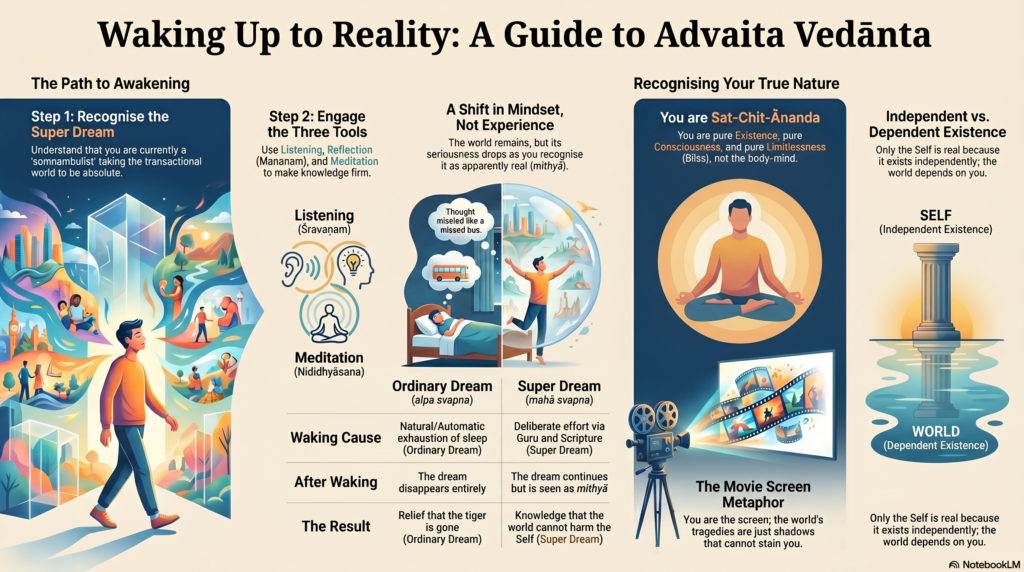
According to the ancient wisdom of Advaita Vedānta, our daily life is not the final reality but a mahā svapna—a “super dream.”
We are currently walking in sleep without realizing it.
Waking up is not a physical act of opening your eyes, but a fundamental shift in the “order of reality” you assign to the world.
Here are five key takeaways to help you navigate this masterful illusion and recognize your true nature.
——————————————————————————–
1. You Are Currently Living in a “Super Dream”
In the metaphysics of Advaita, the distinction between dreaming and waking is not as wide as we assume.
The tradition defines two types of sleep: alpa svapna (the ordinary night dream) and mahā svapna (the transactional waking world).
To understand this, we must look at the Three Orders of Reality:
- Prātibhāsika (Apparent Reality): The “dream snake” or the night dream. It is experienced but negated the moment you wake up.
- Vyāvahārika (Transactional Reality): The waking world. It is predictable and useful for transaction, yet it remains dependent on a higher substratum.
- Pāramārthika (Ultimate Reality): The non-dual Self (Brahman), which is never negated and has existence of its own.
Just as a dreamer takes a dream-tiger to be solidly real—experiencing a racing heart and genuine terror—you take the world of objects and problems to be absolute.
Waking up is the shift from the transactional (Vyāvahārika) to the ultimate (Pāramārthika).
Unlike a night dream, however, this “super dream” continues even after intellectual realization. The world does not vanish; it simply loses its power to delude you.
“Uttiṣṭhata jāgrata prāpya varān nibodhata” (Arise! Awake! Having approached the great ones, know the Ātmā!) — Kaṭha Upaniṣad
2. The “Borrowed Existence” of Your Reality
To understand why the world is termed mithyā (apparently real but factually unreal), we must look at the “Fire-Vessel-Water” principle. Consider a potato boiling in a pot.
The potato becomes hot, but heat is not the svabhāva (intrinsic nature) of the vegetable.
The potato borrows heat from the water, which borrows it from the vessel, which borrows it from the fire.
In this chain, the fire alone is the Svatantra Satya—the independent reality.
In Advaita, what is “borrowed” is not ultimately real in that object.
Your body, your thoughts, and your personality are like that potato; they possess “borrowed consciousness” from the Ātmā (the Self).
If you remove the fire, the potato has no “isness” of its own.
Similarly, your temporary feelings and bodily states are not your intrinsic nature. You are the fire—the self-existent source—not the heated vegetable.
3. You Are the Screen, Not the Movie
One of the most effective tools for understanding the Sākṣī (the witness consciousness) is the metaphor of the movie screen.
- The Screen: It is unchanging, motionless, untainted, and asaṅga (unattached). Whether a river flows or a fire rages in the movie, the screen never gets wet and never burns.
- The Movie Characters: They represent the changing names and forms (nāma-rūpa) of your life—the hero, the victim, the successes, and the failures.
Our suffering arises from adhyāsa (superimposition): we forget the screen and get so absorbed in the plot that we believe the character’s tragedy is our own.
This “movie” moves us only because we have lost sight of the motionless substratum.
“The ignorant person says the screen is pure only during the interval. The wise person knows the screen is pure all the time.” — Vivekacūḍāmaṇi
4. Bliss is a Noun, Not an Adjective
We often treat happiness as an adjective—a fleeting quality that describes us when external conditions are favorable.
However, Advaita defines your true nature as Sat-Chit-Ānanda (Existence-Consciousness-Bliss). In this context, Ānanda is not a temporary feeling but pūrṇatvam: limitlessness and wholeness.
Reality manifests in degrees across three standpoints:
- In stones, only existence (Sat) is manifest; consciousness and bliss are veiled.
- In plants and animals, both existence and consciousness (Chit) are manifest.
- In humans, we have the capacity to reflect the fullness of bliss (Ānanda).
The sage Bhartṛhari asked: why go in a “roundabout way,” struggling to please an unpredictable world for a tiny reflection of joy, when you can recognize yourself as the source?
You are not a bundle of lack seeking fulfillment; you are pūrṇa (full) by nature, currently obscured by the veil of ignorance.
5. Waking Up Requires an External “Jolt”
Unlike waking from a night’s sleep, which happens automatically, waking from the mahā svapna requires a deliberate, external “jolt.”
Because the dream is so immersive, you cannot simply will yourself awake.
You need Guru-Śāstra-Upadeśa (the teacher and the scripture) to shake you.
This awakening is a structured process of three steps:
- Śravaṇam (Listening): Hearing the “alarm clock” of the teaching (e.g., Tat Tvam Asi—”You are That”).
- Mananam (Reflection): Removing doubts through reasoning, such as questioning why the waking world should be more “real” than the dream world.
- Nididhyāsanam (Assimilation): Constant practice to make the knowledge firm so it isn’t lost during life’s stressors.
We often “hit the snooze button” on enlightenment because of our Vāsanās—deep-seated tendencies to go back to sleep and return to the comfort of the familiar dream.
——————————————————————————–
Conclusion: Shifting the Order of Reality
Waking up is not a mystical event where the world vanishes into a cloud of incense.
It is a fundamental shift in mindset. Your body, your family, and your responsibilities remain exactly as they were, but their “seriousness” decreases.
When you know the world is mithyā, a tragedy in life becomes like a tragedy in a movie—it can be experienced and even endured through titikṣā (fortitude), but it no longer leaves a permanent scar on your soul.
You remain the nirvikāra draṣṭā (changeless witness).
The final test of this awakening is simple: How much of your life is currently an obsession with the dream, and what would happen if you finally recognized the screen?
Waking Up to Reality – The Teachings of Advaita Vedānta https://www.youtube.com/watch?v=03LofwR4hA8
Waking Up from the Grand Dream: Discovering Your True Nature in Advaita Vedānta https://www.youtube.com/watch?v=GUQXtoyaAJo