King Lear and the Vedantic Self: Decoding the Tragedy of the Mind [Audio]
1. Introduction: The Identity Crisis of the Jīva
When King Lear stands upon the precipice of his own dissolution, watching his kingdom and sanity vanish into the gale, he is not merely a victim of political betrayal or filial ingratitude.
He is the supreme archetype of the jīva (the individual soul) trapped in the twilight of self-misunderstanding.
His fall is not a secular tragedy, but a metaphysical one: the catastrophic result of ātmājñānam (self-ignorance).
The jīva, navigating the waking state, typically operates in a condition of “partial light.”
We know that we exist—the “is-ness” of our being is undeniable—yet we disown our true status as the ever-free, pure Consciousness (Brahman).
Like Karṇa in the Mahābhārata, who knew he existed but disowned his royal lineage to identify as the son of a charioteer, Lear clings to the borrowed finery of kingship while remaining a stranger to the “Brahman status” that is his birthright.
By applying the Vedantic lens of ātmajñānam (self-knowledge) to this Shakespearean ruin, we uncover the mechanics of a mind that mistakes its masks for its face.
2. Takeaway #1: The Danger Isn’t Darkness—It’s Partial Light
In the Vedantic tradition, total darkness is safer than the twilight.
In the state of deep sleep (suṣupti), there is total ignorance, yet there is bliss because no error can arise.
In total light (wisdom), the truth is seen clearly and suffering ceases.
The tragedy of Lear occurs in the “partial light” of the waking state, where the “is-ness” of the self is known, but its “ropeness”—its true nature—is veiled.
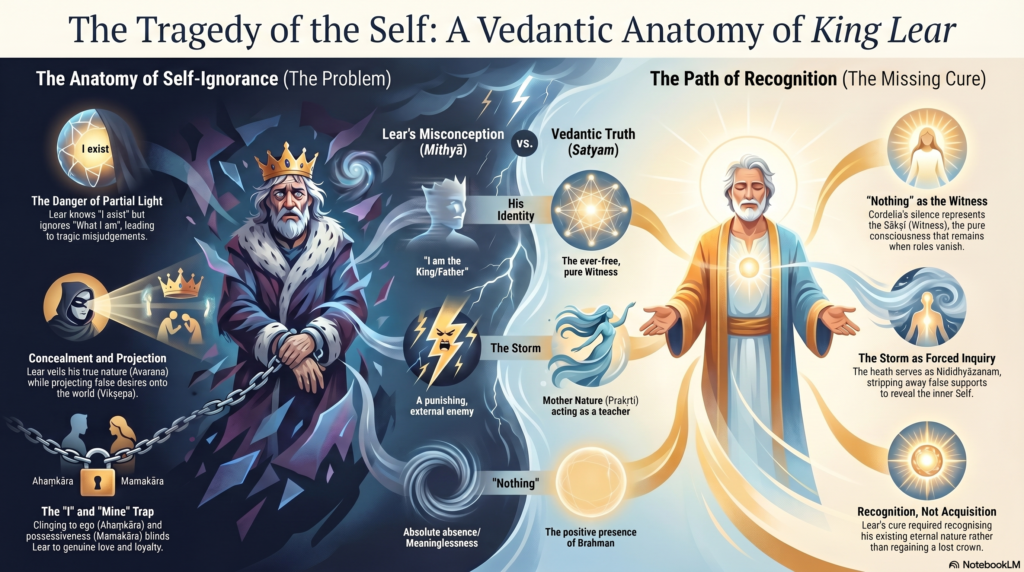
Lear knows “I am,” but he fills the void of “what I am” with projections.
This half-knowledge creates a tāmasic intellect: a mind that is firm in its wrong understanding.
Because he knows he is a King and a Father (partial light), he becomes arrogant, mistaking the “is-ness” of his power for an eternal attribute of his person.
The source context warns us of this specific peril:
“If it is total darkness, I do not see anything at all; then also no problem… but when there is partial lighting up and partial darkness—I know there is something lying down, but I do not know what exactly it is. This is called half-knowledge or partial knowledge; partial knowledge creates a lot of problems.”
Total ignorance is a temporary bliss, but Lear’s “half-knowledge” creates the friction that ignites his madness.
He is certain of his wrong conclusions, and as the texts suggest, the “is-ness” is known, but the “ropeness” is hidden.
He is the man who sees a snake because he can see just enough of the rope to be deceived.
3. Takeaway #2: The Storm is the Only Mother (and She is a Teacher)
A striking void at the center of King Lear is the total absence of a human mother.
In Vedantic symbolism, this absence is profoundly instructional.
Lear is a man who has never transcended the “Mother” principle—Prakṛti (Nature/Māyā)—because he has no awareness of the “Father” principle—Brahman (Pure Consciousness).
Without the “Father” as the silent Witness, Prakṛti appears not as a nurturing force, but as a terrifying, destructive storm.
The mechanics of this suffering are two-fold: āvaraṇa (concealment) and vikṣepa (projection).
Because Lear’s true nature is concealed (āvaraṇa), his mind becomes obsessed with the external world (vikṣepa).
The storm on the heath is not a punishment from without; it is the “Mother” in her “furious teaching” mode, stripping away the borrowed identities of crown and castle to reveal the “poor, bare, forked animal” beneath.
| Vedantic Symbolism | The Mother (Prakṛti/Māyā) | The Father (Brahman/Puruṣa) |
| Metaphysical Nature | Active, Changing, Creative Energy | Silent, Unchanging Witness |
| Cosmic Function | Provides the body, mind, and world | The non-dual source of Existence |
| Role in King Lear | The Storm: Tearing down false identities | The unshakable silence of the Witness Lear ignores |
Nature is only terrifying when the Witness is ignored. When Lear rages at the elements, he is fighting the very mirror meant to show him his own reflection.
4. Takeaway #3: The Secret Power of “Nothing”
The motif of “Nothing” serves as a linguistic void into which Lear’s ego eventually collapses.
From Cordelia’s initial “Nothing, my lord” to Lear’s warning that “Nothing will come of nothing,” the play grapples with the concept of emptiness.
To the worldly mind, “nothing” is nihilism (Śūnya). To the Vedantin, “nothing” is the pointer to the Sākṣī (Witness-Consciousness).
When Cordelia says “Nothing,” she is not expressing a lack of love, but a refusal to objectify it into finite, transactional words. She represents the silent witness.
The source context provides the metaphysical key to this silence:
“Nobody is not nobody. Nobody means, somebody… And who is that somebody? The observer of nobody.”
Lear views “nothing” as a lack, failing to realize that the experiencer of nothing is the only true “something.”
Cordelia’s silence is the “positive nothing”—the Sākṣī-caitanya—that remains when all removable attributes are stripped away.
By clinging to the “something” of flattery, Lear misses the “everything” of the Self.
5. Takeaway #4: The Fool is the Only True Guru
In the inverted world of the play, the court jester is the only clear thinker, acting as a Guru through the methods of anuvāda (referencing the student’s error) and apavāda (the subsequent correction).
The wise person often appears as a “fool” to the worldly-minded because their casual words are “golden,” packed with a truth that the ego finds unpleasant.
The Vedantic texts classify Lear at the play’s start as a “Mahā fool”—one who knows not, and knows not that he knows not.
He is the 10th man of the famous parable, searching outside for the very person (himself) he has failed to count.
The Fool, conversely, is the wise one who “knows and knows he knows.” He uses riddles to point to the “rope” (truth) through the “snake” (Lear’s error). He tries to teach Lear that the glory of a king belongs to the role, not the man; to the actor, not the Witness.
6. Takeaway #5: Why We Die with Lear (The Trap of “I” and “Mine”)
The ultimate tragedy of King Lear is his failure to achieve liberation (mukti) before the final curtain.
He remains trapped in the dual cage of Ahaṃkāra (I-ness/identification with the body) and Mamakāra (Mine-ness/attachment).
Lear is the quintessential actor who has forgotten he is playing a role.
The path to self-knowledge requires the “removal of rocks” (ignorance, doubt, and wrong notions).
Lear “cracks” the rocks of his pride during the storm, but he never removes them. Even at the end, as he cradles the dead Cordelia, he is consumed by Mamakāra. He does not see her as his own Self appearing as a daughter; he sees her as “mine,” a possession lost.
As the source context poignantly notes:
“I AM THE HERO OF MY AUTOBIOGRAPHY; THE QUALITY OF MY LIFE DEPENDS UPON ‘WHO I AM’; AND ‘WHO I AM’ DEPENDS UPON ‘HOW I LOOK AT MYSELF’.”
Lear dies looking outward for a sign of life in a corpse (“Look there, look there!”), still identified with the suffering role, forgetting the infinite Life that is his own nature as the Witness.
7. Conclusion: Returning the Body to the Elements
The Bhartṛhari Vairāgya Śatakam provides the necessary contrast to Lear’s end.
While Lear dies in a paroxysm of grief and rage, the wise person offers a “final salutation” to Mother Earth and Father Air, gratefully returning the borrowed body to the five elements.
The sage recognizes that the storm was a gift—an opportunity for the pure knowledge to arise and destroy all delusion.
Lear’s death is a cautionary tale for any jīva suffering from viparīta bhāvanā (wrong notions about the self). He saw the nothingness of the world’s flattery but could not claim the positive “nothing” of the Witness. He fought the “Mother” of change because he never recognized the “Father” of silent awareness within.
In the storm of your own life, are you still the “Hero of your Autobiography,” raging against the inevitable changes of Prakṛti, or are you ready to drop the role and recognize the silent, unchanging Witness that has been there all along?
King Lear – Map of Your Mind | A Vedantic Guide to Self-Knowledge https://www.youtube.com/watch?v=8PInpXXrlv8
King Lear and the Vedantic Self: Decoding the Tragedy of the Mind [Audio] https://www.youtube.com/watch?v=OCgFQ2U5T-U