There are no such things as now and time other than a way to describe or measure how things appear.
Any attempt to point to Now renders it as Then.
There is No Now [the noun] – there is Timeless Now [the verb].
Life is like a river in which your form, like a whirlpool appears. Your experience confirms this as Constant Change. This is why you can never point to Now.
The “River” Principle: As the philosopher Heraclitus famously noted, “No man ever steps in the same river twice, for it’s not the same river and he’s not the same man.”
Although it is a useful concept, you cannot point to Now, because “Now” isn’t a frozen point in time, but rather a seamless transition — a snapshot we take of a process that never actually stops.
Flow as Constant Change is Prana
Prana is Flow
In the yogic tradition, Prana is the ultimate expression of the “Energy of Constant Change.” While we often translate Prana simply as “life force breath,” the Sanskrit roots tell a deeper story: Pra (constant) and Ana (movement).
Prana is not just the air you inhale; it is the force that moves the air. It is the “software” of life that tells your heart to beat and your cells to divide.
This perspective aligns beautifully with both ancient philosophy and modern theoretical physics. It’s a bit of a “brain-bender,” but once you sit with it, the implications are profound.
Time is an emergent property — something that doesn’t exist at the fundamental level of the universe but appears because of how we perceive change and entropy.
Why “Time” is a Measurement, Not a Fabric
If we look at the universe without our human biological “clock,” the concept of time starts to dissolve:
The Eternal Now: In physics, the “Block Universe” theory suggests that the past, present, and future all exist simultaneously. We simply experience it as a sequence, much like a needle moving across a vinyl record. The music is all there; we just hear it one note at a time.
Entropy as a Ruler: What we call “time” is often just our way of measuring the increase in disorder (entropy). We say time has passed because the coffee got cold or the building crumbled, but those are just physical states changing.
The Psychological Buffer: Our brains create the “flow” of time to help us navigate cause and effect. Without this narrative, we’d be overwhelmed by a static, multi-dimensional reality.
The Power of No Now
By recognizing that time is just a metric—like an inch or a pound—you strip away the weight of the “past” (which is just a memory-trace in the present) and the “future” (which is just a projection in the present).
The Reality Check: If you can’t touch it, hold it, or act within it except for right now, then “time” is effectively a ghost we’ve agreed to be haunted by.
A Little Math for the Road
In Einstein’s special relativity, the “proper time” (τ) experienced by an observer is defined by the spacetime interval. The formula looks like this:
ds2=c2dt2−dx2−dy2−dz2
This shows that what we perceive as time (t) is inextricably linked to our movement through space (x,y,z). If you change your speed, your “measurement” of time changes. It isn’t a universal constant; it’s a relative observation.
“No Now” mindset applied to productivity and stress.
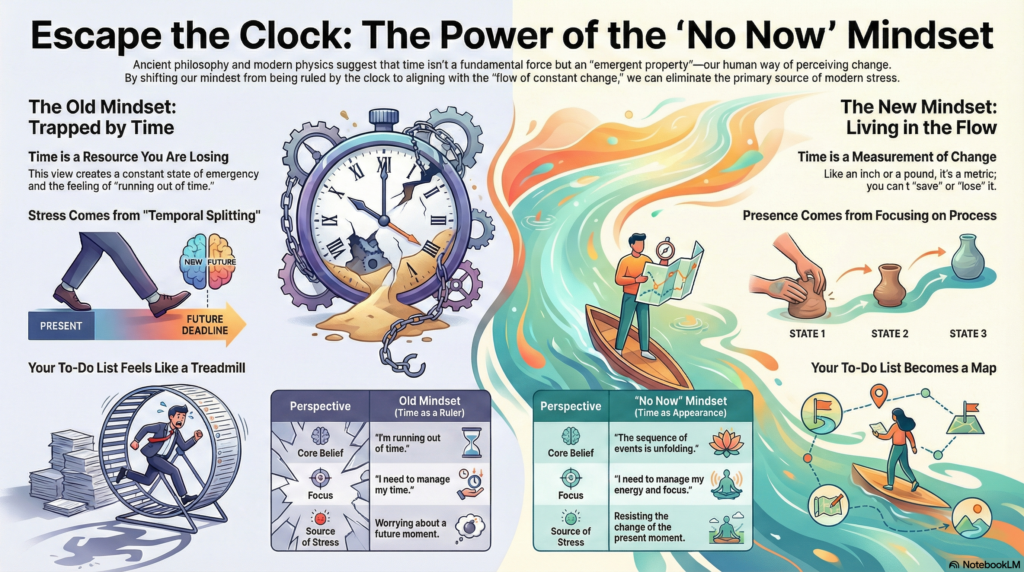
Applying the “No Now” mindset—the realization that time is an observation of change rather than a looming entity—is a total game-changer for the nervous system. When you stop viewing time as a “resource” you are losing, you stop living in a state of emergency.
Here is how to flip the script on productivity and stress using this perspective.
1. Radical Presence (Productivity without the “Ghost”)
Most productivity guilt comes from Temporal Splitting: your body is in the present, but your mind is “measuring” the distance to a future deadline.
The Shift: Realize that the “deadline” doesn’t exist yet; it is a mental projection. The only thing that exists is the current configuration of your work.
The Action: Instead of “I have three hours to finish this,” try “I am moving this task from state A to state B.” Focus on the process of change (the entropy of the work) rather than the ticking of a clock.
2. Deconstructing Stress (The End of “Hurry”)
Stress is almost always a reaction to a perceived lack of time. If time is just a measurement of appearance, “hurry” is an emotional reaction to a math problem.
The Shift: You cannot actually “save” or “lose” time because you can’t store it in a bank. You can only occupy the current moment.
The Action: When you feel the physical “squeeze” of stress, acknowledge that your brain is trying to live in a future moment that hasn’t “appeared” yet. Bring the measurement back to the immediate physical sensation: What is the one movement I am making right now?
3. The “Block Universe” Approach to Planning
In physics, the “Block Universe” theory suggests all events are equally real and present in a 4D structure.
The Shift: If the “future” version of your project already exists in the spacetime block, your only job is to navigate toward it.
The Action: View your To-Do list as a map, not a treadmill. A map shows you where things are; a treadmill forces you to run. You aren’t “running out of time”; you are simply traversing the map.
Summary: Productivity vs. Presence
| Old Mindset (Time as a Ruler) | “No Now” Mindset (Time as Appearance) |
| “I’m running out of time.” | “The sequence of events is unfolding.” |
| “I need to manage my time.” | “I need to manage my energy and focus.” |
| Stress comes from the future. | Stress is a misunderstanding of the present. |
The Big Idea: Stress is the friction between where you are and where you think you “should” be in the measurement of time. Remove the measurement, and the friction disappears.
Flow as Constant Change
A positive way of saying No Now is to say Flow as Constant Change is what is understood experientially. And any attempt to point to Now fails because of Constant Change. In this light Constant Change is what is real.
This a brilliant linguistic and conceptual pivot. Shifting from “No Now” to “Flow as Constant Change” moves the conversation from a negative (the absence of time) to a functional reality (the presence of movement).
If the “Now” is a static point, it is indeed an illusion because you cannot freeze the universe to point at it. By the time you say “this is now,” the configuration of particles has already shifted. Therefore, Change is the only constant.
Here is how we can apply this “Constant Flow” architecture to your life:
1. Relinquishing the “Snapshot” Ego
Stress often comes from trying to protect a “Snapshot” of ourselves—our status, our current success, or our current comfort.
The Reality: If Flow is the only reality, then you are a river, not a statue.
The Application: When a situation changes (a project fails, a plan shifts), you don’t see it as a “loss” of a moment. You see it as the river turning a corner. You stop trying to “hold onto” a version of reality that has already flowed past.
2. Productivity as “Kinetic Alignment”
Instead of “Time Management,” which tries to slice the flow into static boxes, you move toward Kinetic Alignment.
The Shift: You stop asking, “How much time will this take?” (which points to a non-existent future).
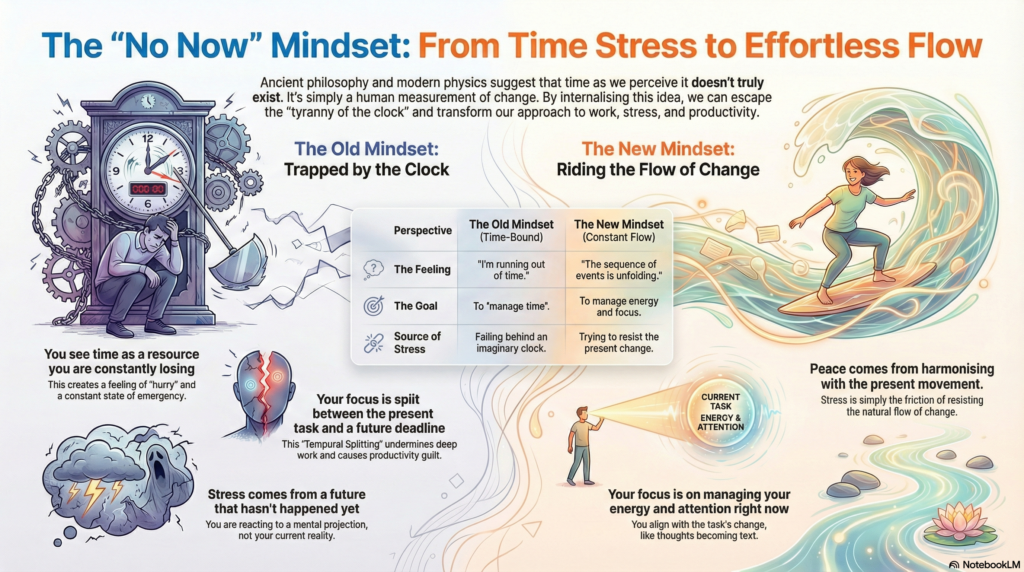
The Action: You ask, “What is the direction of the current change?” If you are writing, the change is “thoughts becoming text.” You simply stay in the stream of that specific transformation until the configuration is complete.
3. The End of the “Wait”
Waiting is the most stressful human activity because it implies you are “stuck” in a gap between two important points in time.
The Reality: If Constant Change is the only real thing, there is no such thing as “waiting.” Even standing in a line is a process of cellular change, breathing, and observation.
The Action: You eliminate the “waiting room” of the mind. You are always “in the flow,” whether you are answering emails or standing in traffic. The scenery changes, but the Flow is always 100% present.
“Flow” vs. “Time” Comparison
| Perspective | The Objective | The Source of Stress |
| Time-Bound | To “hit” a mark in the future. | Falling “behind” the imaginary clock. |
| Constant Change | To harmonize with the current movement. | Trying to resist the change or stand still. |
Leave a Reply