To be is a verb not a noun.
This post describes reality as a unified, continuous flow of energy known as Prana, rather than a collection of static objects. It proposes that space and time are not external containers but active processes, with feeling manifesting as spatial extension and thought creating the narrative of time.
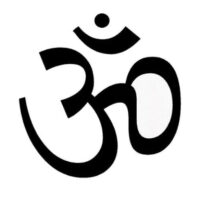
The sacred symbol Om serves as a map for this existence, correlating specific sounds and visual curves with the states of waking, dreaming, and deep sleep.
Furthermore, the human body acts as a microcosm of this universal current, where the rhythms of breath and blood circulation mirror cosmic principles. Ultimately, the source encourages a shift in perspective from seeing oneself as a fixed entity to experiencing life as a dynamic, timeless “verb” unfolding in the present moment.
~ ~ ~
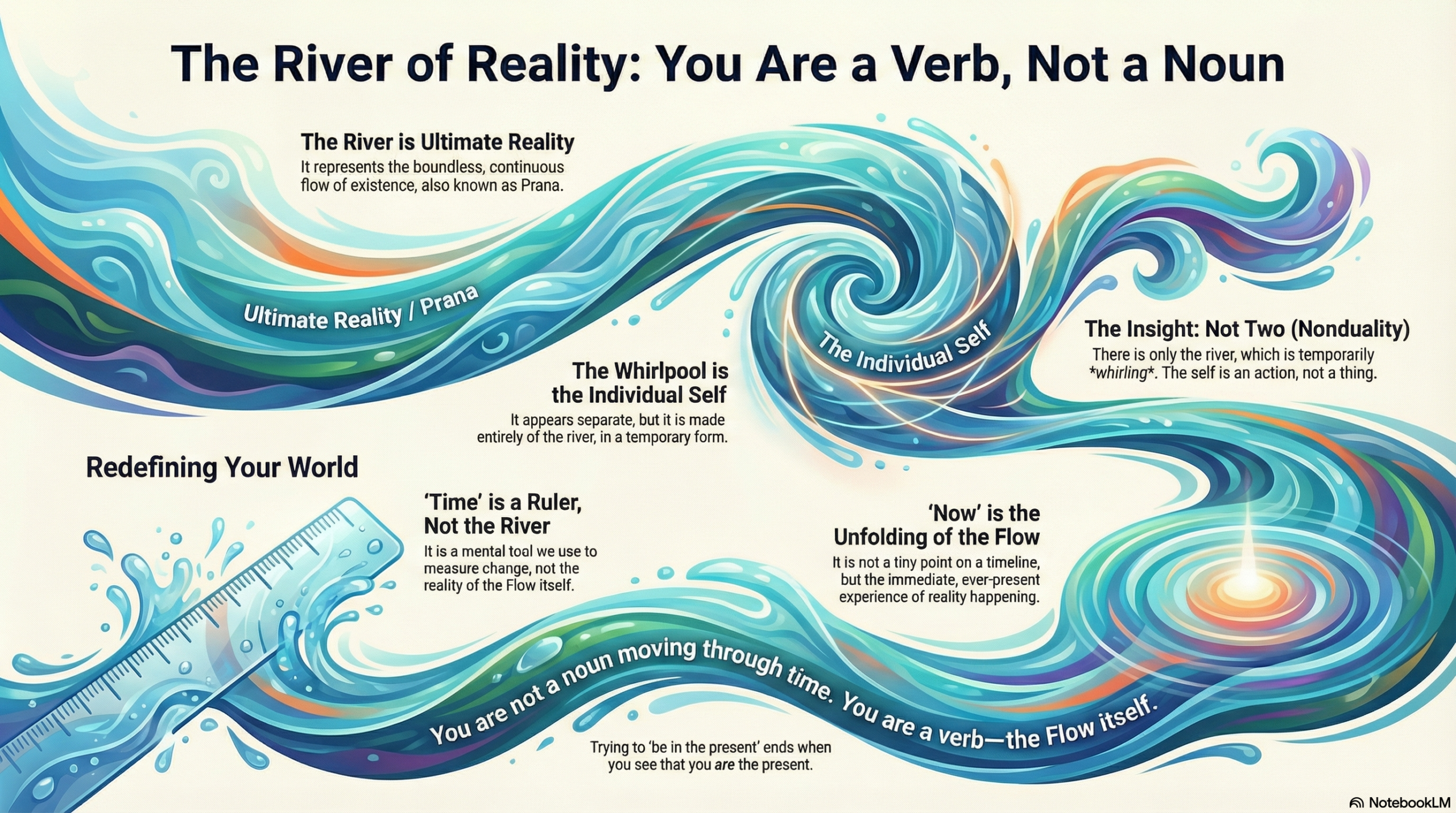
Space and Time are not independent containers or pre-existing voids that hold reality; rather, they are active manifestations or “verbs” of the singular, continuous flow of Prana.
Prana is Flow
Prana is the ultimate, non-linear “Flow” of existence—the “activity prior to things” from which all forms emerge as temporary configurations.
Space and time emerge when this unified Flow appears in two distinct modes: extension and sequence.
1. The Emergence of Space as “Flow Extending”
The common perception of space is that of a passive, empty room. Instead, Space is Flow appearing as extension, the sense of “here” and “there”.
• Feeling as Space: This emergence is directly linked to the quality of Feeling. Unlike thought, feeling is dimensional and pervasive; it has texture, depth, and volume.
• Dimensionality: When the river of Prana “extends” itself, it differentiates into perceived locations and expanses. The “distance” between objects is not an empty void but is how the Pranic flow expresses itself dimensionally.
• The Symbol of “A”: In the sacred sound Om, the syllable “A” represents this initial outward thrust of the Flow, where it becomes perceivable as gross physical forms and spatial dimensions.
2. The Emergence of Time as “Flow Narrating”
Time does not exist as an independent entity separate from the Flow. It is a conceptual framework—a “net” thrown over the river—used to measure, coordinate, and understand patterns of change.
• Thought as Time: Time emerges through the process of Thought, which is inherently sequential and linear. Thought moves from word to word and cause to effect, stringing the seamless “Now” into a narrative of past, present, and future.
• Measurement of Change: Clocks do not measure “time” passing; they count oscillations (like a vibrating atom or a rotating earth) to calibrate the Flow. Time is effectively a “conceptual grid” laid over the ceaseless activity of Prana to sequence patterns.
• The Symbol of “U”: The syllable “U” in Om represents the Flow turning inward and narrating itself temporally. It embodies the mind’s function of creating continuity, duration, and the sense of a self moving through a timeline.
3. The Union: How the World Arises
According to the sources, objects and the “world” arise at the intersection of these two modes of Prana.
• The Meeting of Thought and Feeling: A physical object (like a table) is a pattern of sensation (Feeling/Space) organized by a pattern of recognition (Thought/Time).
• The “Now” as the Source: While thought attempts to divide the Flow into temporal segments, the “Now” is the actual, unmediated experience of the Pranic current. It is not a point on a timeline but the “ever-present, unceasing act of this flow unfolding”.
Summary of Emergence
| Element | Mode of Flow | Mental/Somatic Expression |
| Space | Extension (“Here” and “There”) | Feeling: Dimensional, expansive field. |
| Time | Sequence (“Before” and “After”) | Thought: Linear narration and measurement. |
Ultimately, you are not a “noun” moving through space and time; you are the Flow (Prana) appearing as the sense of being located somewhere (space) and somewhen (time). By seeing through the illusion that space and time are external containers, one recognises that everything is the one “verb” of existence, constantly sounding its own name.
How the Om Symbol Maps the Nature of Reality
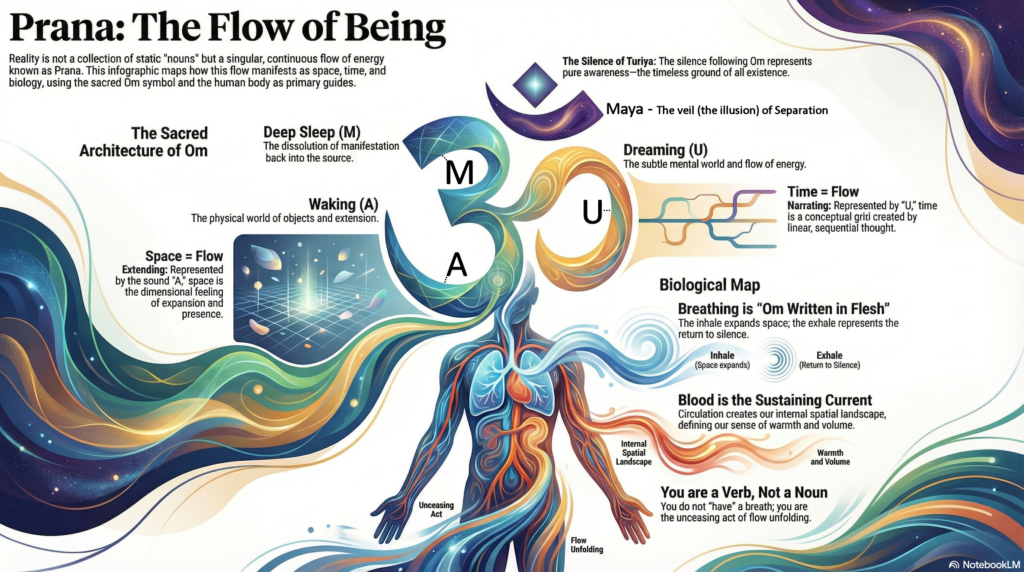
The sacred sound Om (Aum) is not merely a symbol representing reality; it is a sonic architecture and a map of nonduality that encodes the way the ultimate Flow, or Prana, manifests as the world of experience. It tracks the transition of reality from unmanifest potential, through the extensions of space and time, and back into silence.
The OM symbol maps the nature of reality through four distinct components:
1. The Sound “A” (अ): Space and Feeling
The “A” sound, pronounced from the back of the throat, represents the waking state and the gross physical world.
• Space as Extension: It maps the initial outward thrust of the Flow as it “extends” to create the sense of “here” and “there”.
• Feeling as Space: In this state, the Flow is experienced as Feeling. This is the direct, non-conceptual sensation of textures, solidity, and vastness—the qualitative “is-ness” of the physical world.
2. The Sound “U” (उ): Time and Thought
As the sound rolls forward in the mouth, it becomes “U,” representing the dreaming state and the subtle mental world.
• Time as Sequence: This syllable maps Time, which the sources define as the Flow appearing as sequence.
• Thought as Narration: “U” represents the mind’s narrative function. Just as a dream weaves events into a story, thought strings moments together to create the illusion of a continuous “self” moving through past and future. It is the Flow narrating itself temporally.
3. The Sound “M” (म): Dissolution
The closing of the lips creates the “M” vibration, representing deep sleep and the dissolution of manifestation.
• Causal State: This stage maps the re-absorption of individual whirlpools (space, time, and self) back into the undifferentiated current.
• Beyond Concept: In this state, the outward spatial awareness of “A” and the inward temporal narration of “U” are suspended. It is the Flow qualifying its own presence before thought labels it.
4. The Silence (Turiya): The Pure Flow
The most critical part of the map is the silence that follows the chant, known as Turiya or the “fourth state”.
• The Absolute Ground: This silence is the pure, unmanifest Prana—the timeless, spaceless ground from which the sounds of A-U-M arise and into which they return.
• True Reality: It signifies that you are not a “noun” (a person) experiencing the sound, but the aware stillness in which both sound and silence appear.
The Visual Geometry of ॐ
The written symbol provides a geometric map of these same states:
• The Large Lower Curve: Represents the waking state (A), the world of extension and objects.
• The Middle Side Curve: Represents the dream state (U), the flow of energy between states.
• The Upper Curve: Represents deep sleep (M), the closing of the cycle of manifestation.
• The Crescent: Represents Maya, the illusion that space and time are separate containers rather than movements of the one Flow.
• The Dot (Bindu): Represents the absolute “Now” or pure consciousness, the singularity beyond all appearance.
The Biological Map: “Om Written in Flesh”
The sources suggest that your own body is a living map of Om through the breath:
• Inhale (A): The body expands, and internal space arises.
• The Pause (U): Presence gathers, and time is momentarily suspended in the “holding”.
• Exhale (M): Contraction and the return of sound/breath to silence.
Ultimately, Om maps reality by showing that there is no “Flow” separate from its manifestations; space, time, thought, and feeling are simply different modes of the one “verb” of existence constantly speaking its own name.
Breath Flow and Blood Flow also Map the Nature of Reality
In the nondual framework of these sources, your body is not a static machine but a microcosm of the ultimate Flow, or Prana. The constant movements of breath and blood are the “verbs” of existence, acting as living maps that reveal how space, time, and awareness emerge from a singular source.
1. Breath Flow: “Om Written in Flesh”
The breath is considered the most direct and tangible manifestation of Prana, mirroring the sacred architecture of the Om symbol within the physical form.
• The Inhale (The Sound “A”): As you inhale, the body expands and internal space arises. This represents Space as Flow extending—the outward thrust of reality where “here” and “there” become distinguishable. It is the qualitative feeling of expansion and presence.
• The Pause (The Sound “U”): In the slight retention of breath, presence gathers and time feels suspended. This pause relates to Thought and Time, where the Flow is “held” or narrated. A steady breath slows the mind’s temporal narration, while erratic breathing accelerates the perceived “speed” of time.
• The Exhale (The Sound “M”): The contraction and return of the breath to the atmosphere represents Dissolution. It is the return of the individual “whirlpool” of breath back into the undifferentiated “river” of the atmosphere.
• The Silence (Turiya): The stillness between breaths is the map of Pure Awareness, the timeless ground that remains when the active “doing” of the breath pauses.
2. Blood Flow: The Inner River
If the breath is the “spirit” of the Flow, the blood is its sustaining current, providing a map of how the Flow creates an internal landscape and enables cognition.
• Mapping Internal Space: The vast network of arteries and capillaries is the Flow extending throughout the body, defining its volume, temperature, and vitality. The felt pulse in the fingertips or the warmth in a limb is a direct Feeling of Space—the Flow qualifying its spatial presence.
• Mapping Time through Cognition: The consistent flow of oxygenated blood to the brain is what enables the narration of thought. Without this steady Pranic current, the mind could not perform the sequential processing required to construct the illusion of “past” and “future”.
• The Automatic Verb: Blood flow illustrates that the “Self” is not a “mover” but a process. You do not consciously pump your blood; rather, the Flow organises itself as a heartbeat, a rhythmic pulse that is “always now” and never separate from your being.
3. Synthesis: The Embodied Verb
Together, breath and blood flow map reality by demonstrating that there is no “inside” and “outside”.
• Dissolving the Noun: These flows prove you are a verb, not a noun. You do not “have” a breath or “own” blood; you are the breathing and the circulating.
• The Union of Thought and Feeling: The body arises where these flows meet awareness. Breathing anchors you in the “Now”, while blood flow sustains the physical extension (space) and mental sequence (time).
• The Flow Knowing Itself: When you notice your heartbeat or your breath, it is not a “thinker” watching an “object.” It is the Flow becoming aware of its own pulsing—the ultimate reality of Prana recognising itself through your unique form.
| Biological Process | Nature of Reality Mapped | Expression of Prana |
| Inhalation | Space / Extension | The Flow expanding “here” and “there”. |
| Blood Circulation | Internal Landscape | The Flow reaching everywhere without edge. |
| Breath Rhythm | Time / Thought | The Flow influencing the narrative of sequence. |
| The Heartbeat | The “Now” | The continuous, non-linear arrival of existence. |
Breath is the ‘Spirit’ and Blood the ‘Current’
The body is a microcosm of the ultimate Flow (Prana), and its two primary internal movements—Breath and Blood—act as living maps of reality. These terms are used interchangeably with “Flow”, yet the distinction of breath as the “Spirit” and blood as the “Current” highlights their specific roles in the manifestation of consciousness and biological existence.
1. Breath as the “Spirit” (The Architecture of Awareness)
Breath is described as the “spirit” because it is the most direct, tangible manifestation of Prana, the universal life force. It is the primary “verb” of existence that connects the unmanifest to the manifest world.
• The Etymology of Life: The root of Prana (pra-√an) literally means “to breathe forth”. Thus, the breath is not just air; it is “activity itself”, the primordial movement prior to things.
• The Blueprint of Reality: Breath is referred to as “Om written in flesh”. It mirrors the architecture of reality (A-U-M): the inhale acts as the spatial expansion (A), the pause acts as the gathering of presence (U), and the exhale acts as the dissolution back into silence (M).
• The Connector: Breath is the bridge between the apparent “inside” and “outside”. It demonstrates that you are not a “noun” (a static person) but a process—the “breathing forth of existence itself”.
2. Blood as the “Current” (The Sustaining Inner River)
If breath is the vital spirit or energy, blood is the “Inner River”—the literal, sustaining current that defines the body’s internal landscape.
• Defining Internal Space: Blood flow represents the “Flow extending” throughout the physical form. By reaching every fingertip and cell, it creates the qualitative feeling of space, volume, and warmth that we identify as a “body”.
• The Engine of the Narrator: The blood current is what enables cognition. By providing a steady flow to the brain, it allows the mind to perform the “temporal narration of thought”. Without this sustaining current, the mental construction of time (the sequence of past and future) would cease.
• Localized Expression of the Flow: The heartbeat is not a mechanical pump but a “localized expression of the Flow”—a whirlpool in the river of Prana that organizes itself as rhythm. It proves that the Flow does not need a “mover”; it is an automatic, life-sustaining current that is “always now”.
Summary of the Relationship
These two flows work in union to create the experience of “you”. While breath (spirit) anchors awareness in the immediate “Now” and mimics the cosmic vibration of Om, blood (current) defines the internal spatial field and sustains the mental capacity to narrate life through time. Together, they show that there is no “inside” and “outside”—only the one Flow knowing itself as you.
Blood Flow Defines Our Internal Spatial Landscape
In the nondual framework blood flow functions as the “Inner River”, a continuous current that defines your internal spatial landscape by manifesting as extension. Rather than the body being a container that holds blood, the movement of blood is the very process that creates the sense of internal space.
Blood flow defines this landscape in the following ways:
• Flow as Extension: Space is defined not as an empty void but as “Flow appearing as extension”. The vast network of arteries and capillaries is the Pranic flow extending throughout the physical form, giving the body its volume, depth, and discernible boundaries. Wherever the blood reaches, it creates a “here” within the body; where it cannot reach, there is no “there” for the internal landscape to exist.
• Feeling as the Map of Space: We experience this internal landscape through Feeling, which is described as the “direct experience of extension”. Unlike linear thought, feeling is dimensional, possessing texture, weight, and warmth. The immediate sensations of a racing pulse, a flushed face, or the warmth in a limb are the “Feeling of Space” that maps our embodied presence.
• The Heart as a Localised Whirlpool: The heart is not viewed as a mechanical pump separate from the blood, but as a “localized expression of the Flow”—a rhythmic whirlpool in the river of Prana. This rhythm organises the internal landscape into a dynamic process (a “verb”) rather than a static entity (a “noun”).
• Defining the “Inside”: The circulation of blood serves to qualify and pervade our internal “here”. It connects the apparent “inside” of the body with the “outside” world, demonstrating that the body is a microcosm of the universal Flow, defining a landscape that is constantly arriving and renewing itself in the “Now”.
Ultimately, blood flow is the Flow qualifying its immediate spatial presence. It ensures that the body is not perceived as a static machine with fixed parts, but as a “singular, continuous, dynamic Flow” that is aware of its own pulsing and extension.
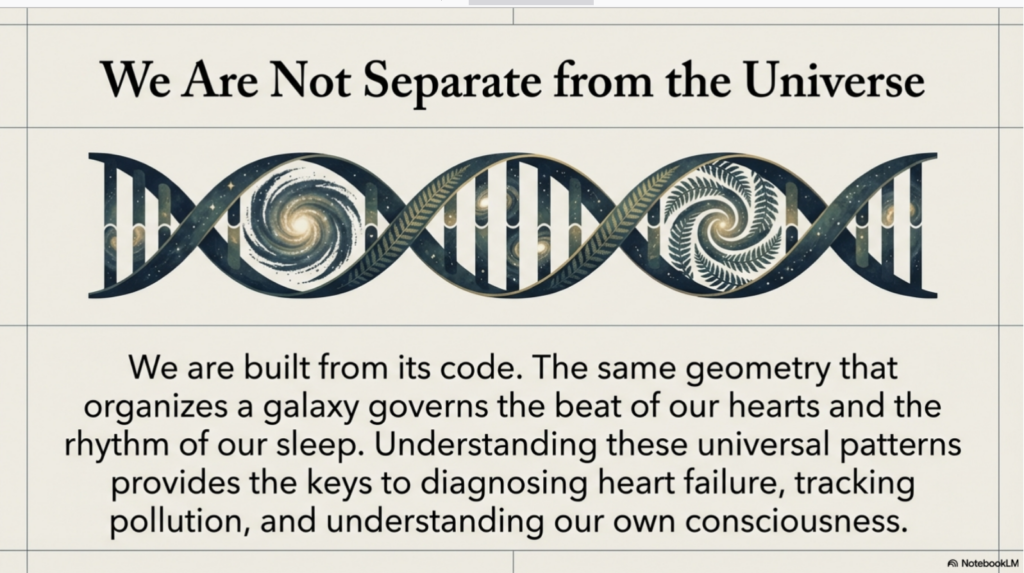
Integration: Thought is Time, Feeling is Space, Breathing is Om written in Flesh, Timeless Now
This integrated framework reveals that Reality is a Singular, Continuous Flow (Prana), and what we perceive as the world is simply this Flow appearing in different modes. You are not a static “noun” but a dynamic “verb”—the action of existence itself.
Thought is Time
In this nondual understanding, Time is not a container for events; it is Flow appearing as sequence.
• The Sequential Process: Thought is inherently linear, leaping from one word or cause to the next. It is this sequential processing that constructs the categories of “past” and “future”.
• The Narrative Function: Thought acts as a “whirlpool of chronology,” narrating the Flow to create a sense of duration and a continuous “self” moving through it.
• Temporalization: Essentially, Time is the process of thought attempting to measure and coordinate the ceaseless activity of Prana. Without the mental act of linking moments together, linear time would not arise.
Feeling is Space
Similarly, Space is not a passive room but Flow appearing as extension.
• Dimensionality: Feeling is the direct, non-conceptual experience of this extension. Unlike the linear nature of thought, feeling has texture, volume, and depth.
• The Felt Map: When you feel warmth, contraction, or openness, you are experiencing the Flow “qualifying” its immediate spatial presence.
• Here and There: The sense of “here” and “there” are not coordinates in a void but are vectors of felt sense. Space is the arising of this field within awareness; it is the “Flow being expansive”.
Breathing is Om Written in Flesh
The breath is the most tangible map of reality, mirroring the sacred architecture of the sound Om (Aum) within the biological form.
• Inhale (A): The opening of the throat and expansion of the body represents the arising of space and outward manifestation.
• The Pause (U): The holding of the breath represents presence and continuity, the “Flow’s persistence” through what thought calls time.
• Exhale (M): The contraction and return to silence represents the dissolution of manifestation back into the source.
• The Body as Microcosm: Through this rhythm, the body functions as a living “verb.” You do not “have” a breath; you are the breathing—a localized expression of the universal Pranic current.
The Timeless Now
The Timeless Now is the culmination of this insight, collapsing the artificial divisions created by the mind.
• Not a Point: The mind pictures “now” as a fleeting dot on a timeline, but the entirety of the ongoing process of existence.
• Undivided Flow: It is the unmediated experience of the river’s current without conceptual division. It has no duration; it is not “always” or “forever,” as those are still words for time.
• Aware Stillness: The Timeless Now is the silence—the “fourth state” (Turiya)—in which the movements of space (feeling), time (thought), and breath all appear. It is the unchanging ground upon which all change occurs.
Ultimately, you are not a person moving through space and time. You are the Flow itself, extending as space, narrating itself as time, and breathing itself into the form of a living question.
Leave a Reply