Why the Universe (and You) is Actually a Verb
You are a Biological Verb – Audio
The Illusion of the “Solid” Self
We often perceive our lives as a collection of static snapshots, much like a photo album of fixed, frozen moments.
Our minds tend to visualize time as a blinking cursor moving across a page, attempting to capture a “now” that is fundamentally fluid.
However, this attempt to grasp the present is like trying to clutch water in a fist; by the time you think you have it, the substance has already slipped through your fingers.
In the tradition of Advaita Vedanta, this misunderstanding is the first rung on a “ladder of perception.”
We start with the “Solid World View” (Srishti-Drishti Vada), the common-sense paradigm where the universe is a finished, objective thing and we are merely observers who popped into it.
But ancient wisdom and modern physics suggest a more radical reality.
“Now” is not a static point on a timeline; it is a ceaseless, dynamic flow.
To understand your true nature, you must move beyond the illusion of being a solid, separate object and embrace the reality of being an uninterrupted movie—a process in motion.
1. The Grammar of Existence: You Are a Verb
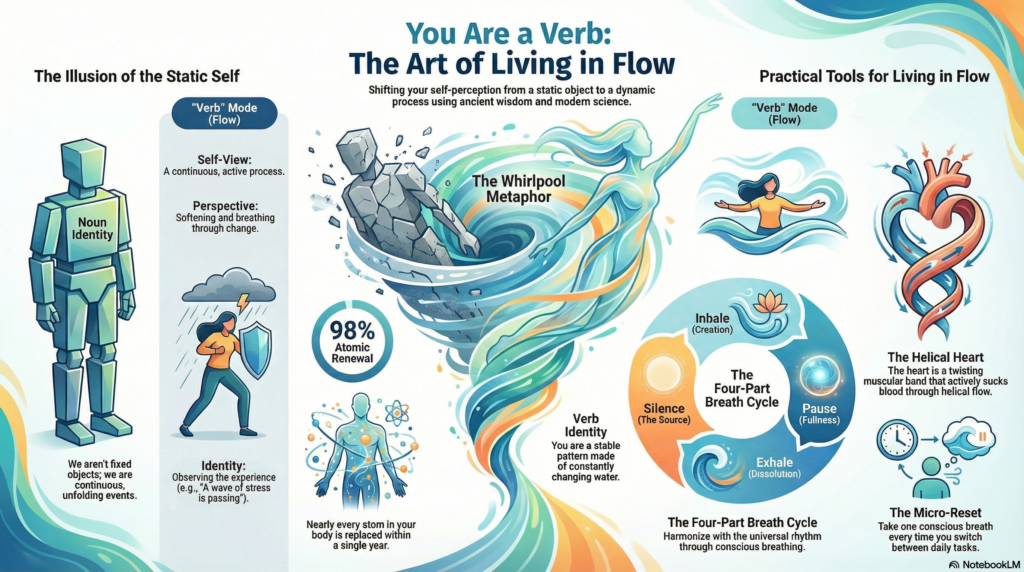
Our language conditions us to see the world as a collection of nouns—static, finished objects.
We apply these labels to ourselves through job titles, roles, and personality types.
This “noun-thinking” freezes us in time, creating a rigid identity that we feel compelled to defend.
In reality, you are a “verb.”
You are not a fixed thing called a person; you are a continuous event, an ongoing activity of “selfing.”
Biologists like Francisco Varela describe this as Autopoiesis—a Greek term meaning “self-creating.”
You are a living system that is constantly producing and maintaining itself, a machine that repairs its own parts in a perpetual loop of becoming.
This “self” even extends beyond your skin; according to the Extended Mind Thesis, your cognitive loop includes the tools you use and the language you speak.
You are not a container for life; you are the process of living.
“What if you [aren’t] a noun, but a verb?
Seriously, what if you [isn’t] a fixed static thing, but an ongoing process, a constant state of becoming?”
2. The Seven-Year Body Swap: Atomic Renewal
Modern science reveals that the “solid” body is a biological illusion.
Through a process called total atomic renewal, approximately 98% of your atoms are replaced every single year.
Within a seven-year cycle, nearly every atom in your body is swapped for new material drawn from the cosmos.
Consider the metaphor of a whirlpool.
A whirlpool has a recognizable, stable shape, but the water composing it is never the same from one moment to the next.
You are a stable pattern made of constantly changing “stuff.”
This shift reframes the body: it is not a closed fortress, but an open-ended conversation with the universe.
While this chemistry of renewal keeps the “water” of your being fresh, it is the underlying geometry of your form—the “vortex” of your anatomy—that organizes this flow into life.
3. Your Heart is a Helix, Not a Pump
For centuries, the “Harvey model” depicted the heart as a four-chambered box that mechanically squeezed blood.
However, the pioneering dissections of Dr. Francisco Torrent-Guasp revealed a more sophisticated truth.
The heart is actually a single, continuous muscular band that twists and loops into an elegant helix.
This helical structure allows for a “twist and suck” cycle.
Instead of passively filling, the heart’s geometry creates active suction as it untwists, pulling in a staggering 90% of its blood during the filling phase.
This motion transforms the heart from an inefficient sphere—like a basketball—into a highly efficient elliptical shape, similar to a football.
This biological form mirrors the universal spiral pattern, a physical manifestation of what ancient sages called the “geometry of prana.”
In the yogic view, this flow is managed by the Vayus, or internal winds, which direct the currents of our own internal river.
4. Nature’s Secret Code for Survival: The Golden Angle
Nature operates on a mathematical blueprint of “ruthless efficiency” known as the Fibonacci sequence and the Golden Ratio (1.618 or Phi).
This code is most evident in the “Golden Angle” of 137.5°, which determines how plants place new leaves or seeds.
By using this specific angle, a plant ensures that new growth never perfectly covers the old, maximizing exposure to sunlight and rain while wasting zero space.
This code is truly universal.
Applied mathematician George Holler discovered that the equations describing the seed-packing of a sunflower are functionally identical to the equations describing how light behaves in a “photon sphere” around a black hole.
Whether on a botanical or cosmic scale, the universe utilizes the same elegant logic to manage energy.
Just as nature uses the Golden Angle to prevent leaves from blocking their own light, we can use specific mental “angles” to prevent our thoughts from blocking our own inner clarity.
5. The “Language Shift” Hack for Stress
The same “Nature’s Code” that organizes the seeds of a sunflower also organizes the seeds of our thoughts.
When we lack efficiency in our emotional processing, we become “jammed up.”
When you say, “I am stressed,” you fuse your identity with the emotion, treating a temporary movement of energy as a permanent noun.
You can create immediate psychological resilience by shifting your phrasing to: “I am experiencing a wave of stress.”
This linguistic hack positions you as the observer rather than the emotion itself.
By viewing stress as a “wave,” you acknowledge that it is a temporary event passing through your system.
Just as waves in the ocean always pass, the stress moves through the “observer” without becoming a permanent fixture of your identity.
You stop fighting the energy and start letting it move through you, transitioning from a “traffic jam” of prana back into a state of flow.
6. Yoga Nidra and the “Manual Override”
To facilitate this flow on a deeper level, we can use Yoga Nidra, or “conscious deep sleep.”
This practice acts as a manual override to flip the body’s operating system from the sympathetic (fight-or-flight) gear to the parasympathetic (rest-and-digest) mode, where cellular repair occurs.
During Yoga Nidra, you are guided through a tour of brain waves:
- Beta: The active, logical, and often frantic thinking mind.
- Alpha: The bridge to light relaxation and calm.
- Theta: The creative zone where the subconscious becomes accessible.
- Delta: The “Holy Grail” of physical healing and cellular repair.
By learning to hover on the edge of awareness during the Delta state, you access a physiological reset button.
Because it bypasses the restless tossing and turning of normal sleep, one hour of Yoga Nidra can be as restorative as three or even four hours of regular sleep.
It allows you to plant a Sankalpa—a positive intention—into the fertile soil of the subconscious, rewiring your patterns from the inside out.
7. Non-Duality and the Debris of Personality
The philosophy of non-duality (Advaita) uses the relationship between the river and the whirlpool to explain the “Self.”
A whirlpool often gathers floating debris—twigs, leaves, and bubbles.
This debris is analogous to our memories, quirks, and personal history; it gives us a unique look, but it is not our substance.
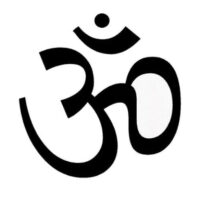
The sacred symbol AUM (or OM) provides a map for this realization, linking consciousness to the biology of the breath:
- A (Inhale): The waking state; the expansion of the physical world.
- U (Pause): The dreaming state; the world of time and thought.
- M (Exhale): Deep Sleep; the dissolution of form back into the source.
- The Silence (Bindu): Pure consciousness; the “fourth state” (Turiya) that underlies all others.
“The whirlpool is made of nothing but river water… We think we are the debris when our true substance is and has always been the water itself.”
Conclusion: Learning to Surf the Waves
Shifting from “static” mode to “flow” mode changes your entire experience of existence.
You move from the second rung of the ladder—where the world is a dream projected by your mind—to the final peak: the realization that there is no separate world at all, only the one undivided reality of pure consciousness.
This transition leads to a profound paradox: by embracing constant movement, you find a deep, internal stillness.
Like the eye of a hurricane, which remains perfectly calm because of the immense motion surrounding it, your “flow state” becomes a point of peace amidst the guaranteed waves of life.
You have a choice in every moment: you can fight the current, or you can recognize that you are the current.
By turning inward and listening to the “guru within,” you stop trying to capture the wind in a jar and instead learn to surf the infinite ocean of the now.

Leave a Reply to The River of Life – Cancel reply